Electric Yellow Cichlid
Labidochromis caeruleus
 AI-generated
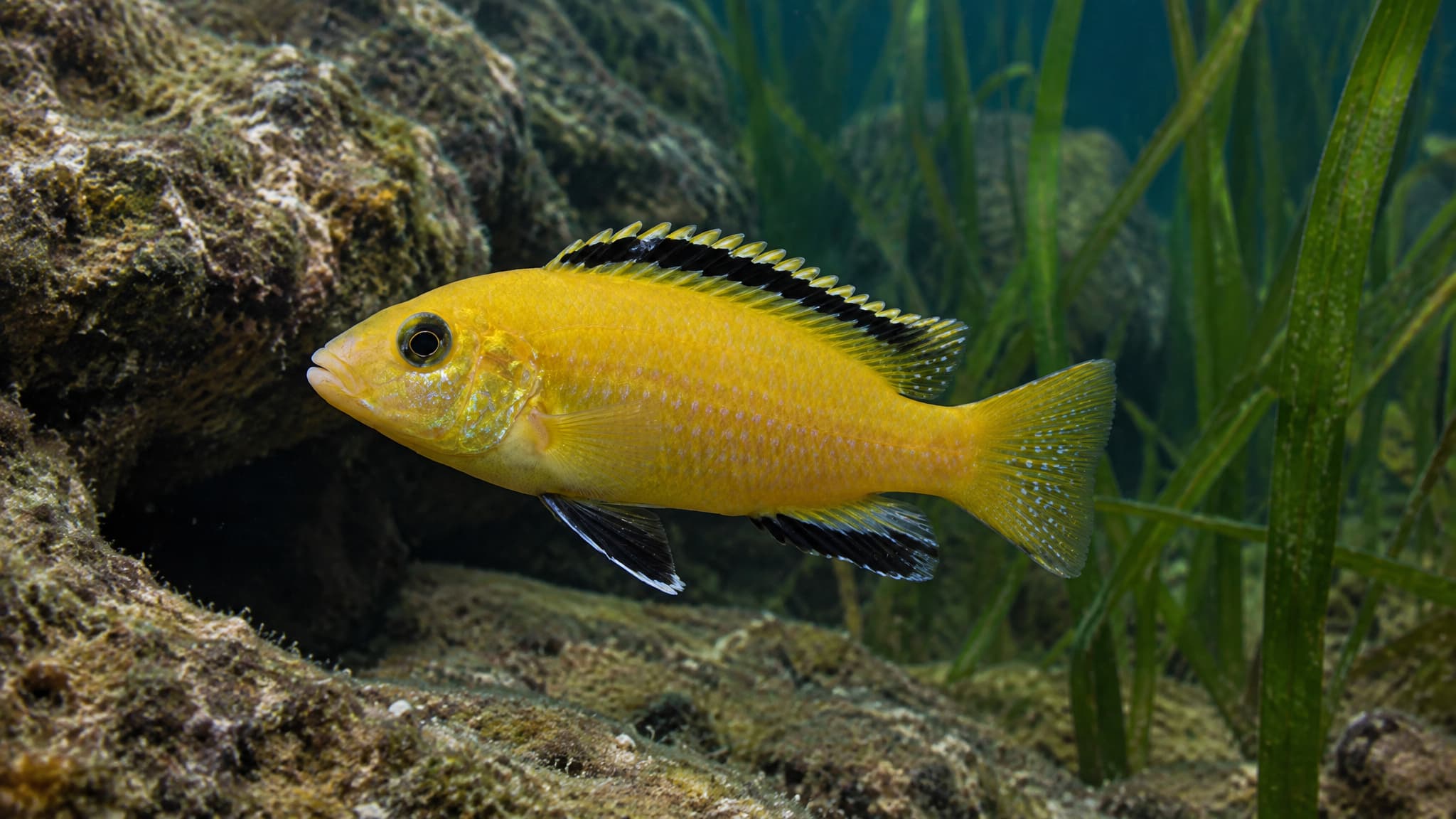
A bright yellow Electric Yellow Cichlid swims leftward in profile in an aquarium, with algae-covered rocks and tall aquatic plants behind it. Its black-edged dorsal and ventral fins and translucent, spotted tail are clearly visible.
The electric yellow cichlid (Labidochromis caeruleus), also sold as the yellow lab or blue streak hap, is a small mbuna cichlid described by Geoffrey Fryer in 1956. FishBase gives a maximum of 8.1 cm standard length, while aquarium specimens are reported to reach about 10 cm. Wild fish are most often blue and white; the bright lemon-yellow morph that dominates the aquarium trade is rarer in nature. Mature fish show a black band along the dorsal fin and black markings on the anal fin, which become vivid only with age, and males are slightly larger than females.
The species is endemic to Lake Malawi in East Africa, where it lives along the northwestern coast. It occupies two kinds of habitat: rocky shores with caves and crevices, and dense beds of Vallisneria plants. Reported depths range from about 10 to 30 m, usually around 20 m. The yellow form has been recorded only in a short stretch of coast between Charo and Lion's Cove.
In the wild it feeds mainly on small invertebrates that live on and among rocks, such as snails, other molluscs, and insects and their larvae. By mbuna standards it is relatively peaceful, but males become territorial when breeding and dig a pit in the sand inside their territory.
Like many Lake Malawi cichlids, it is a maternal mouthbrooder. The female spawns in the male's pit and takes the eggs into her mouth, where they are fertilized and incubated. Clutches usually hold about 10 to 30 eggs, depending on the female's size. She carries the brood for roughly three to four weeks and does not eat during that time. Young are released after about 25 days at 27 to 28 °C, or about 40 days at 23 to 24 °C, and reach sexual maturity at about 6 months. In aquariums, lifespans of about 6 to 10 years are reported.
As an invertebrate feeder in a rocky lake habitat, it is part of the dense community of mbuna that crop the life growing on Lake Malawi's rocks. The IUCN Red List assessed it as Least Concern in 2018. It is widespread within its range and has no recognized major threats; most fish in the hobby are tank-bred rather than wild-caught. Different colour forms and other Labidochromis species can hybridize, so keepers are advised not to mix them.
Ideal water
The water this fish does best in, as kept in aquariums.
- Water type
- Freshwater
- Temperature
- 23–26 °C
- pH
- 7.7–8.6
- alkaline
- General hardness
- 10–25 dGH