Dusky grouper
Epinephelus marginatus
 AI-generated
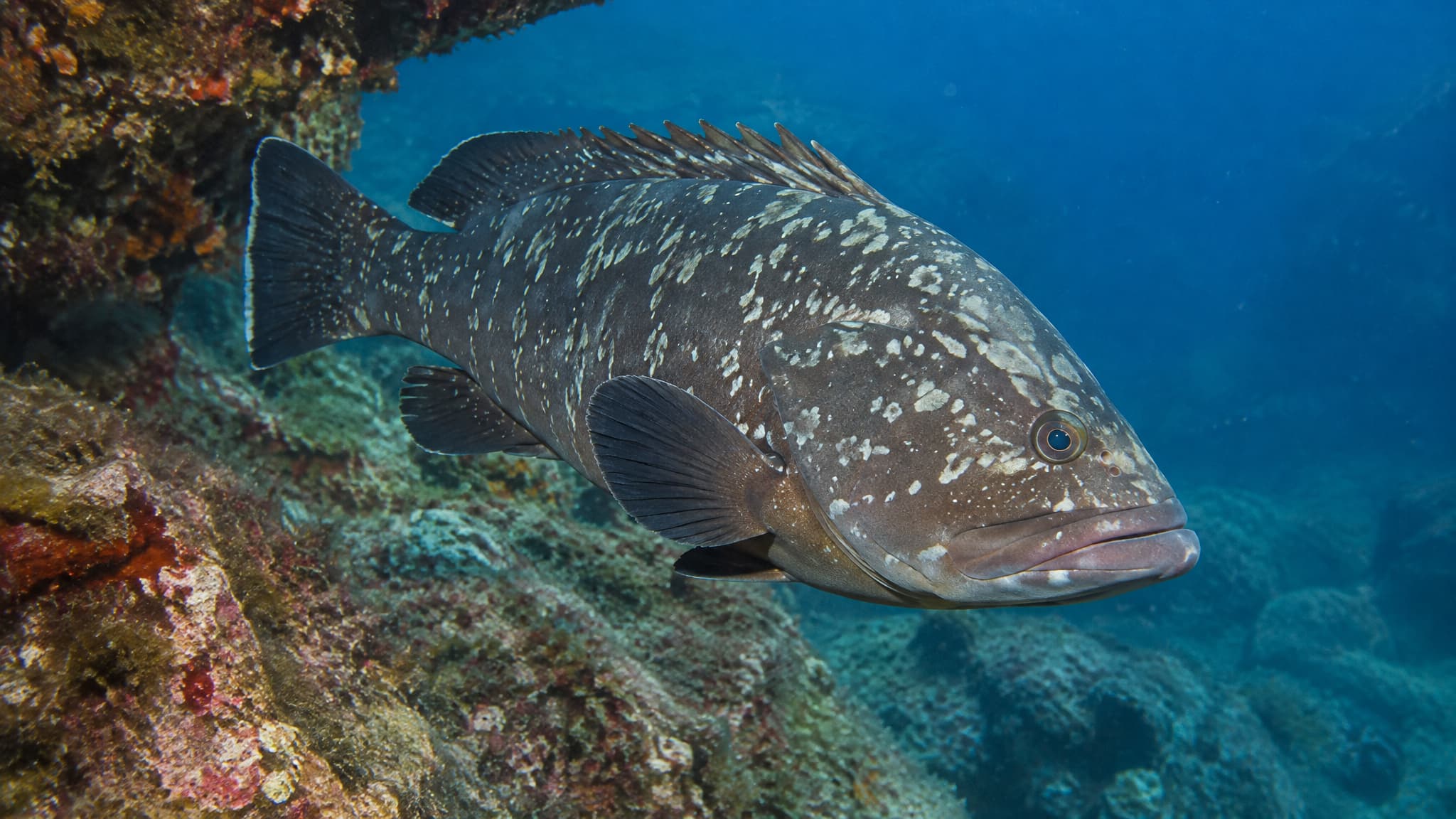
A dusky grouper swims to the right beside a rocky, encrusted reef overhang in clear blue water. Its robust body, broad pectoral fin, spiny dorsal fin, rounded tail, and irregular pale mottling are clearly visible.
The dusky grouper is a large, robust reef fish with a broad head, powerful mouth, and rounded tail. Its body is usually dark brown, reddish brown, or gray above and more golden-yellow below, with pale irregular spots that may form vague vertical bands. Fine white edging on the tail and anal fins is often visible. It can reach about 150 cm in total length, weigh up to 60 kg, and has been reported to live as long as 60 years.
It occurs in the Mediterranean and adjacent eastern Atlantic, along Atlantic coasts of Africa, in the southwest Atlantic from southeastern Brazil to Argentina, and in parts of the western Indian Ocean. Adults occupy rocky reefs, boulder fields, caves, ledges, and other structured seabed habitats, from shallow coastal water to roughly 300 m deep. Juveniles generally use very shallow, sheltered rocky areas and tide pools.
Usually solitary and territorial, this grouper is an ambush predator. Crabs and octopuses are important prey, while larger fish consume increasing amounts of reef-associated fishes. By preying on mobile invertebrates and fish, it is a high-level reef predator and contributes to the structure of coastal food webs.
The species is a protogynous hermaphrodite: individuals mature first as females, and some later change sex to male as they become older and larger. Mature fish gather to spawn, a behavior that can make them especially susceptible to fishing. Slow growth, longevity, late sex change, and targeted capture by commercial, recreational, and spear fisheries all increase its vulnerability.
Epinephelus marginatus is globally listed as Vulnerable. Protecting large adults, spawning aggregations, and rocky reef habitat is particularly important because removal of large fish may disrupt reproduction as well as reduce the population's breeding capacity.