European eel
Anguilla anguilla
 AI-generated
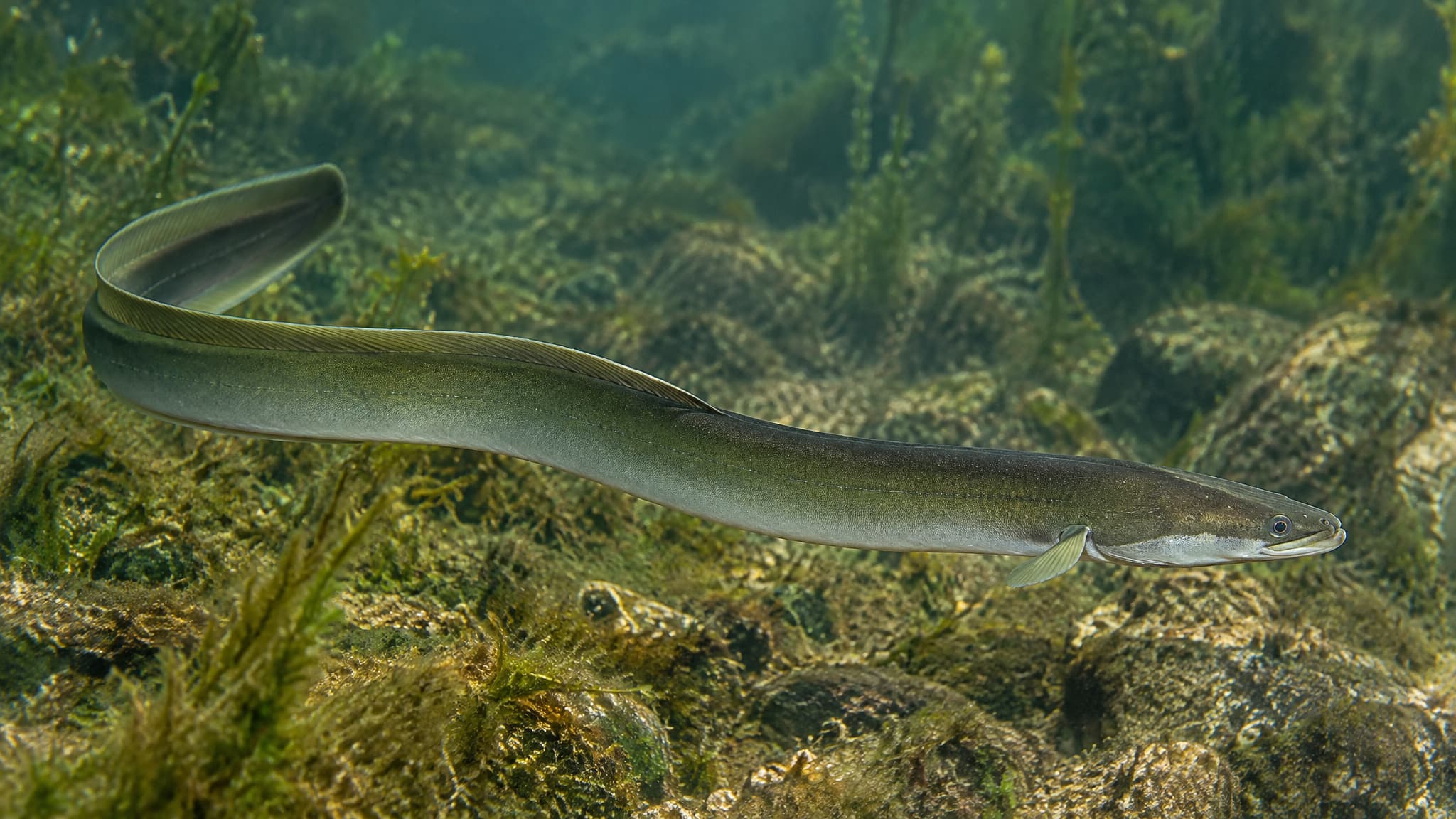
An elongated eel swims horizontally above an algae-covered rocky bottom, with its tail curled upward at the left. Its olive-brown body, pale underside, continuous fin edge, pectoral fin, eye, and pointed snout are visible.
The European eel (Anguilla anguilla) is a long, snake-like fish of the freshwater eel family Anguillidae. Its body is slender and slimy, with a single fin running along the back, tail and belly. Yellow-phase adults usually measure 45–65 cm, rarely pass 1 m and exceptionally reach 133 cm; females grow much larger than males, and the heaviest published weight is 6.6 kg.
The species lives along the Atlantic coast of Europe and North Africa, from Scandinavia and Iceland to Morocco, and in the Baltic, North, Mediterranean and Black Seas and the rivers that drain into them. It is catadromous: it grows in fresh or brackish water and returns to the sea to breed, and it occurs from the surface down to about 700 m. Inland it shelters among plants, in rock crevices and in soft mud.
Eels are solitary, bottom-dwelling hunters that feed mostly at night and find prey largely by smell. They take worms, snails and other molluscs, crustaceans such as crayfish, insect larvae, carrion and fish, sometimes prey too large to swallow whole. They are also facultative air-breathers, able to take in air when needed.
The life cycle is one of the most remarkable among fishes. Spawning is believed to take place in the Sargasso Sea, although it has never been observed in the wild. The leaf-shaped leptocephalus larvae drift toward Europe for about 300 days, turn into transparent glass eels at the coast, then into elvers that move upstream. After 5–20 years as brownish yellow eels they mature into silver eels with larger eyes and silvery flanks, stop feeding, swim back across the Atlantic, spawn once and die. Typical wild lifespan is 15–20 years, while some captive eels have lived more than 80 years.
As both predator and prey, eels link marine and freshwater food webs; herons, cormorants, pike and larger eels eat them. The species is listed as Critically Endangered by the IUCN and on CITES Appendix II. The number of young eels reaching Europe has fallen by about 90% since the 1970s because of overfishing, dams and other barriers to migration, the swim-bladder parasite Anguillicola crassus, pollution and changes in ocean currents. It has not yet been bred through its full life cycle in captivity.
Ideal water
The water this fish does best in, as kept in aquariums.
- Water type
- Freshwater
- Brackish
- Marine
- Temperature
- 4–20 °C