European lobster
Homarus gammarus
 AI-generated
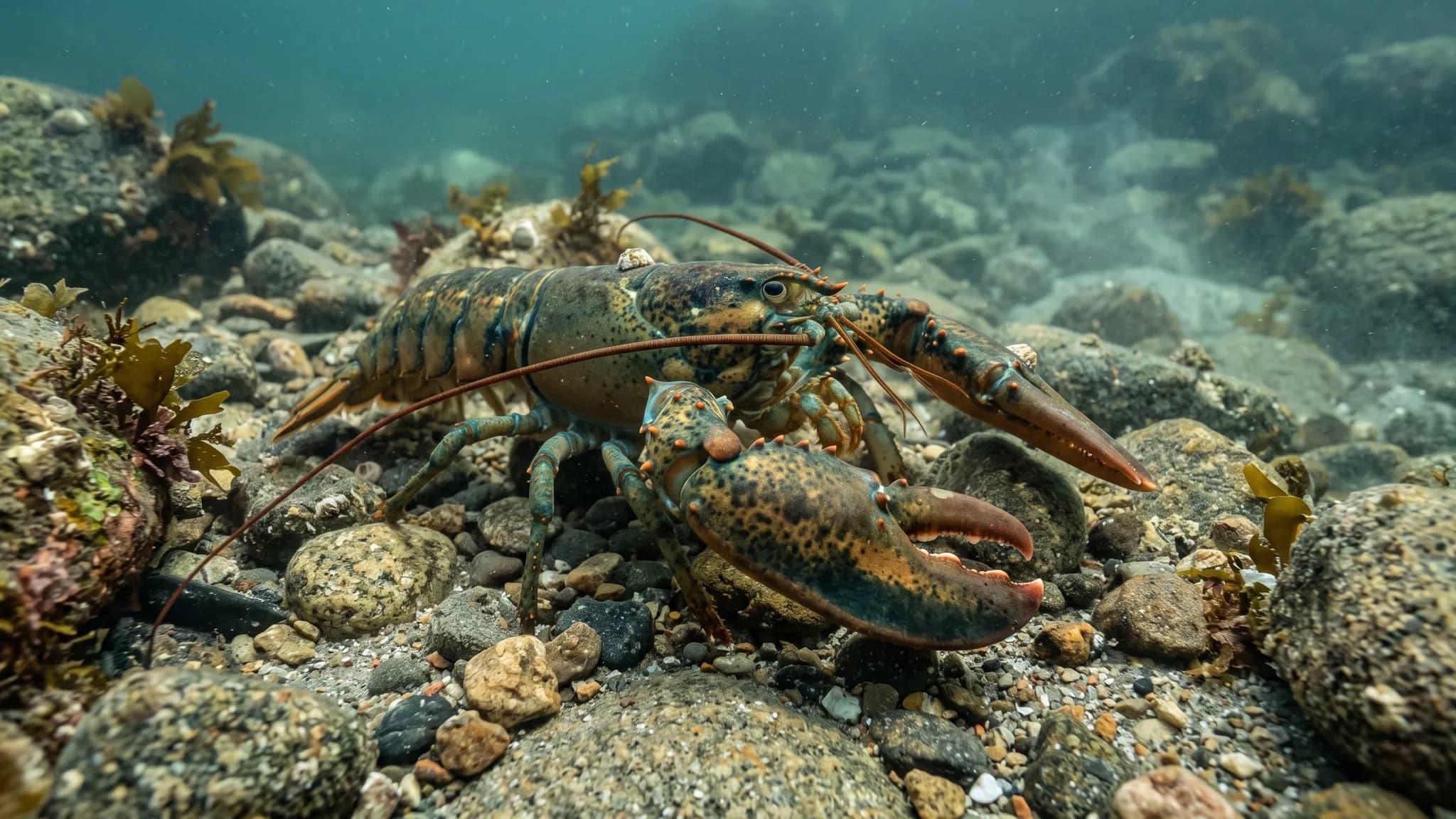
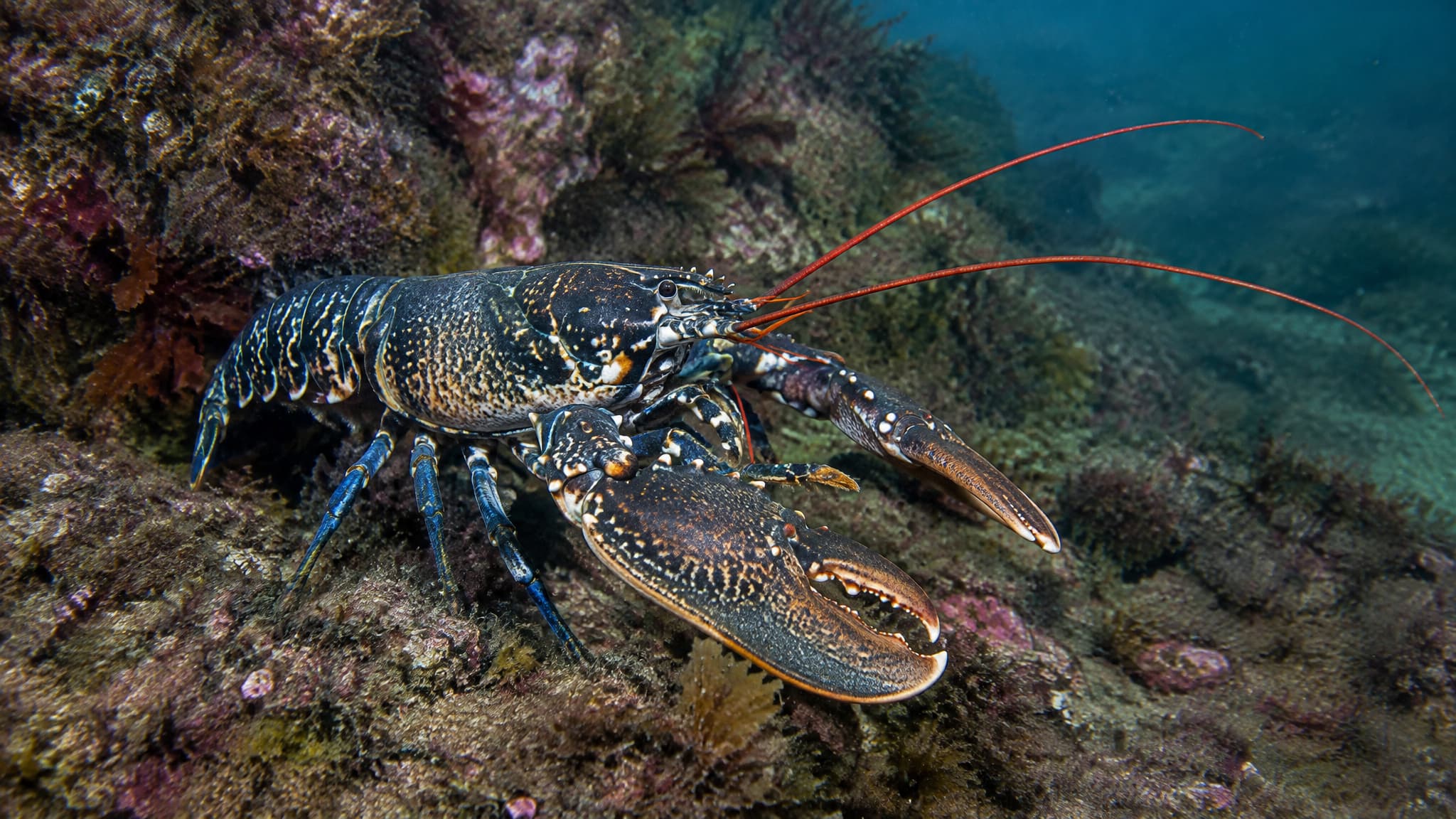
A European lobster rests on a rocky seabed underwater, facing right with its long antennae extended. Its blue-black shell, segmented abdomen, walking legs, and two large unequal claws are clearly visible.
The European lobster is a large, heavy-bodied clawed lobster with a hard external skeleton, ten walking legs, long antennae, and a broad tail fan used for rapid backward escapes. It is usually deep blue above, marked with paler spots, and paler yellowish below. Its first pair of legs bears massive, unequal claws: one is adapted mainly for crushing and the other for cutting or gripping. Adults commonly reach about 23–50 cm in total length, while exceptional animals can approach 60 cm and weigh several kilograms.
Homarus gammarus occurs in the eastern Atlantic, from northern Norway south to Morocco and the Azores, and also inhabits much of the Mediterranean and the northwestern Black Sea; it is absent from the Baltic Sea. A bottom-dwelling marine crustacean, it occupies continental-shelf waters, especially rocky bottoms, hard mud, crevices, caves, and self-excavated shelters. It is often found in relatively shallow water but has been recorded to roughly 150 m.
Mostly solitary, territorial, and nocturnal, the European lobster spends daylight hours concealed and emerges to forage. It is an opportunistic predator and scavenger that eats molluscs, crabs and other crustaceans, worms, and carrion. By consuming both live benthic prey and animal remains, it helps transfer energy through seabed food webs; juveniles and soft-shelled individuals can in turn be prey for fishes and larger crustaceans.
Growth occurs through moulting, when the lobster sheds its rigid shell and is temporarily vulnerable. Females carry fertilized eggs externally beneath the abdomen for many months; the hatchlings pass through planktonic larval stages before settling to the seabed. Longevity is difficult to measure because moulting removes many physical age clues, but the species can live for several decades and may exceed 70 years. It is heavily valued by fisheries and is caught mainly in pots. The global IUCN assessment categorizes it as Least Concern, although local populations can be affected by fishing pressure and management measures such as size limits and protection of egg-bearing females are important.