European Mantis
Mantis religiosa
 AI-generated
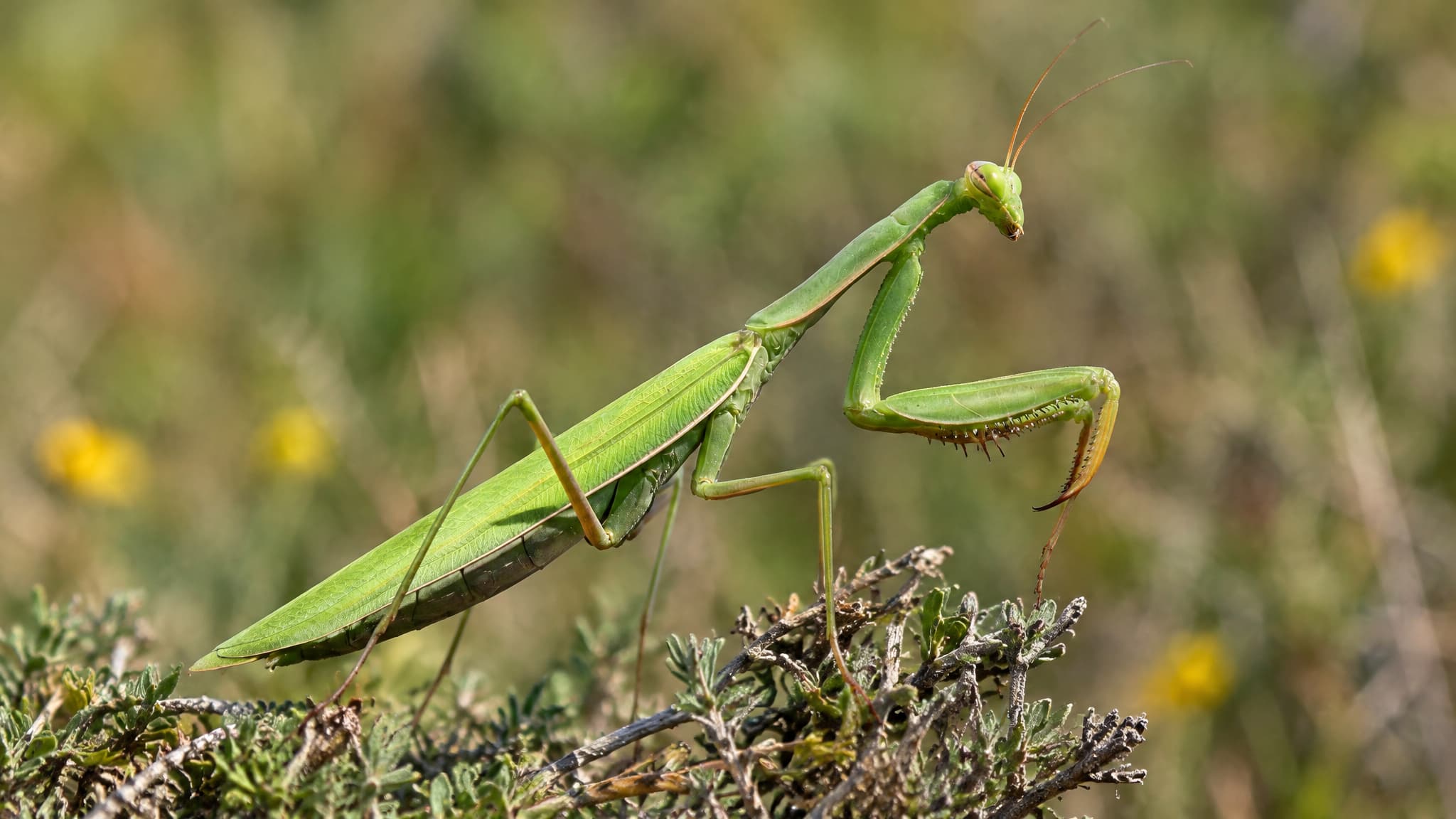
A green European mantis perches on low vegetation with its spiny, raised forelegs extended and long antennae projecting above its head.
The European mantis (Mantis religiosa) is a large praying mantis of the family Mantidae. Females measure about 6–8 cm and males about 5–7 cm; males have longer antennae, bigger eyes and more prominent ocelli. Colour varies from pale brown or yellow to bright green, and occasionally black. The best field mark is a black bull's-eye spot with a pale centre on the inner base of each raptorial foreleg. Its name comes from the folded, "praying" posture of those forelegs at rest.
The species is native to Europe, Asia and Africa. It was introduced to North America, where it is now established across much of the northeastern United States, southern Canada and parts of the west, and it is the state insect of Connecticut. In Europe it has been spreading northwards, with records from Germany, the Baltic states, the Channel Islands and southern England. It lives among grasses, shrubs and other vegetation, which it uses as perches for hunting.
The European mantis is a sit-and-wait ambush predator. It snatches almost any insect it can overpower, especially grasshoppers, crickets and cockroaches, and also takes spiders, molluscs, myriapods and worms; it sometimes eats other mantises. Each compound eye has 8,000–10,000 ommatidia and the insect perceives depth in stereo. A single ear on the underside of the thorax detects low frequencies and ultrasound. When threatened, it spreads its wings and raises its forelegs to flash the eyespots and look larger.
Mating usually takes place in September or October. The male approaches slowly and freezes whenever the female looks his way. Sexual cannibalism is real but not the rule: a field study found females ate the male in 31% of natural pairings, and hungry females attack more often. The female then builds a foamy egg case, or ootheca, holding about 100–200 eggs. The eggs overwinter and hatch in spring, usually once temperatures reach at least 17 °C, and there is one generation per year.
Adults die in autumn; males live about 7–8 months and females about 11–12 months. As a generalist predator it eats many insects, some of them pests, though mantises cannot multiply fast enough to control an outbreak. The IUCN lists it as Least Concern, while Germany's national Red List treats it as endangered.