European Stag Beetle
Lucanus cervus
 AI-generated
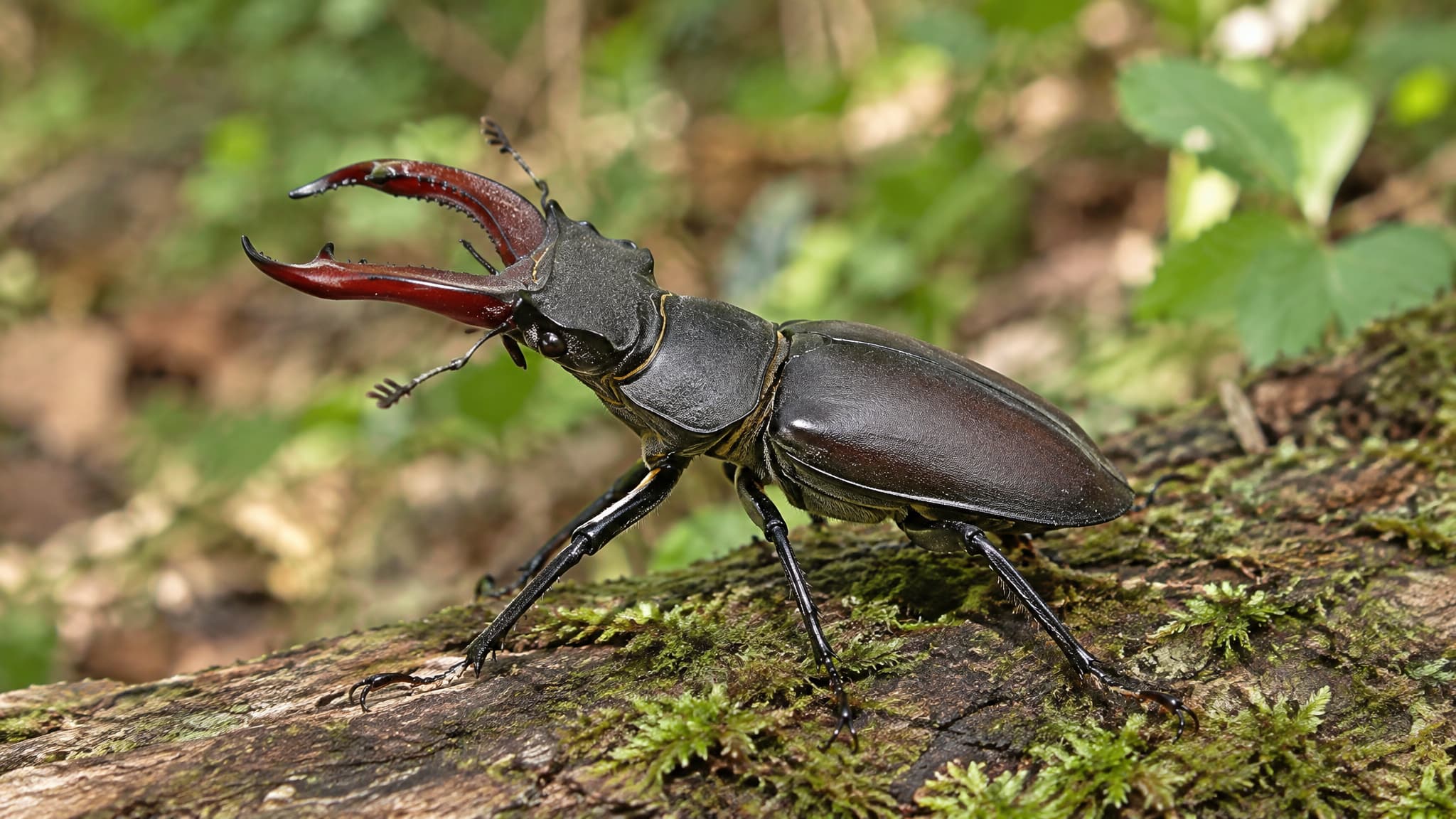
A male European stag beetle rests in side profile on a moss-covered log in a forest setting, displaying its large, curved reddish-brown mandibles, segmented antennae, and six legs.
The European stag beetle (Lucanus cervus) is a large beetle of the family Lucanidae and is often described as the largest beetle in Europe. Males are known for their greatly enlarged, antler-like mandibles, which give the species its name, and measure about 35 to 75 mm including the jaws. Females are smaller, about 30 to 50 mm long, with short jaws, a smaller head and brown wing cases. Males have a reddish-brown body, and adults weigh roughly 2 to 6 g.
The species is widespread across much of Europe but absent from Ireland, and it also occurs in the Caucasus, Asia Minor, Syria and western Kazakhstan. It has died out in Latvia and vanished from Denmark around 1970 before being reintroduced there in 2013. In Britain it lives mainly in southeast England, with strongholds in the Thames Valley, the New Forest and London. Its natural home is broadleaved woodland, especially oak, but it also uses hedgerows, traditional orchards, parks and gardens that keep dead wood, favoring sun-exposed timber and light, well-drained soil.
Larvae feed on decaying wood of broadleaved trees, preferring oak but also using beech, willow, ash, lime, apple and others; they avoid conifers and do not harm living trees. Adults take no solid food and drink tree sap and the juice of fallen or decomposing fruit. The beetle is crepuscular: from about May to early August, males fly on warm evenings with a slow, lumbering, buzzing flight, while females fly less and stay mostly near the ground. Rival males fight with their mandibles, each trying to throw the other off a log or branch.
A female lays up to about 30 eggs in dead wood or in the soil beside it, and the eggs hatch after about three weeks. The blind, C-shaped larvae communicate by stridulation, grow up to about 11 cm and spend three to seven years underground. Pupation starts in the final autumn and lasts about six weeks, but the adult stays in the soil until May or June. Above ground, adults live only a few weeks and usually die by August.
By breaking down dead wood, stag beetle larvae return nutrients to the soil, and both adults and larvae are food for animals such as cats, foxes, badgers, crows, magpies, woodpeckers and kestrels. The IUCN European Red List of saproxylic beetles assesses the species as Near Threatened, with significant declines in the north and center of its range. The main threats are the removal of dead wood when woods, parks and gardens are tidied, the loss of broadleaved woodland, road deaths and predation. It is protected in the United Kingdom under the Wildlife and Countryside Act 1981, and log piles are built to give the larvae food.