Fire Goby
Nemateleotris magnifica
 AI-generated
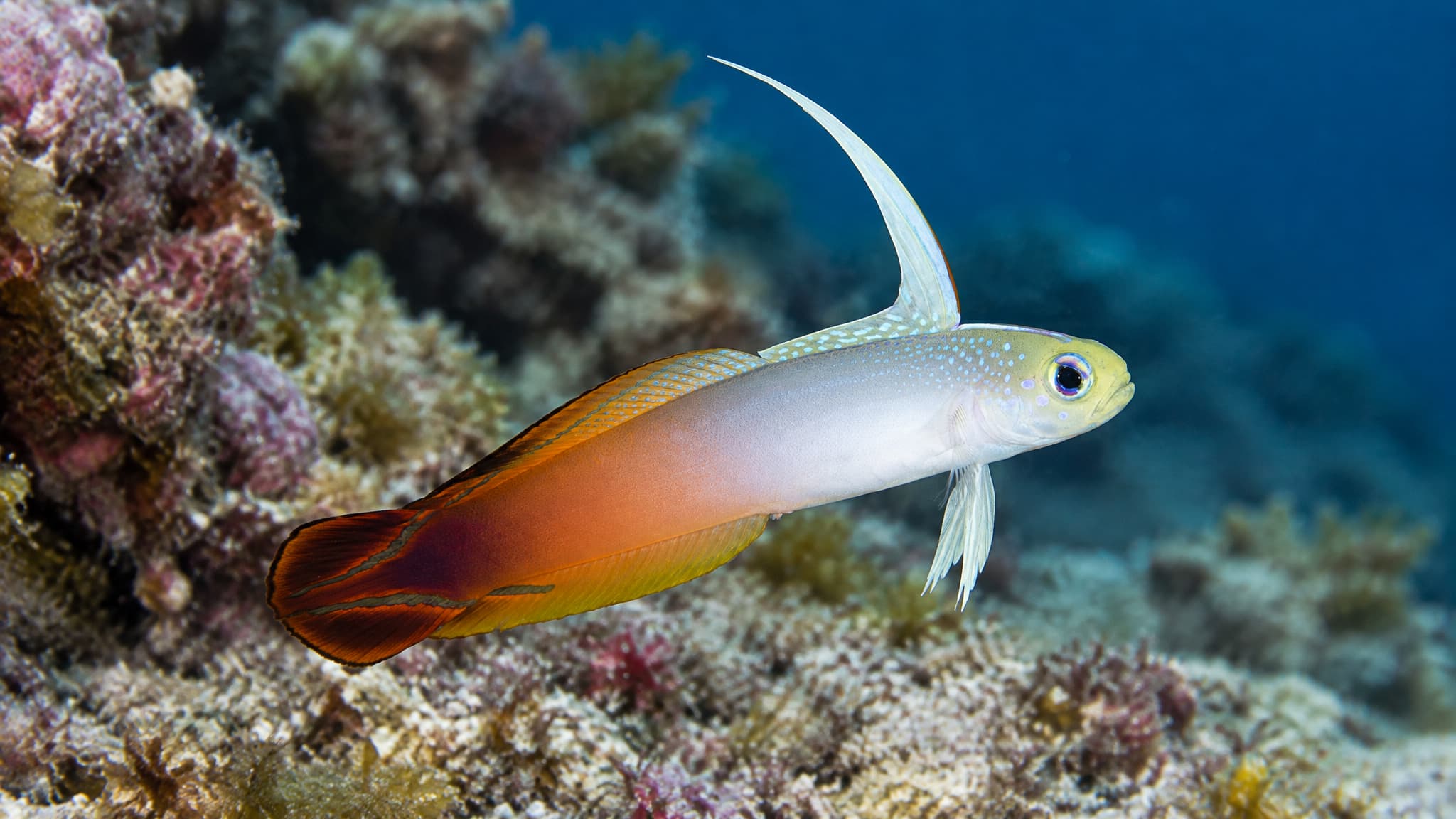
A Fire Goby hovers horizontally above a coral reef, facing right. Its pale, blue-speckled front contrasts with the orange lower body and dark-edged tail, while a long, raised dorsal filament extends upward.
The fire goby (Nemateleotris magnifica), also called the red firegoby, fire dartfish or firefish, is a small, slender dartfish that reaches about 9 cm in total length. Its head is yellowish and its front body is pale pearly white. Toward the rear the body turns orange-red, ending in a deep red tail, and the second dorsal, anal and tail fins are edged with black. Its most distinctive feature is a very tall, thread-like first dorsal fin.
The species is widespread across the tropical Indo-Pacific, from the coast of East Africa to the Hawaiian Islands, and from the Ryukyu Islands south to the Austral Islands. It lives on the upper parts of outer reef slopes and is recorded from about 6 to 70 m deep, though it is usually found between 6 and 28 m. The species was described by Henry Weed Fowler in 1938 from a specimen collected in the Gulf of Tomini, Sulawesi.
Fire gobies hover just above the bottom, facing into the current, and pick off passing zooplankton such as copepods and crustacean larvae. They constantly flick the long first dorsal fin back and forth, which is thought to act as a signal to others of their species. When threatened, they dart headfirst into a burrow or crevice in rubble or sand. They can wedge themselves inside using the raised fin.
Adults usually live alone or in pairs, while juveniles often gather in small groups and may share the same hole. Pairs are monogamous and share a burrow, and the eggs are laid in the burrow or on the substrate. Scientific sources give little information on how long the species lives in the wild.
As a plankton feeder, the fire goby helps transfer energy from drifting invertebrates to the reef food web, and it is prey for larger reef predators. The IUCN lists it as Least Concern because of its huge range. It is one of the most popular fishes in the marine aquarium trade, so collecting for that trade is the main human pressure on local populations.
In collections
Ideal water
The water this fish does best in, as kept in aquariums.
- Water type
- Marine
- Temperature
- 22–28 °C
- pH
- 8.1–8.4
- alkaline
- Carbonate hardness
- 8–12 dKH
- Specific gravity
- 1.020–1.025