Fire Salamander
Salamandra salamandra
 AI-generated
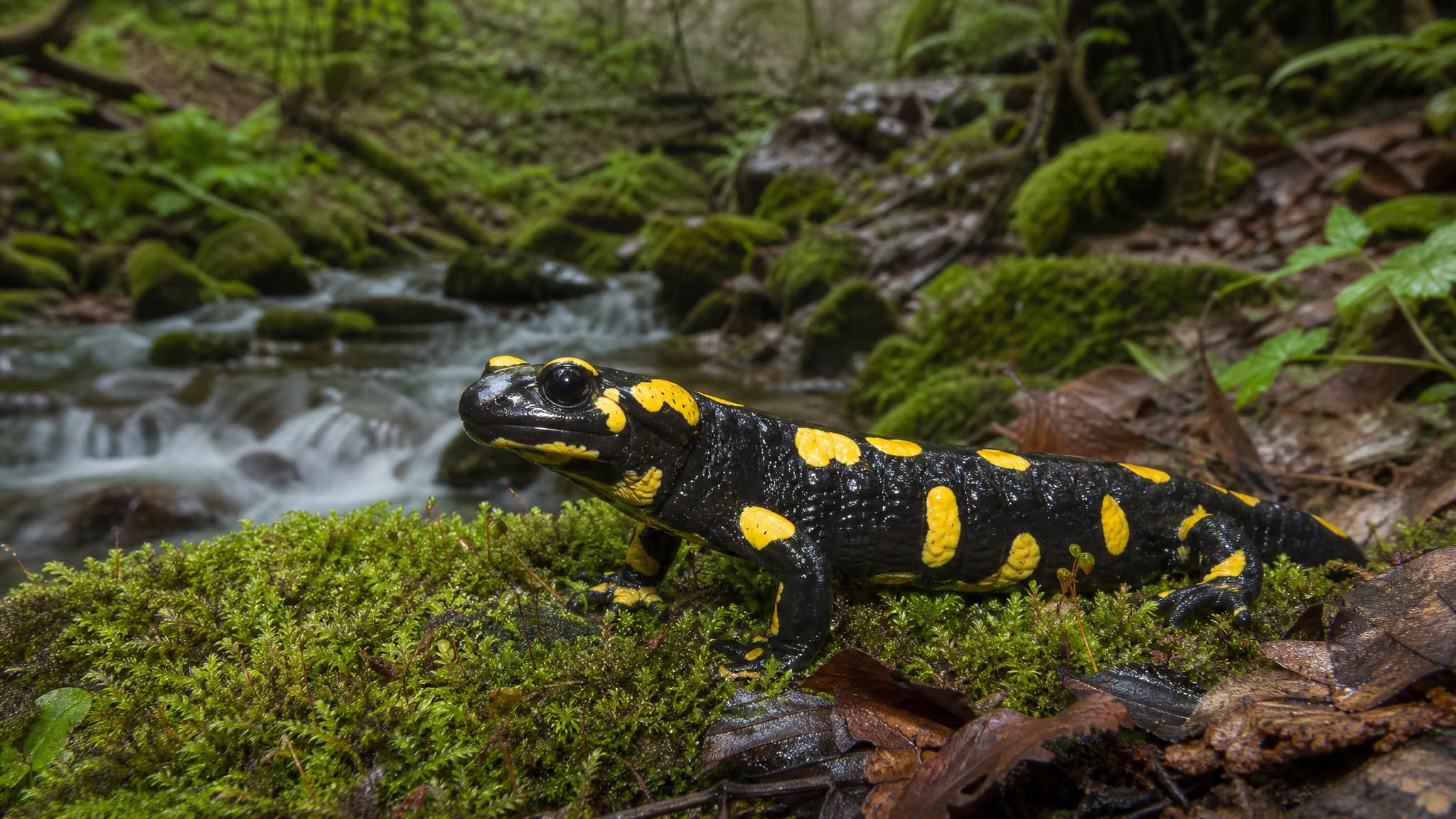
A black-and-yellow fire salamander faces left while standing on moss beside a shallow forest stream, with its spotted body, short limbs, and tapering tail visible.
The fire salamander is a large, robust European salamander, best known for its glossy black body marked with bright yellow to orange spots, blotches, or bands. Marking patterns differ greatly among individuals and populations. Adults are usually about 15–25 cm long, although some grow longer; females are often somewhat larger than males. Its conspicuous colors are warning coloration, associated with defensive skin secretions from glands including the prominent parotoid glands behind the eyes.
It occurs across much of central and southern Europe, with parts of its range extending into northern Africa and western Asia. Adults live mainly on land in humid, shaded woodland, sheltering beneath stones, logs, leaf litter, and in crevices. They require access to clean ponds, springs, or slow streams for reproduction, and are most likely to emerge on mild, wet nights.
A secretive, generally solitary predator, the fire salamander feeds chiefly on small invertebrates such as earthworms, slugs, insects, millipedes, centipedes, and beetles. It hunts using vision when light is available and relies more heavily on scent in darkness. By consuming ground-dwelling invertebrates, it participates in forest-floor food webs; in turn, its toxic secretions and warning colors help deter many predators.
Courtship and fertilization occur on land: a male deposits a spermatophore, which the female takes up internally. Females retain developing, yolk-fed embryos and later release advanced larvae into water; in some populations, young may be born already metamorphosed. Larvae develop in freshwater before becoming terrestrial juveniles. Individuals can live for more than 14 years, and captive animals have reached roughly 24 years.
The species is assessed globally as Least Concern, but this does not eliminate local risk. Habitat loss, fragmentation, water pollution, road mortality, collection, and emerging amphibian diseases can harm populations. Protection of moist forests, safe breeding waters, and connected terrestrial habitat is important, particularly because adults may repeatedly use the same home ranges and overwintering sites.