Fire Shrimp
Lysmata debelius
 AI-generated
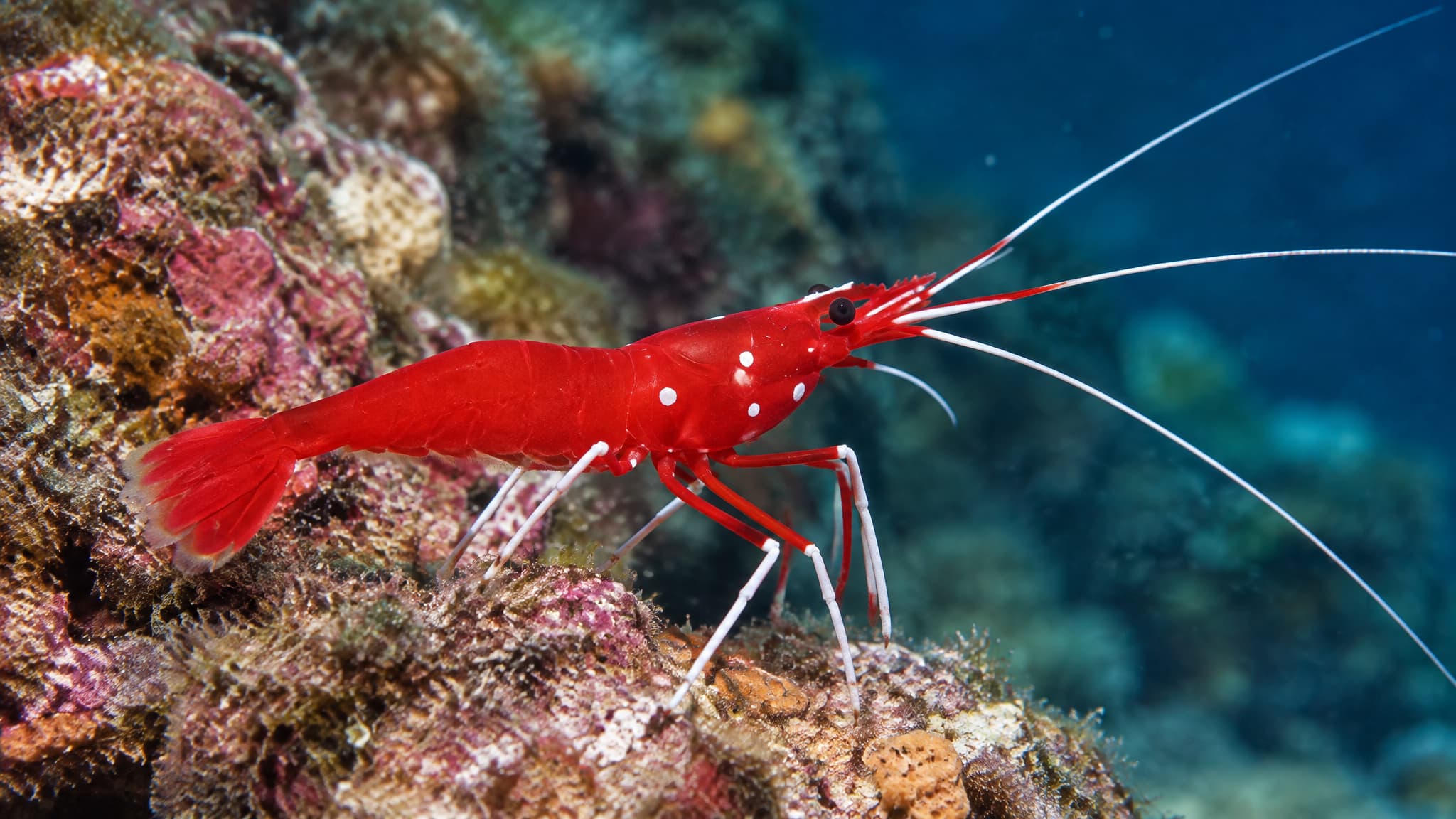
A Fire Shrimp rests on a rocky reef in side profile, facing right with its long white antennae extended. Its vivid red body, white spots, pale banded legs, and fan-shaped tail are clearly visible.
The fire shrimp (Lysmata debelius), also called the blood shrimp or scarlet cleaner shrimp, is a small caridean shrimp of the family Lysmatidae. It was described by A. J. Bruce in 1983 from specimens collected at Polillo Island in the Philippines, and its name honors Helmut Debelius, who gathered the type material.
Its body is a deep, uniform red with large white spots on the cephalothorax and legs. The long antennae are white, and the third, fourth and fifth pairs of legs end in white tips. The body usually reaches about 3 cm in length, although some aquarium references give figures of up to 5 cm. It looks almost identical to Lysmata splendida, a close relative that can be told apart by white spots on the abdomen, which the fire shrimp lacks.
The species lives on tropical coral reefs across the Indo-Pacific. Records span the Red Sea and the coast of East Africa, Madagascar, the Seychelles and the Maldives, through Indonesia, the Philippines, Vietnam and Japan, out to the Marshall Islands and French Polynesia. It is a bottom-dwelling animal usually reported at depths of 20 to 30 m, where it shelters among reef rock.
Like other cleaner shrimp, it removes parasites and dead tissue from reef fish, forming a mutually beneficial relationship with its clients, and it also feeds on scraps and small crustaceans. It is strongly territorial: it attacks other shrimp that enter its space, recognizes members of its own species and forms long-term pair bonds.
The fire shrimp is a hermaphrodite. After molting an individual can function as a female, and between molts as a male, so any two adults can mate. The parent carries the eggs under its body, and a pair can release a new batch of larvae roughly every week. The larvae drift in the plankton for a long period, which makes rearing difficult: a 2016 study in Sri Lanka reached metamorphosis in 50 to 90 days with larval survival of 12.7% to 18.35%. Its wild lifespan is not documented, but one aquarium specimen lived for more than 7 years.
It is one of the most sought-after shrimp in the marine aquarium trade, and most animals exported from places such as Sri Lanka are still taken from the wild, a pressure researchers warn could threaten local populations if it is not managed sustainably. The species has not been assessed for the IUCN Red List.