Fleischmann's glass frog
Hyalinobatrachium fleischmanni
 AI-generated
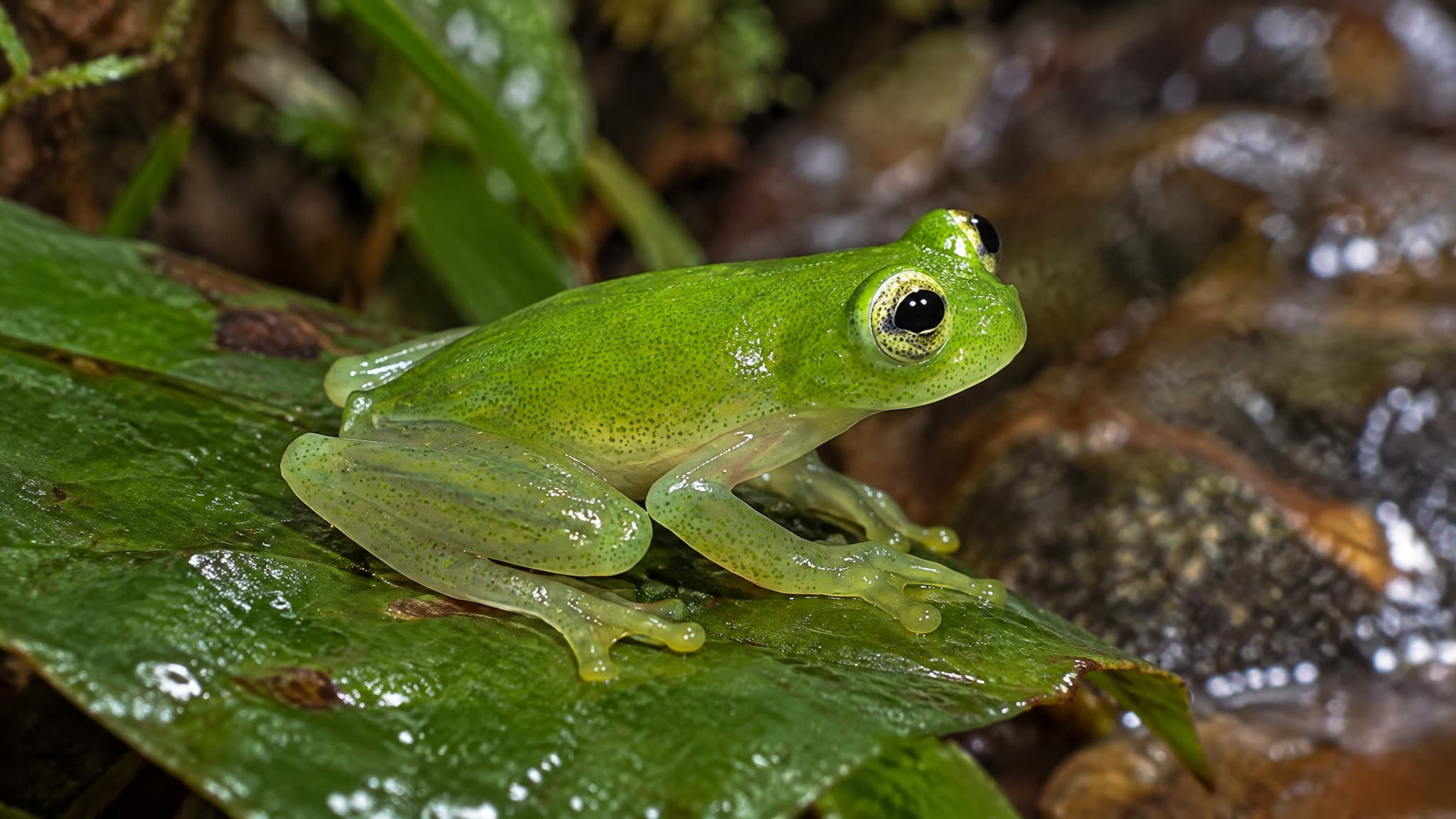
A Fleischmann’s glass frog rests in a crouched pose on a wet broadleaf beside a rocky stream. Its green, partly translucent body, large dark eyes, and expanded toe pads are clearly visible.
Fleischmann's glass frog (Hyalinobatrachium fleischmanni) is a small tree frog of the family Centrolenidae, known for the see-through skin of its underside. Males measure 19–28 mm and females 23–32 mm. The back is pale lime green, sprinkled with tiny dark melanophores and small yellowish spots; the tips of the fingers and toes are yellow and the iris is gold. Seen from below, the belly skin is transparent and the beating heart is visible, while a white sheet of guanine covers several internal organs.
The species lives in humid lowland and montane forests, from near sea level to above 1600 m, always close to clear, flowing and often rocky streams. It was long treated as one of the most widespread glass frogs, ranging from Mexico to Ecuador. A 2020 integrative revision by Mendoza-Henao and colleagues split that complex: H. fleischmanni in the strict sense now covers populations from eastern Honduras to Costa Rica, while Mexican and Guatemalan frogs were assigned to H. viridissimum and the southern lineages of Costa Rica and South America to H. tatayoi.
It is nocturnal and arboreal. By day it sleeps pressed against the underside of a leaf, and while asleep it stores about 89% of its red blood cells in the liver, becoming 2 to 3 times more transparent, a trick that probably helps it avoid predators. At night it hunts small insects such as crickets, moths and flies, as well as spiders and, at times, smaller frogs.
Breeding takes place in the rainy season. Males hold territories on leaves hanging over streams, calling with a single short, high-pitched peep, and will chase or wrestle intruders. Females lay clutches of about 18–30 eggs on the underside of leaves above the water. The male stays with the eggs and moistens them with urine so they do not dry out. The eggs hatch after about 10–15 days, and the tadpoles drop into the stream, where they hide in debris or gravel for 1–2 years before metamorphosis. The lifespan of adults has not been documented.
Losses are heavy: about 80% of clutches are eaten or destroyed before hatching, by cat-eyed snakes, harvestmen, fly larvae and fungi, and the fringe-lipped bat hunts calling males. As an insect-eater it likely fills an important role in its forest habitat. The IUCN lists it as Least Concern, although deforestation threatens its streams and urban noise reduces calling activity.