Foureye Butterflyfish
Chaetodon capistratus
 AI-generated
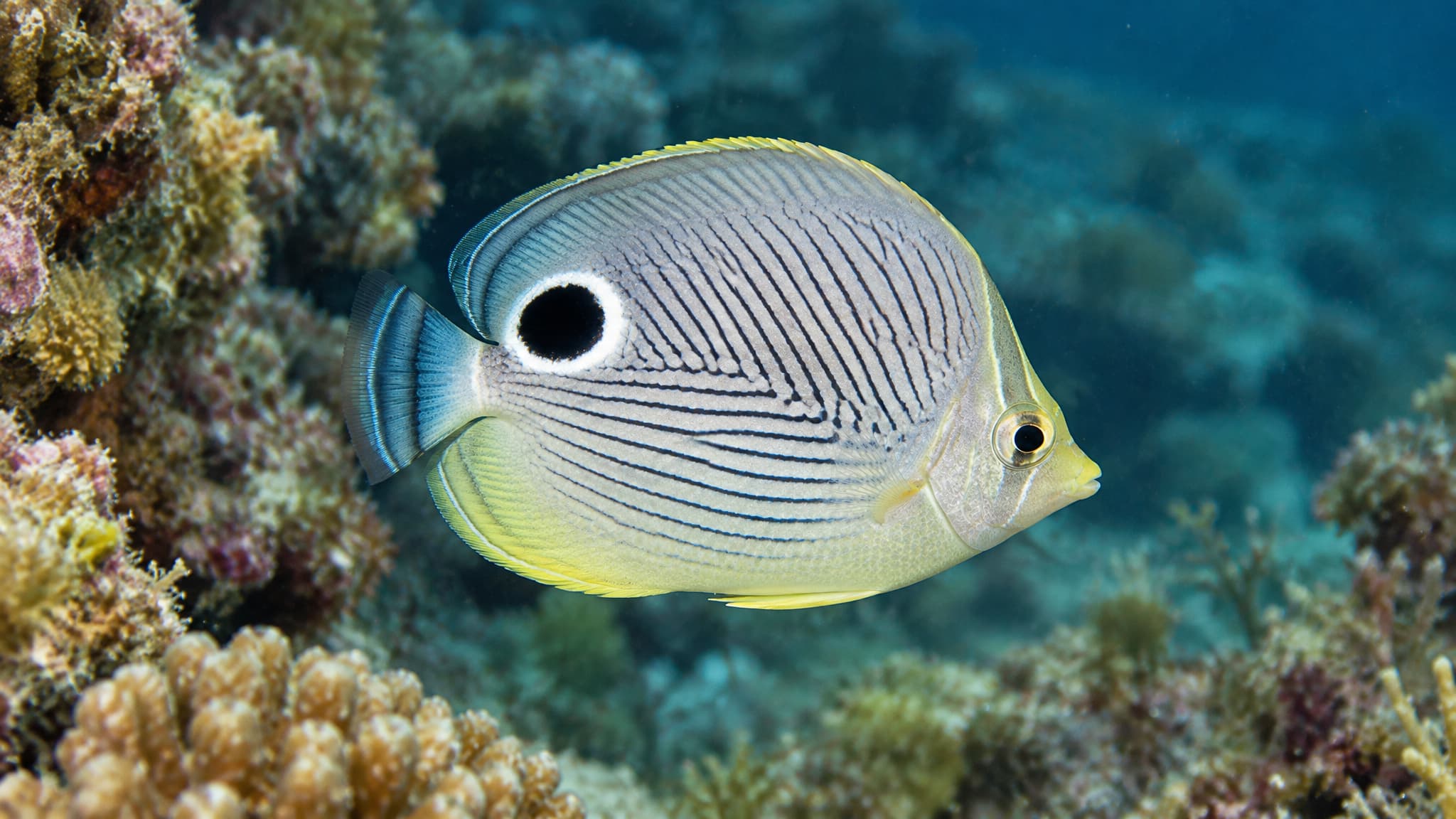
A Foureye Butterflyfish swims to the right above a coral reef, showing its laterally compressed body, fine blue-gray striping, yellow fin margins, and prominent false eyespot near the tail.
The foureye butterflyfish (Chaetodon capistratus) is a small reef fish from the western Atlantic. It is the type species of the genus Chaetodon, the group that gave the butterflyfish family its name. Its deep body is flattened from side to side, with a single dorsal fin and a small mouth full of fine, bristle-like teeth. The body is pale grey, sometimes tinged with yellow, and marked with many thin dark lines that form forward-pointing chevrons. A dark bar crosses the real eye. Near the tail on each side is a large black spot ringed in white. This spot is the false "eye" behind the common name. Adults reach about 15 cm, though most are smaller.
The species lives from Massachusetts and Bermuda south through the Bahamas, the Gulf of Mexico and the Antilles to northern South America. Some sources extend the range to Brazil. It is one of the most common butterflyfishes in the Caribbean. Adults mainly live on shallow coral reefs, usually 2 to 20 m deep. Juveniles are often found in mangroves and seagrass beds.
The foureye butterflyfish is a daytime browser. It picks at anthozoans, especially stony corals, sea anemones and zoanthids, and also eats polychaete worms, small crustaceans and fish eggs when they are available. At night it shelters in reef crevices. The false eyespot and the bar hiding the real eye are thought to confuse predators about which way the fish will flee. A cornered fish may turn to face the threat with its head lowered and dorsal spines raised.
Adults usually travel in pairs, and pairs are believed to stay together for a long time, often for life. Where adults are crowded, loose foraging groups of up to about 15 fish have been seen. Spawning happens at dusk, when the female releases a few thousand small eggs into the water column. Like all butterflyfishes, the larvae pass through a tholichthys stage, with bony plates protecting the head. Juveniles carry an extra eyespot on the soft dorsal fin. Lifespan in the wild is poorly documented. One estimate puts it at about seven years.
By feeding on coral polyps and small invertebrates, the species is part of the coral reef food web. It is also prey for moray eels, sharks and other large predators. It is collected for the aquarium trade. Because it depends on corals for food and shelter, the loss of reef habitat could affect local populations. Overall, the IUCN lists it as Least Concern.