Giant African Land Snail
Lissachatina fulica
 AI-generated
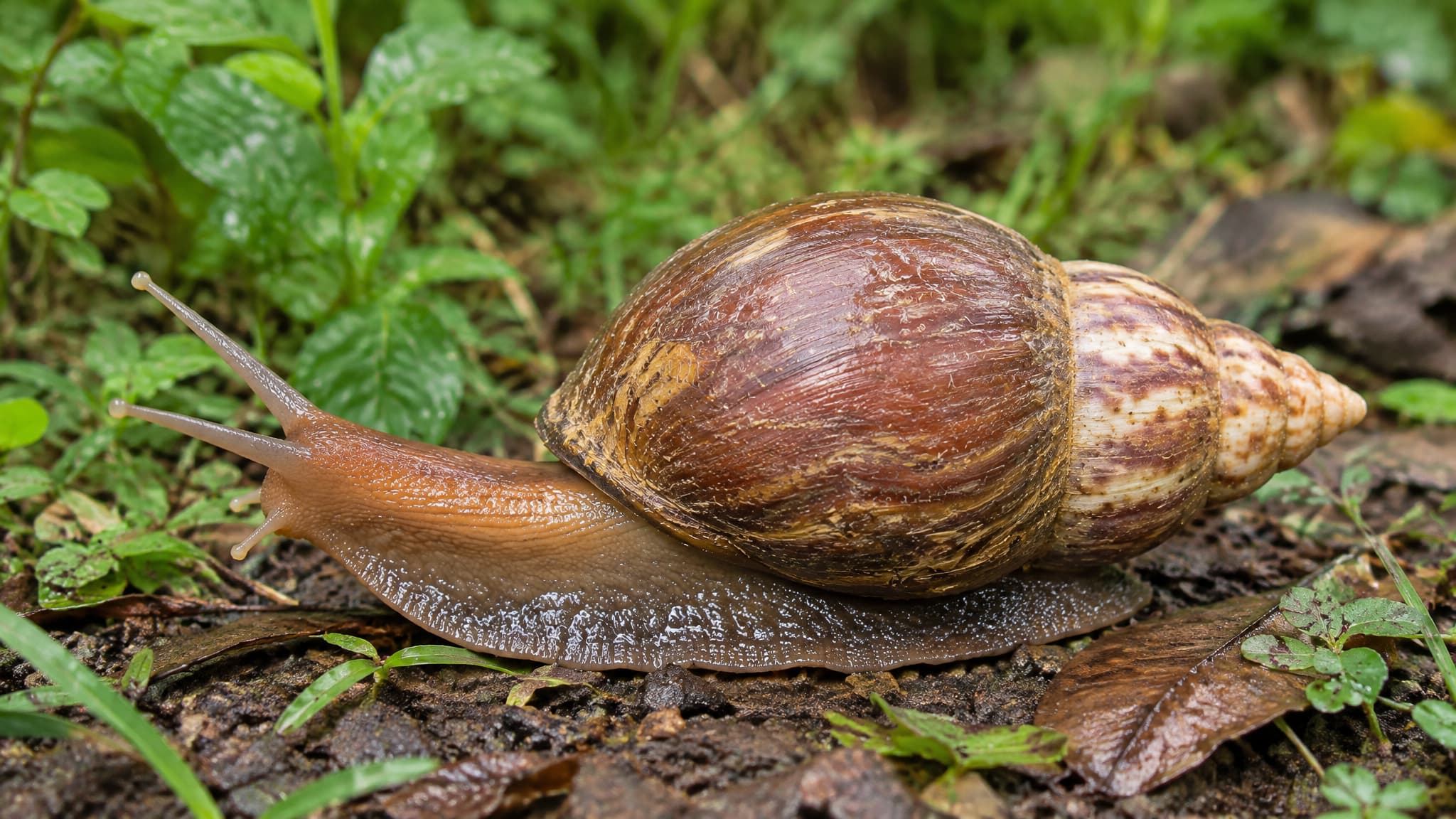
A Giant African Land Snail crawls across damp soil and leaf litter in a leafy forest setting, with its elongated brown-striped shell and two pairs of extended tentacles clearly visible.
The giant African land snail (Lissachatina fulica), long known as Achatina fulica, is a large air-breathing land snail of the family Achatinidae. Its tall, cone-shaped shell is about twice as long as it is wide and has seven to nine whorls. The shell can reach 20 cm or more in length and about 7 cm in diameter, although adults found in Brazil usually measure 7 to 12 cm.
The species is native to coastal East Africa and nearby islands, from Mozambique north to Kenya and Somalia, where it lives along forest margins. Carried by people through trade and deliberate releases, it is now established in many tropical and subtropical countries. In its invasive range it thrives in farmland, gardens, wasteland and towns, sheltering in leaf litter, damp soil and on walls, fences and tree trunks. In Brazil it was brought to Paraná in the 1980s as a cheap substitute for escargot; when the trade failed, breeders released the snails, and the species has since been recorded in 23 Brazilian states.
The snail is mainly herbivorous and eats a very wide range of living plants, including crops, fruits, vegetables, ornamental plants and weeds, as well as lichens and fungi. Young snails eat soil, a source of calcium for the shell, and decaying matter, and near homes the species also feeds on food scraps, paper, cardboard and feces. It is solitary and nocturnal, hiding from sun and heat during the day, and it aestivates, becoming dormant, during dry or unfavourable periods.
Each snail is a hermaphrodite, but it needs a partner to mate and cannot fertilize itself. Clutches average about 200 eggs, laid in soil and buried or partly buried, and the eggs hatch in 11 to 15 days. Snails mature at about six months, can lay several clutches a year and usually live 3 to 5 years, with a recorded maximum of 10 years.
It helps break down dead vegetation and is eaten by predators such as rodents, land crabs and ants; in Brazilian cities, black rats have been recorded eating it. As an invader it damages crops and gardens and competes with native snails. It can carry the rat lungworm (Angiostrongylus cantonensis), which causes eosinophilic meningitis in people, and empty shells can hold water in which the dengue mosquito Aedes aegypti breeds.
The species has not been evaluated by the IUCN Red List and is not threatened. Brazil declared it an invasive species in 2005, and breeding it there is illegal. People can catch the lungworm by eating raw or undercooked snails or by handling live wild snails.