Giant isopod
Bathynomus giganteus
 AI-generated
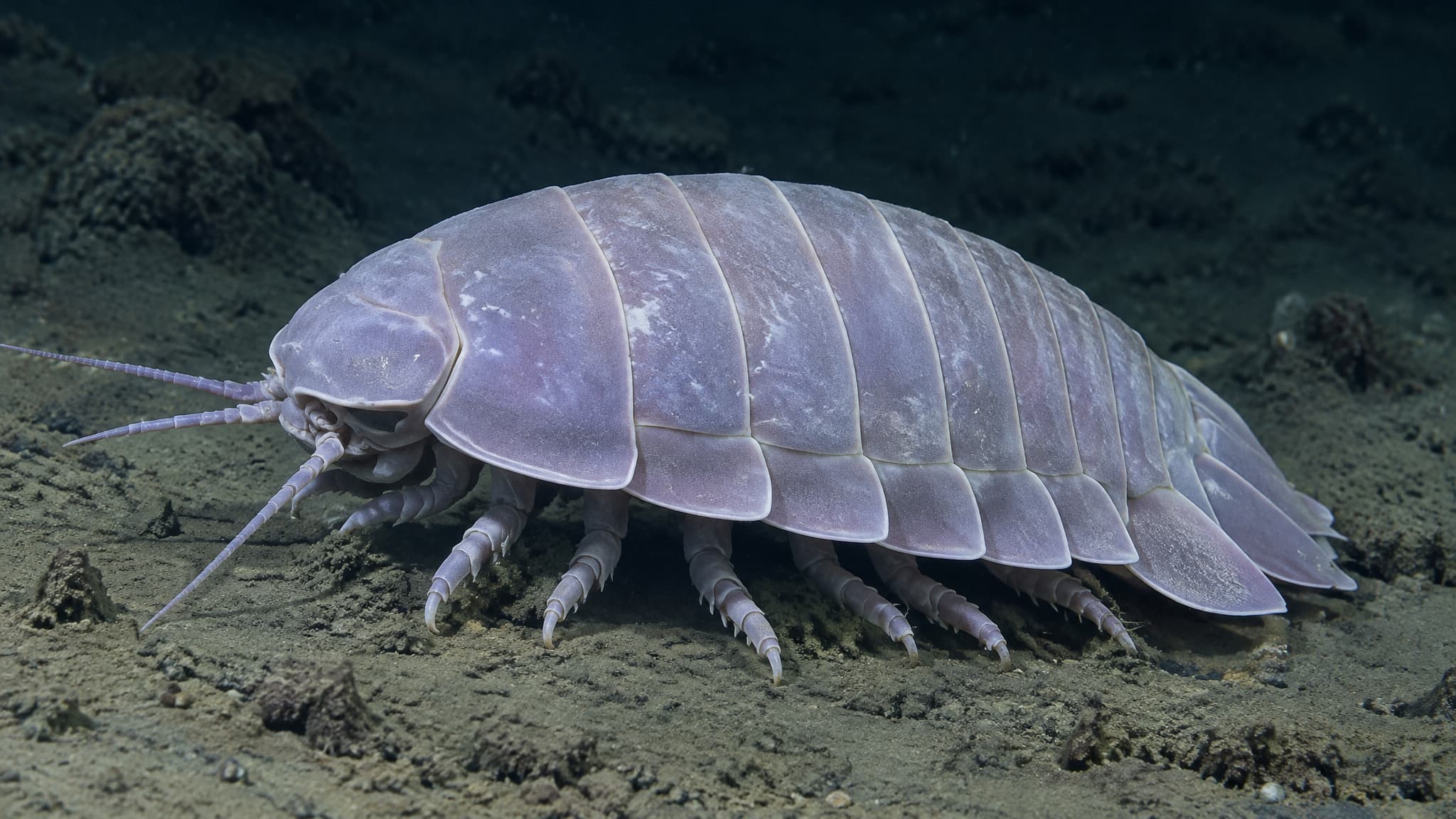
A giant isopod crawls in side view across a dark, sandy seafloor, showing a broad segmented armored body, long antennae, numerous jointed legs, and overlapping tail plates.
The giant isopod (Bathynomus giganteus) is a deep-sea crustacean in the order Isopoda and the family Cirolanidae, making it a distant relative of shrimps and crabs and a much larger cousin of the familiar woodlouse. Described by Alphonse Milne-Edwards in 1879 from specimens hauled up off the Dry Tortugas, it was the first Bathynomus species ever documented. Adults usually measure 19 to 36 cm, and the largest confirmed specimens approach 50 cm, a striking example of deep-sea gigantism.
Its flattened body is covered by a thick, calcified exoskeleton of overlapping plates in brown or pale lilac tones. Two large, widely spaced compound eyes, each with more than 4,000 facets, sit on the head, and a reflective layer behind them makes them seem to glow in light. It has two pairs of antennae, seven pairs of walking legs and a tail fan, and when threatened it can roll its armored body up much like a pill bug.
The species lives in the western Atlantic, from the southeastern United States through the Gulf of Mexico and the Caribbean to Brazil. It is a benthic animal of cold, dark water, recorded from roughly 170 to 2,140 m deep, and favors soft mud or clay bottoms where it can dig into the sediment.
The giant isopod is above all a scavenger that finds food mainly by chemical cues. Gut studies off the Yucatán Peninsula found fish, squid and decapod crustaceans as the most common items, but also echinoderms and tunicates, suggesting it takes slow-moving prey too. Whale carcasses and fish discarded by trawlers are welcome meals. Food is scarce at depth, so it gorges whenever it can and then endures long fasts; one specimen at Toba Aquarium in Japan went years without eating.
Reproduction is seasonal. Mature females form a brood pouch, the marsupium, from overlapping plates on their legs and carry roughly 20 to 30 large eggs there, apparently without feeding. The young hatch as mancae, miniature adults up to about 6 cm long that lack only the last pair of legs, with no free-swimming larval stage. Its lifespan in the wild is not well established.
By recycling the dead animals that sink to the seafloor, the giant isopod helps return nutrients to the deep-sea food web, and it is in turn eaten by sharks. It has not been assessed for the IUCN Red List. Deep-sea trawling can catch brooding females, and isopods from the southern Gulf of Mexico have been found with plastic in their stomachs.