Giant monkey frog
Phyllomedusa bicolor
 AI-generated
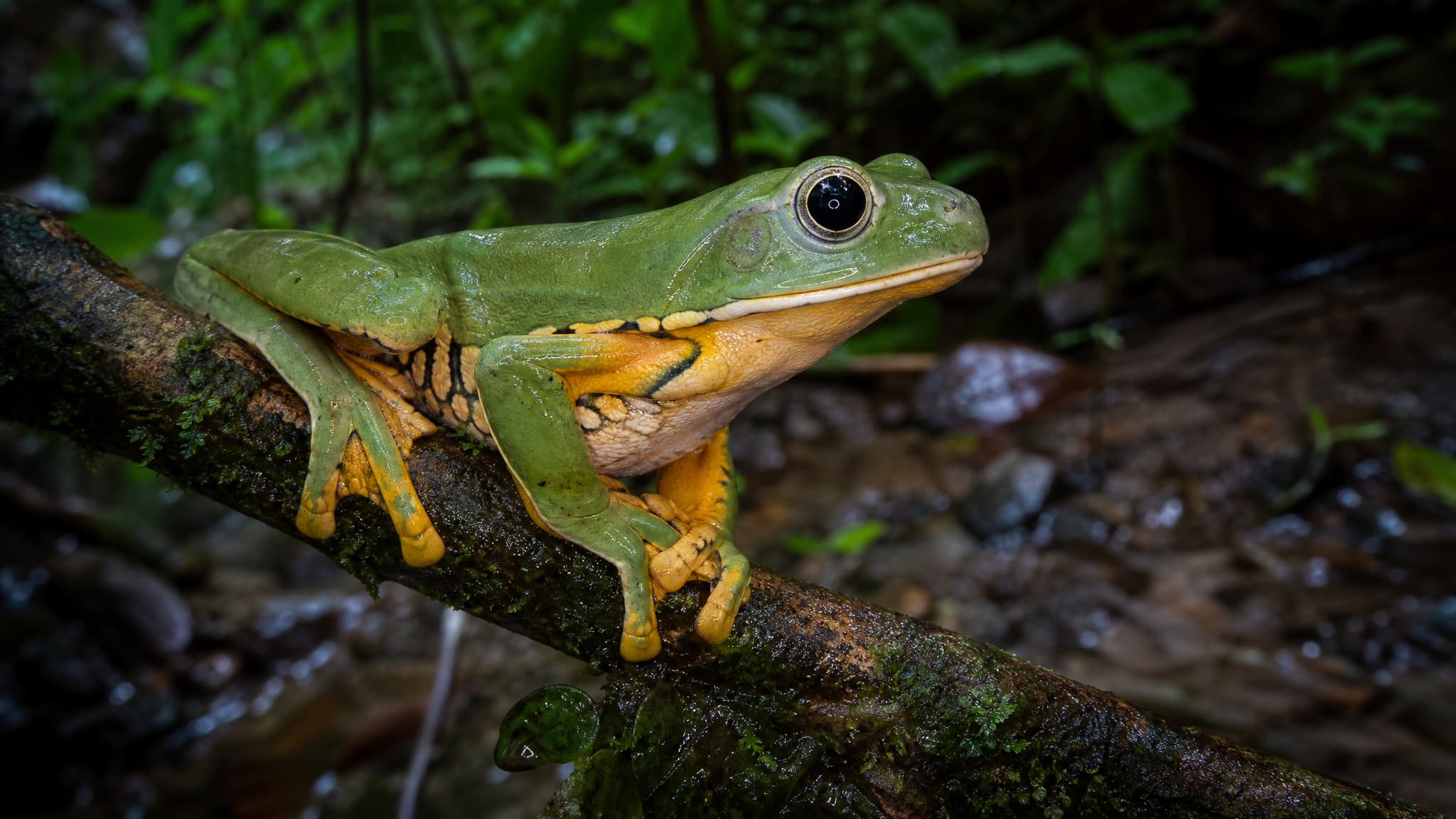
A large green frog rests sideways on a moss-covered branch in a dim tropical forest, showing a broad head, prominent eye, orange-gold underside, and long limbs with yellowish toe pads.
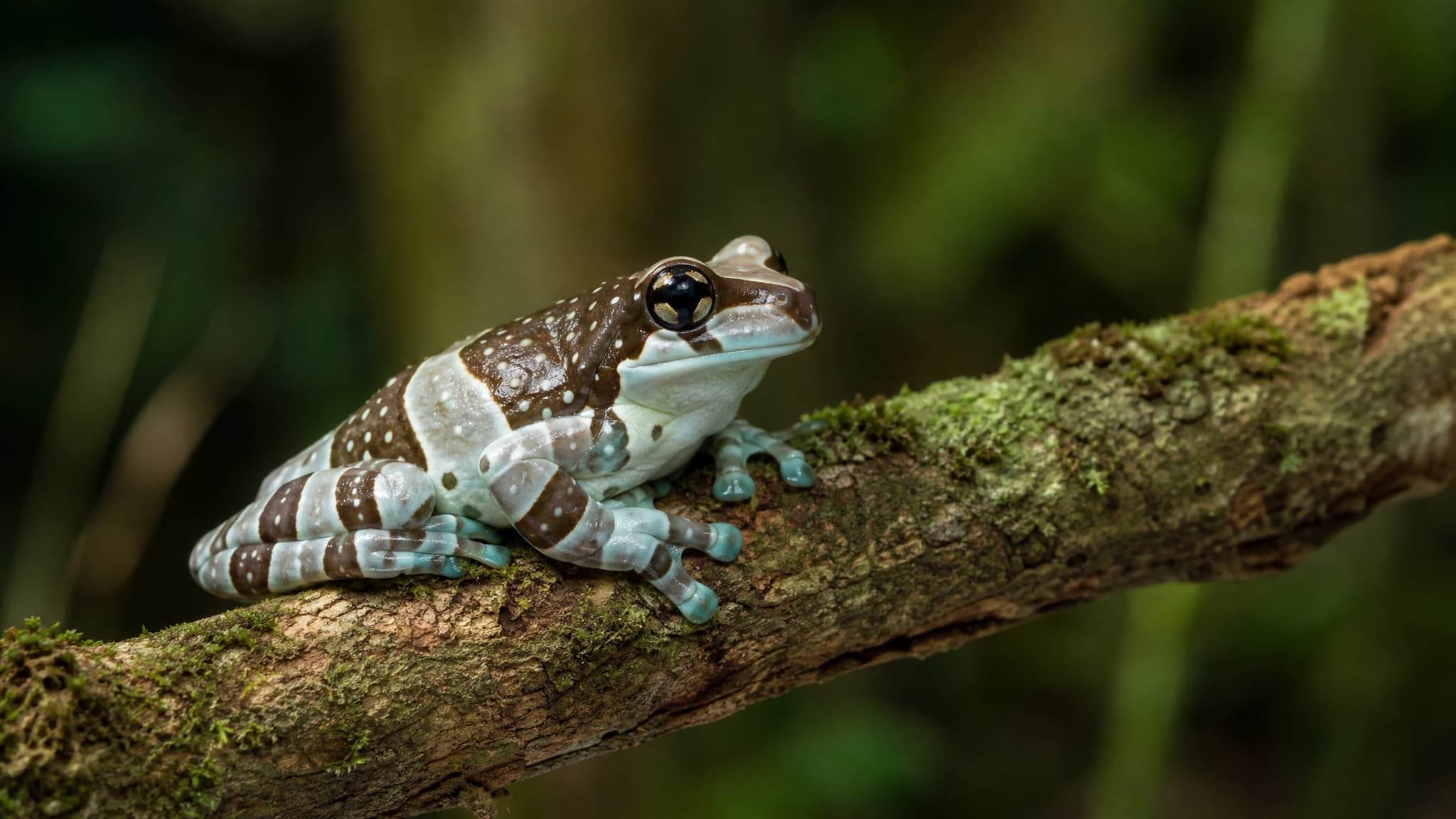
Phyllomedusa bicolor is a large, arboreal Amazonian frog often called the giant monkey frog, giant leaf frog, or giant waxy tree frog. Adults are strikingly two-toned: the back is deep green, while the underside is white, cream, or yellowish. Adult males measure roughly 91–118 mm from snout to vent and females about 106–119 mm. Broad adhesive toe pads, long limbs, and a deliberate climbing gait suit it to life among branches; the species also has conspicuous skin glands and bony deposits in the dorsal skin.
Its range spans much of the Amazon Basin and Guianan region, including Brazil, Bolivia, Colombia, Peru, Venezuela, Guyana, Suriname, and French Guiana. It lives chiefly in humid, well-preserved tropical forest, using trees and shrubs near streams, temporary pools, or permanent still-water breeding sites. By day it rests in higher vegetation; males become active after dusk, calling from foliage and defending access to females.
This frog is a carnivore. Direct records of its natural prey remain scarce, but related leaf frogs are generalist, ambush-oriented predators that take arthropods such as spiders, beetles, and caterpillars. Like other phyllomedusids, it spreads lipid-rich skin secretions over its body with its limbs. These secretions help limit water loss and contain bioactive peptides that are likely important in deterring predators. The secretion is associated with traditional kambô practices, but its use can be medically dangerous and should not be treated as a proven therapy.
Breeding is concentrated in rainy periods, although timing differs across its extensive range. Calling males gather singly or in small groups in vegetation, sometimes several metres above ground. A paired male and female fold a leaf into a chamber above water and place a gelatinous egg mass inside. Clutches may contain roughly 241–1,722 eggs. About two weeks later, the hatchlings drop into the water below, where the tadpoles feed and grow until metamorphosis. Eggs are vulnerable to heavy predation despite the protective leaf nest.
The giant monkey frog is currently listed as Least Concern globally, largely because of its broad distribution and occurrence in protected areas. It nevertheless depends on intact forest and suitable aquatic breeding habitat. Deforestation, degradation of Amazonian forests, collection for trade or extraction of skin secretions, and unresolved cryptic diversity may create localized conservation risks. Reported longevity is at least five years, though robust lifespan data from wild populations are lacking.