Giant oarfish
Regalecus glesne
 AI-generated
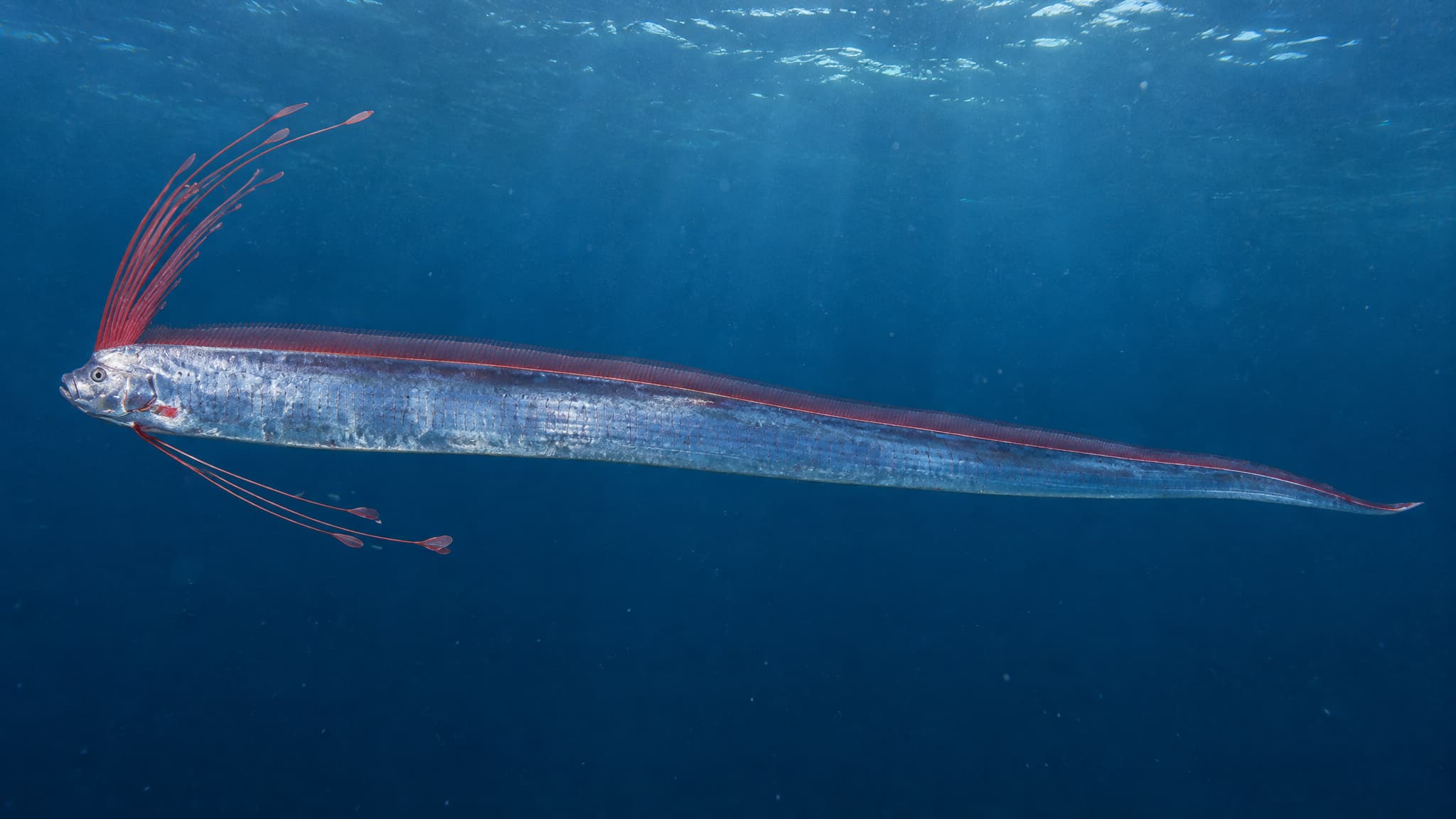
A giant oarfish is shown in profile, swimming horizontally through open blue water. Its extremely elongated, silvery body bears a long red dorsal fin and prominent red filamentous rays near the head.
The giant oarfish (Regalecus glesne) is widely described as the longest bony fish alive. FishBase gives a maximum total length of 8 m and a maximum published weight of 272 kg, although most specimens measured are around 3 m. Its body is ribbon-like, strongly compressed from side to side and silvery, often marked with blue to blackish streaks, spots and wavy lines. A crimson dorsal fin with 414 to 449 soft rays runs from between the eyes to the tip of the tail, and its first 10 to 12 rays are lengthened into a red crest on the head. Each pelvic fin is a single long ray with a widened, oar-like tip, which gives the fish its common name. It has a small head, toothless protrusible jaws, no anal fin and no swim bladder.
The species lives in the open ocean almost worldwide outside the polar regions, with records from 72°N to 52°S in the Atlantic (including the Mediterranean), the Indo-Pacific and the eastern Pacific. It is a pelagic, oceanic fish of the epipelagic and mesopelagic zones; FishBase records it at depths from 20 to 1000 m, and it is usually found well below the sunlit surface layer.
The giant oarfish feeds mainly on krill and other small crustaceans, along with small fishes and squid. Lacking teeth, it sucks prey-laden water into its mouth and strains food with specialised gill rakers. It swims by rippling its long dorsal fin and often holds a vertical, head-up posture, which may help it spot prey silhouetted against the light above. It is occasionally found in pairs, but no schooling has been recorded.
Spawning takes place from July to December. The species is a broadcast spawner with no parental care, and its eggs are round and covered in short spines. Larvae are nearly transparent with dark spots and have a small tail fin that adults lack. Throughout life the fish can shed the rear part of its body, a form of self-amputation that does not harm its vital organs, which sit toward the head. Its lifespan is unknown.
No natural predators of adults have been documented, though the fish hosts parasites such as tapeworm larvae; one adult female carried at least 63 of them. Rare strandings and surface sightings, often of dying animals, have fed sea serpent legends for centuries.
The giant oarfish is assessed as Least Concern by the IUCN. It is not targeted by commercial fisheries but is occasionally caught as bycatch, and FishBase rates its resilience as very low, with a population doubling time of more than 14 years.