Giant Prickly Stick Insect
Extatosoma tiaratum
 AI-generated
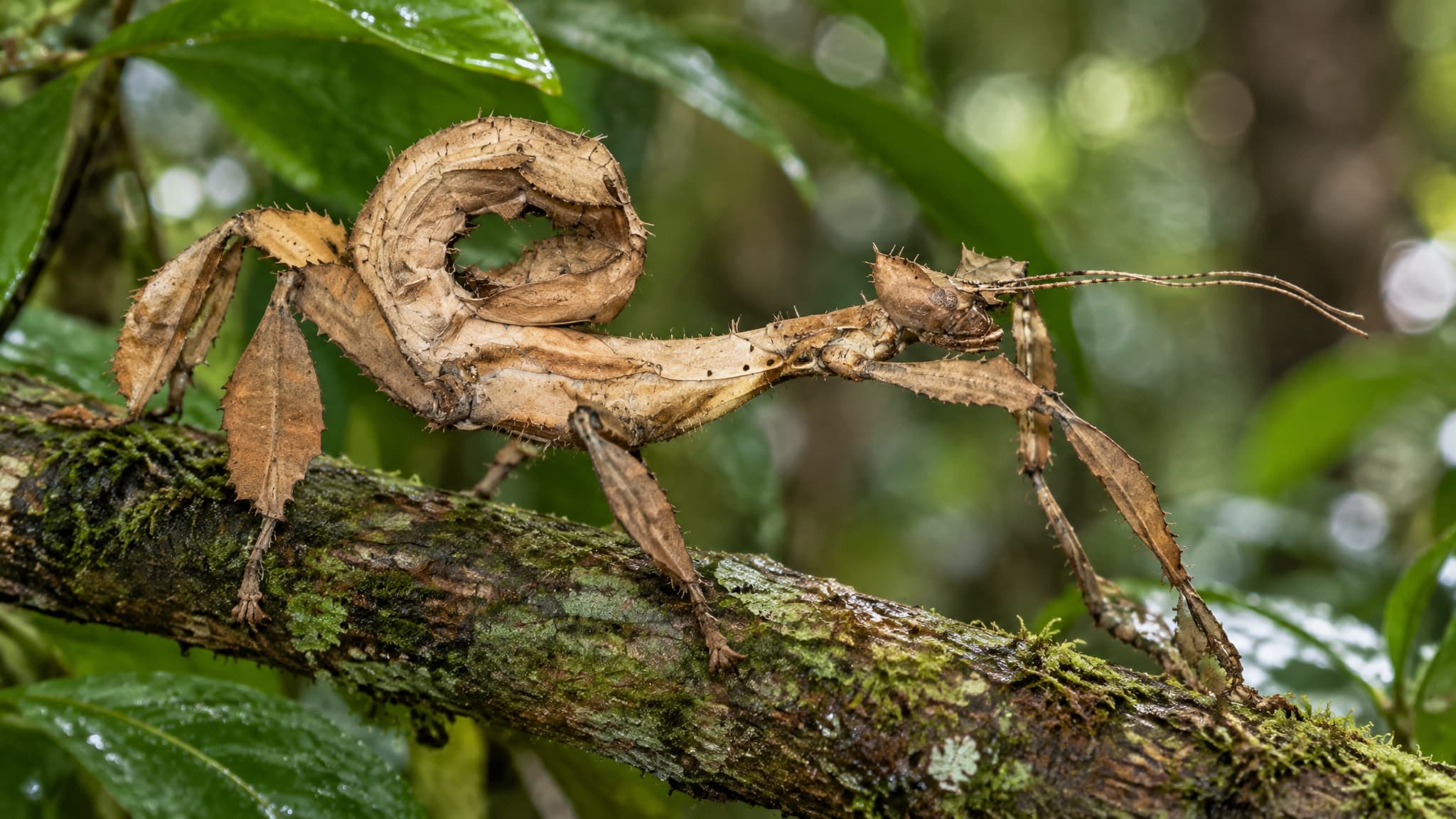
A Giant Prickly Stick Insect rests on a moss-covered branch in lush foliage, with its abdomen curled tightly and its spiny, leaf-like legs and long antennae prominently visible.
The giant prickly stick insect, also called Macleay's spectre or the spiny leaf insect, is one of Australia's best-known phasmids. The sexes look very different. Females are heavy-bodied, covered in spines and reach about 20 cm, with knobbly legs and leaf-like edges that make them resemble a dry, curled-up leaf. Males are slender, smoother and smaller, at about 11 cm. Adults weigh roughly 5 to 20 g. Colour varies from brown and mottled brown to green, reddish, cream, yellowish or even entirely white.
The species is native to eastern Australia, mainly eastern Queensland and eastern New South Wales. It lives in rainforests and woodlands, where it hangs motionless among foliage and is very hard to spot. It is mainly nocturnal, feeding at night and staying still during the day, and it sways gently while perched, like a leaf moving in the breeze.
It is a plant eater. Eucalyptus is its native food, and it also takes the leaves of other plants such as blackberry. Birds and reptiles are its main predators. When threatened, a female curls her abdomen over her back in a scorpion-like pose, although she has no sting, and can jab with the spines on her hind legs. Adults may also make clicking sounds and release a defensive odour likened to toffee, while males can flash their wings. Males have fully working wings and fly well; females have only tiny wings and cannot fly.
Females drop their seed-like eggs one by one from the trees to the forest floor. Ants often carry the eggs to their nests, eat an edible outer part and leave the egg intact underground. Newly hatched nymphs are fast-moving and mimic ants of the genus Leptomyrmex, a disguise that deters birds. Eggs from mated females hatch after about four months. Without males, females reproduce by parthenogenesis, producing only female offspring from eggs that can take up to nine months to hatch. Males moult five times and females six times before reaching adulthood.
Females live for about 18 months, while males live for about 6 to 8 months. The species is assessed as Least Concern by the IUCN. It is also raised by breeders, and in Brazil it is found only in breeding collections.