Blue sea dragon
Glaucus atlanticus
 AI-generated
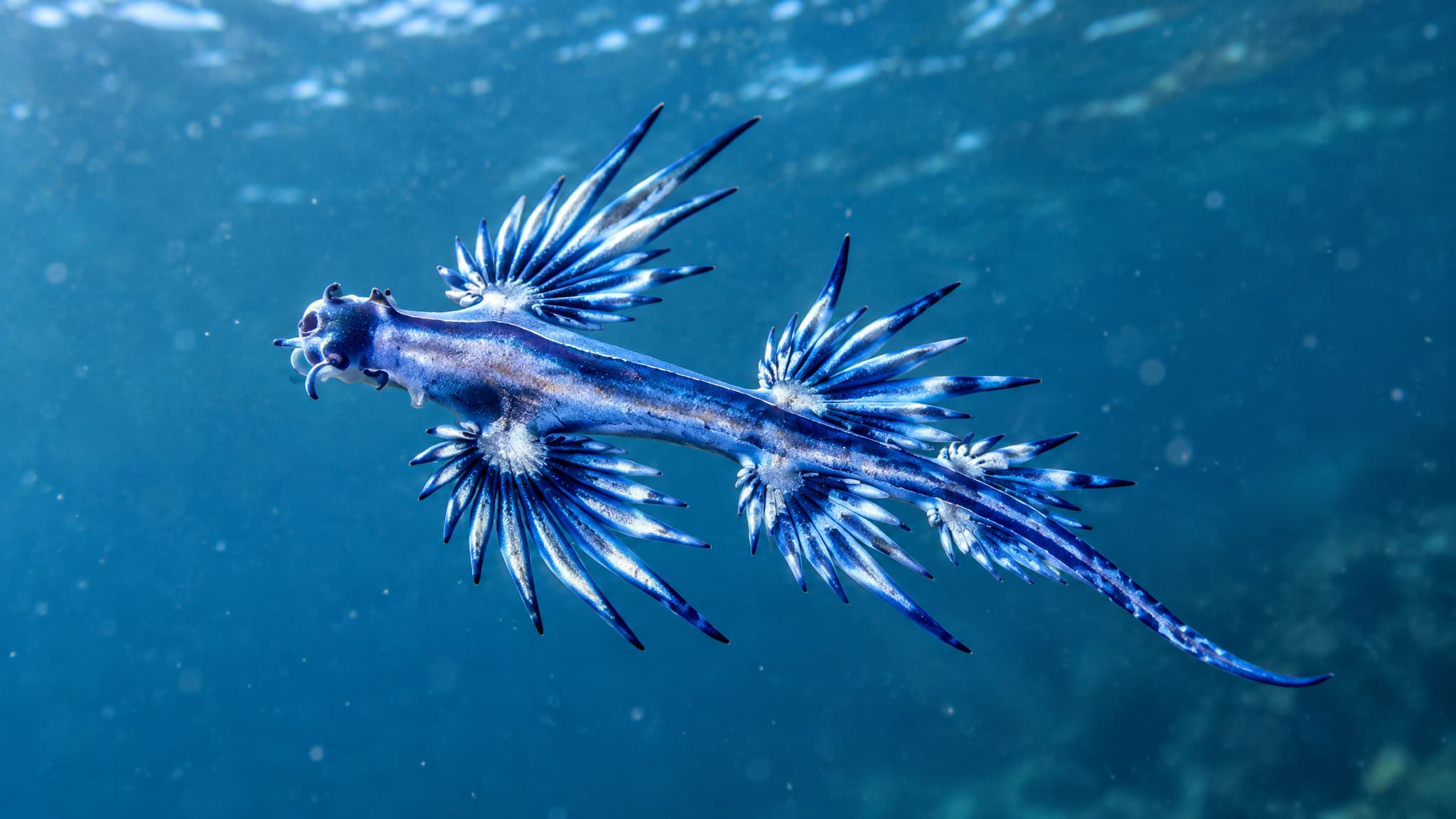
A blue sea dragon floats horizontally in open blue water, showing a slender blue body, a distinct anterior head, and numerous radiating cerata along its sides and back. 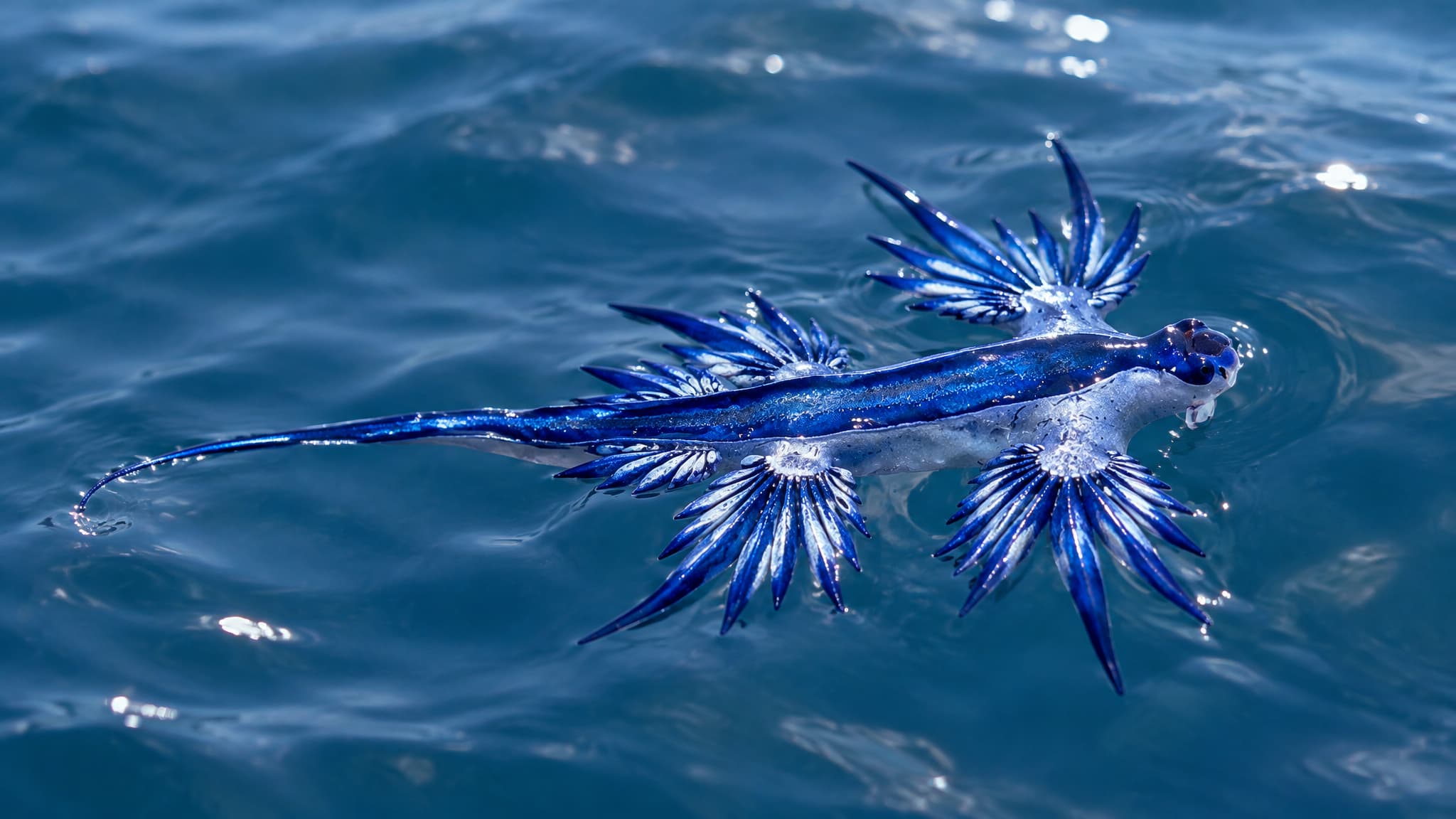 AI-generated
A vivid blue sea dragon floats laterally at the ocean surface, showing an elongated body and numerous radiating, finger-like cerata.
The blue sea dragon (Glaucus atlanticus) is a small sea slug that spends its whole life drifting at the ocean surface. Described by Georg Forster in 1777 from material collected on Captain Cook's second voyage, it is an aeolid nudibranch of the family Glaucidae. Adults usually measure about 3 to 4 cm, although some specimens reach about 7 cm. The body is elongated, widest just behind the head and tapering to a pointed tail, and it carries six groups of long, finger-like cerata. One side is a vivid mix of dark and pale blue, while the other is silvery grey.
That colour pattern makes sense once you know how the animal lives. A bubble of gas held in its stomach keeps it afloat, and it hangs upside down from the surface film, its foot pressed against the water's surface. The blue side faces the sky and blends with the sea, while the silvery side faces down and matches the bright surface seen from below. Wind and currents carry it across the open ocean, and it can swim slowly with its cerata.
The species lives in temperate and tropical waters of all oceans. Records span the Brazilian coast, South Africa, Mozambique, European waters, the Azores, the Canary Islands, Bermuda, Barbados, Texas, Peru, the Gulf of California, India and eastern Australia. Large numbers sometimes wash up on beaches, often linked to currents and weather events such as El Niño.
The blue sea dragon is a predator of other floating animals. Its main prey are venomous siphonophores such as the Portuguese man o' war, together with by-the-wind sailors (Velella velella), blue buttons (Porpita porpita) and violet snails (Janthina). It is unharmed by the man o' war's stinging cells. Instead, it stores the most potent ones in sacs at the tips of its cerata, a habit called kleptocnidy, and uses them for its own defence. In captivity, individuals may attack one another when no other food is available.
Each animal is a hermaphrodite, with both male and female organs. Unlike most nudibranchs, two partners mate with their undersides pressed together, and both then lay strings of white eggs, often on floating wood or carcasses. Under good conditions an individual can live for up to a year.
The species has not been assessed by the IUCN. Its borrowed stinging cells mean that touching one, even on a beach, can cause a painful sting with pain, nausea and skin reactions similar to a man o' war sting, so stranded animals are best admired without handling.