Golden Poison Frog
Phyllobates terribilis
 AI-generated
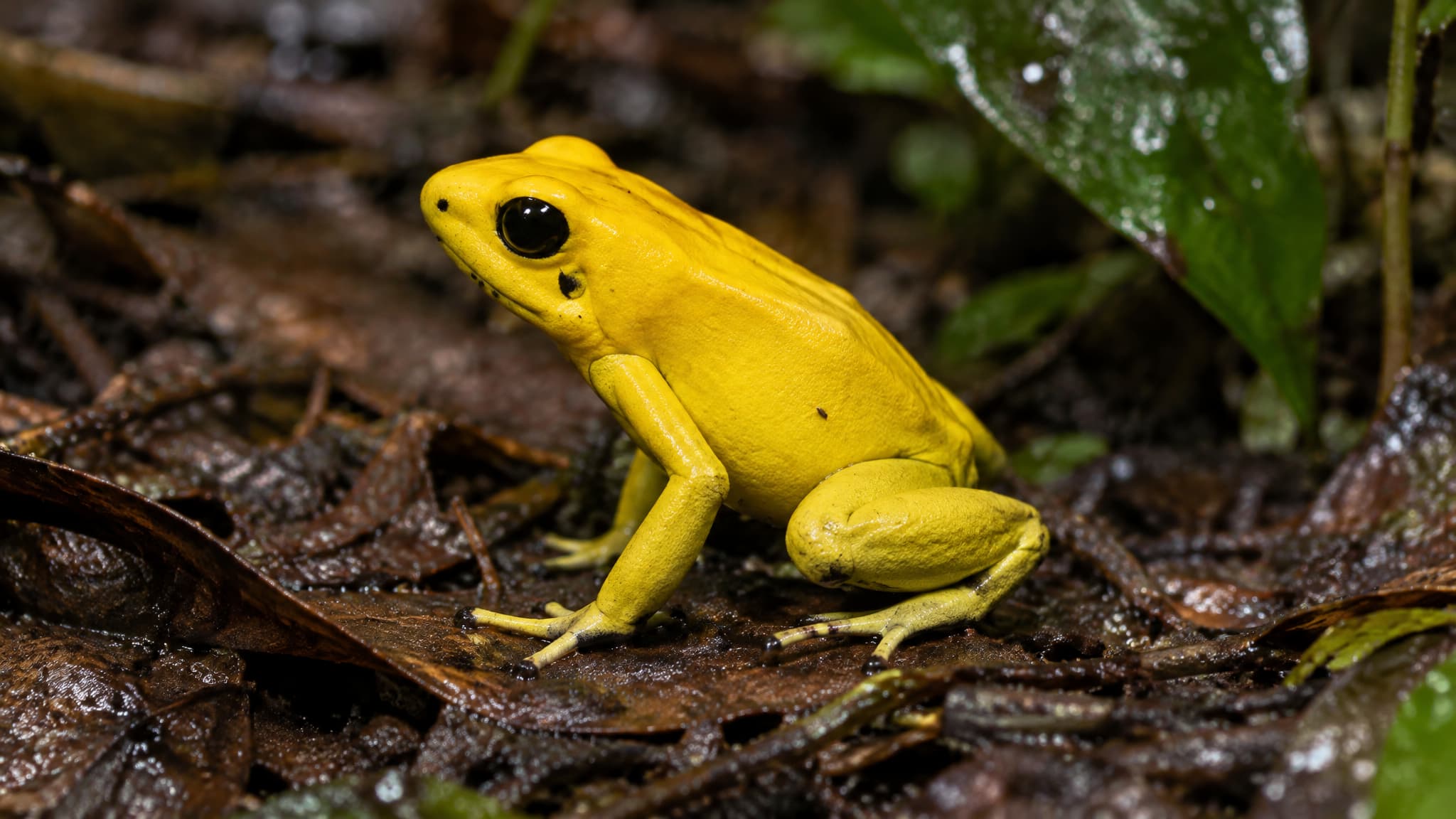
A bright yellow frog crouches on wet forest leaf litter, with its head raised, large black eyes, folded hind legs, and slender toes visible.
The golden poison frog (Phyllobates terribilis) is widely seen as the most toxic frog known. It is also one of the largest poison dart frogs. Females reach about 47 mm in snout–vent length and males about 45 mm. The skin is smooth to finely granular and has no dark markings. Depending on the population, adults are bright golden yellow, golden orange or pale metallic green. These bright colors warn predators that the frog is poisonous.
The species is found only in a small area of lowland rainforest along the Pacific coast of western Colombia. It lives on the forest floor, is active by day and stays on the ground. It is known from only a few locations, and its exact range has been hard to survey.
Adults are insectivores. In the wild they mainly eat small ants of the genera Brachymyrmex and Paratrechina, along with termites, beetles and other small invertebrates. They catch prey with a long, sticky tongue. The frog's skin holds steroidal alkaloids: batrachotoxin, homobatrachotoxin and batrachotoxinin A. Researchers think the frog gets these toxins from its wild diet, possibly from melyrid beetles. Frogs raised in captivity are not toxic. A dose of about 2 to 200 micrograms is thought to be lethal to a human. Indigenous Emberá people have traditionally used the toxin on blowgun darts.
Males attract females with a long, melodious trill. Courtship and egg-laying have mostly been seen in captivity, where clutches usually hold fewer than 20 eggs, laid on land. The male keeps the eggs moist. After hatching, he carries the tadpoles on his back to small pools of water. Captive frogs have lived to about 5 years, and wild lifespan is not confirmed.
Because it is so toxic, the golden poison frog has few natural predators. The snake Leimadophis epinephelus resists its toxins and may eat young frogs. The frog in turn helps control ant and other invertebrate populations on the forest floor.
The IUCN lists it as Endangered, and it is on CITES Appendix II. Its populations are declining mainly because forest is cleared for farming within its very small range.