Goldfish
Carassius auratus
 AI-generated
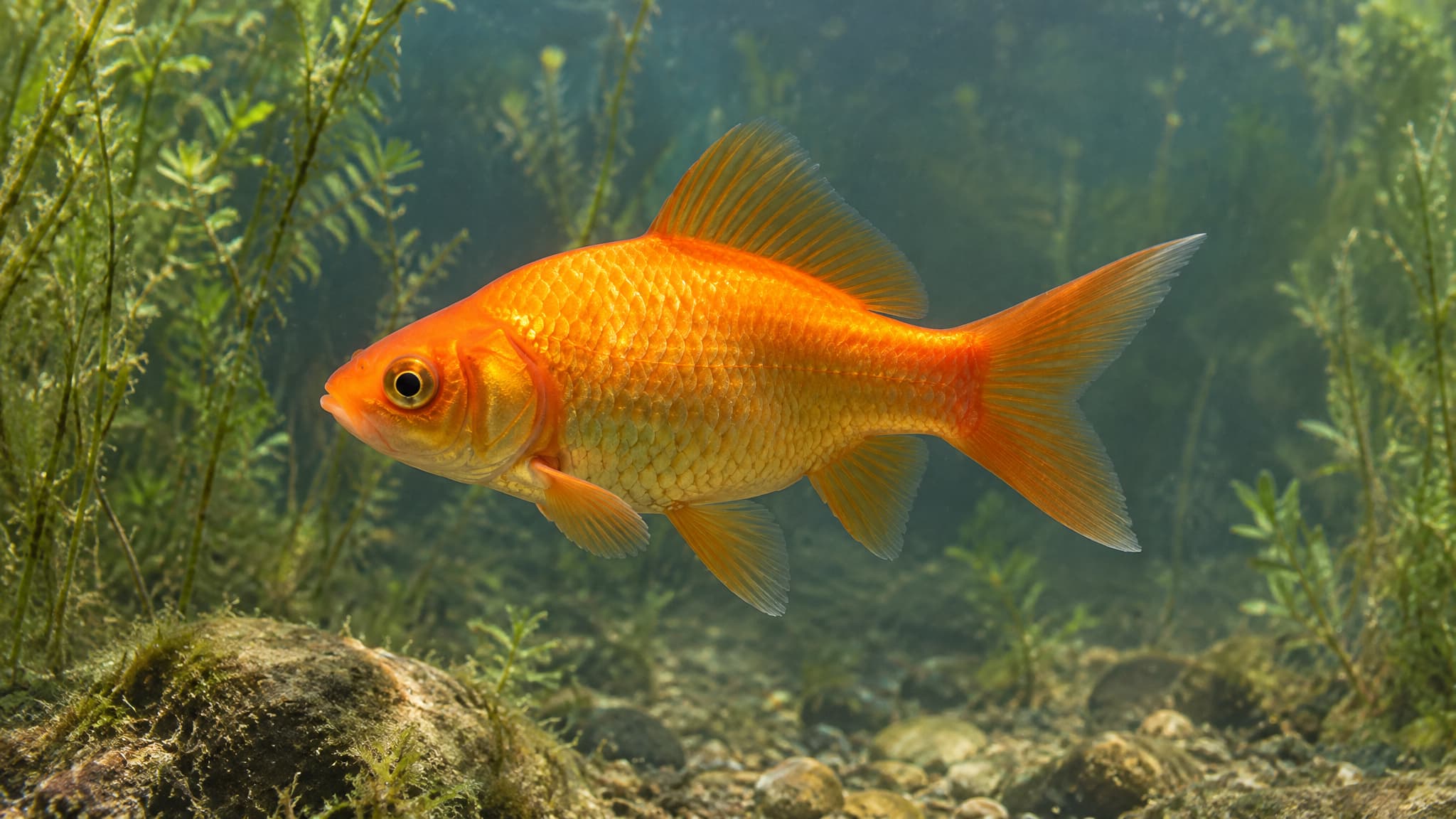
A bright orange-gold fish swims left in side profile through clear, plant-filled freshwater above a rocky bed. Its reflective scales, prominent dorsal fin, paired fins, and forked tail are clearly visible.
The goldfish (Carassius auratus) is a member of the carp family, Cyprinidae, and one of the earliest fish ever domesticated. Wild-type fish are stocky and deep-bodied with large scales, a long dorsal fin and a stiff, serrated spine at the front of the dorsal and anal fins. Unlike the common carp, it has no barbels at the mouth. Wild and feral fish range from olive-bronze to gold or creamy white, while centuries of selective breeding in China produced countless ornamental forms such as comets, orandas and ryukins, all belonging to the same species. Most individuals reach 10–20 cm, though exceptional fish have been recorded near 48–59 cm.
Goldfish are native to East Asia, including China, Korea and neighbouring regions, but releases from ponds and aquariums have established feral populations across North America, Europe, Africa and elsewhere. They favour stagnant or slow-moving fresh water — ponds, lakes, ditches, canals and well-vegetated, often eutrophic wetlands — at depths of up to about 20 m. The species tolerates temperatures from near freezing to about 41 °C, low oxygen and some salinity, which helps explain its success as an invader.
This omnivore forages over vegetation and soft bottoms for plankton, benthic invertebrates, plant material and detritus, and will also eat fish eggs and larvae, including its own offspring. Goldfish are social, use chemical cues to locate food and avoid predators, and spawn in groups.
Breeding is triggered as water warms in spring. Females release pheromones that stimulate males, then scatter adhesive eggs over submerged plants in shallow water, where males fertilise them externally. A single female may lay thousands to several hundred thousand eggs over multiple spawnings, and eggs hatch in roughly 2–9 days. Wild fish often live 6–7 years, while well-kept captive fish commonly reach 10–15 years; ages above 40 years have been reported.
Ecologically, goldfish recycle nutrients and serve as prey, but where introduced they stir up sediment, increase turbidity, uproot plants, may encourage algal blooms and prey on the eggs of native fish and amphibians. The IUCN lists the species as Least Concern, and management efforts focus mainly on preventing releases and controlling invasive populations.
In collections
Ideal water
The water this fish does best in, as kept in aquariums.
- Water type
- Freshwater
- Brackish
- pH
- 6.0–8.0
- acidic to alkaline
- General hardness
- 5–19 dGH