Mangrove root crab
Goniopsis cruentata
 AI-generated
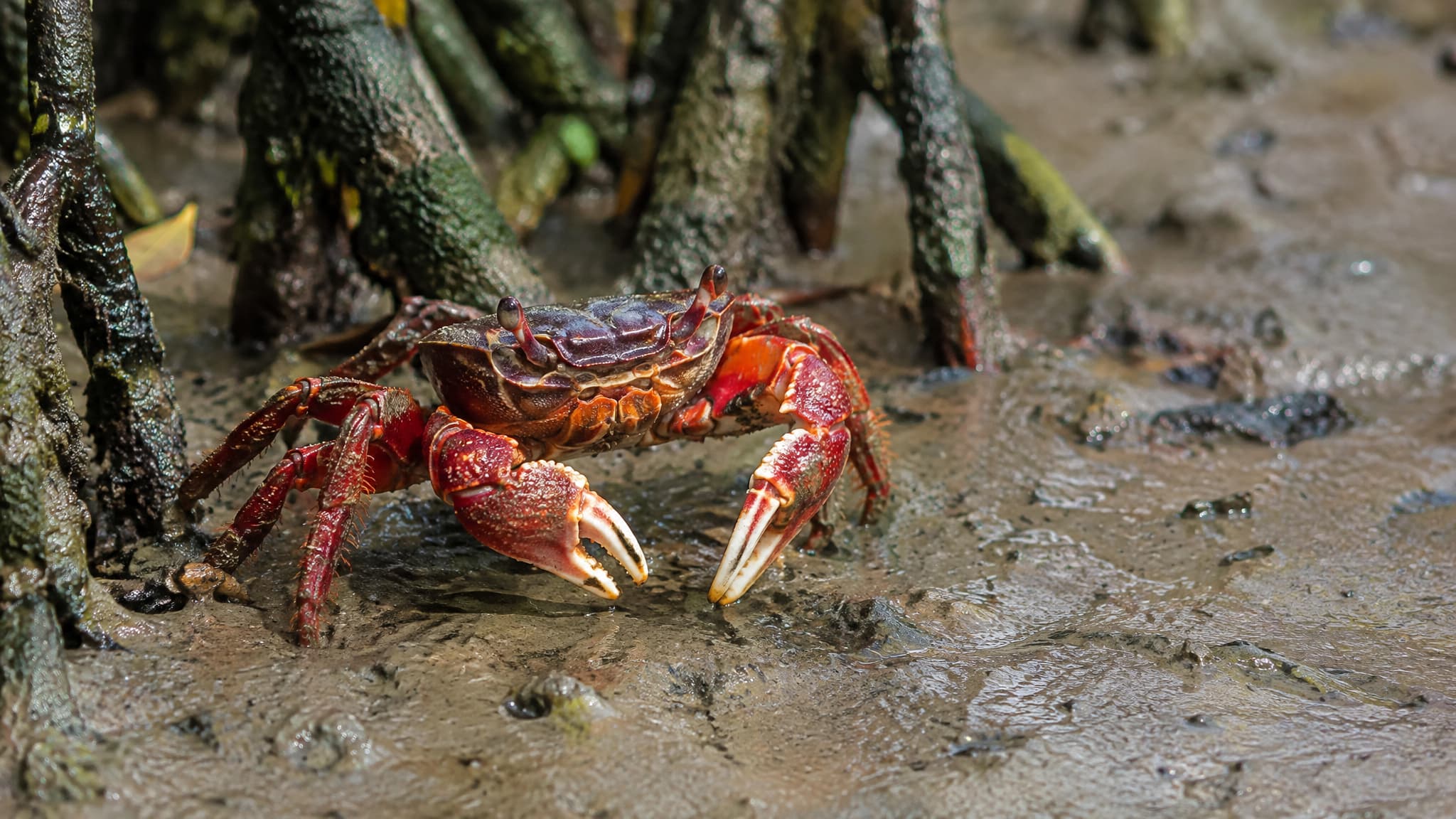
A red-orange mangrove root crab stands in a frontal, raised-claw pose on wet mud among mangrove roots; its dark glossy carapace, stalked eyes, and pale-tipped chelae are visible.
Mangrove root crab
Goniopsis cruentata is a grapsid crab of Atlantic American mangroves, also called the red mangrove crab. It has a broad, squarish carapace and stout, spiny claws. Adults can approach 50 mm in carapace length. Its living coloration is notably variable but vivid: the carapace is often tan or golden with purple marbling and pale spots, while the legs may show strong red, purple, or orange tones. This camouflage-breaking pattern is especially conspicuous on mangrove roots.
The species occurs in the western Atlantic, from Bermuda and Florida through the Gulf of Mexico, Caribbean, and Guianas to Brazil; Brazilian records extend from Pará to Santa Catarina, including offshore islands. It is closely associated with estuaries and mangrove forests. At low tide, it may walk over muddy ground, shelter beneath debris or in available burrows and crevices, and climb trunks, branches, and prop roots. It is therefore semi-terrestrial rather than a crab confined to open water.
An opportunistic omnivore, the mangrove root crab eats mangrove propagules and leaf litter, scavenges animal material, and can act as a predator. It moves quickly into cover when disturbed. By feeding on propagules, it can influence which mangrove seedlings establish; through detritus consumption and scavenging, it also helps transfer organic matter through the mangrove food web.
Females carry eggs externally beneath the abdomen. Research in northeastern Brazil found seasonal-continuous breeding, with a stronger reproductive peak during the dry period, whereas another southeastern Brazilian population showed continuous reproduction with spring–summer peaks. A growth study estimated short longevity—about 1.3 years for males and 1.2 years for females—in that particular population, so these figures should not be treated as a universal lifespan.
The species supports artisanal fisheries and is an important food and income resource in parts of northeastern Brazil. It is not globally assessed on the IUCN Red List, but its dependence on mangroves makes it vulnerable to habitat conversion, degradation, and pollution. Intensive harvesting may also reduce crab abundance, body size, and reproductive potential locally; conserving mangrove habitat and managing harvest are therefore important safeguards.