Great Barracuda
Sphyraena barracuda
 AI-generated
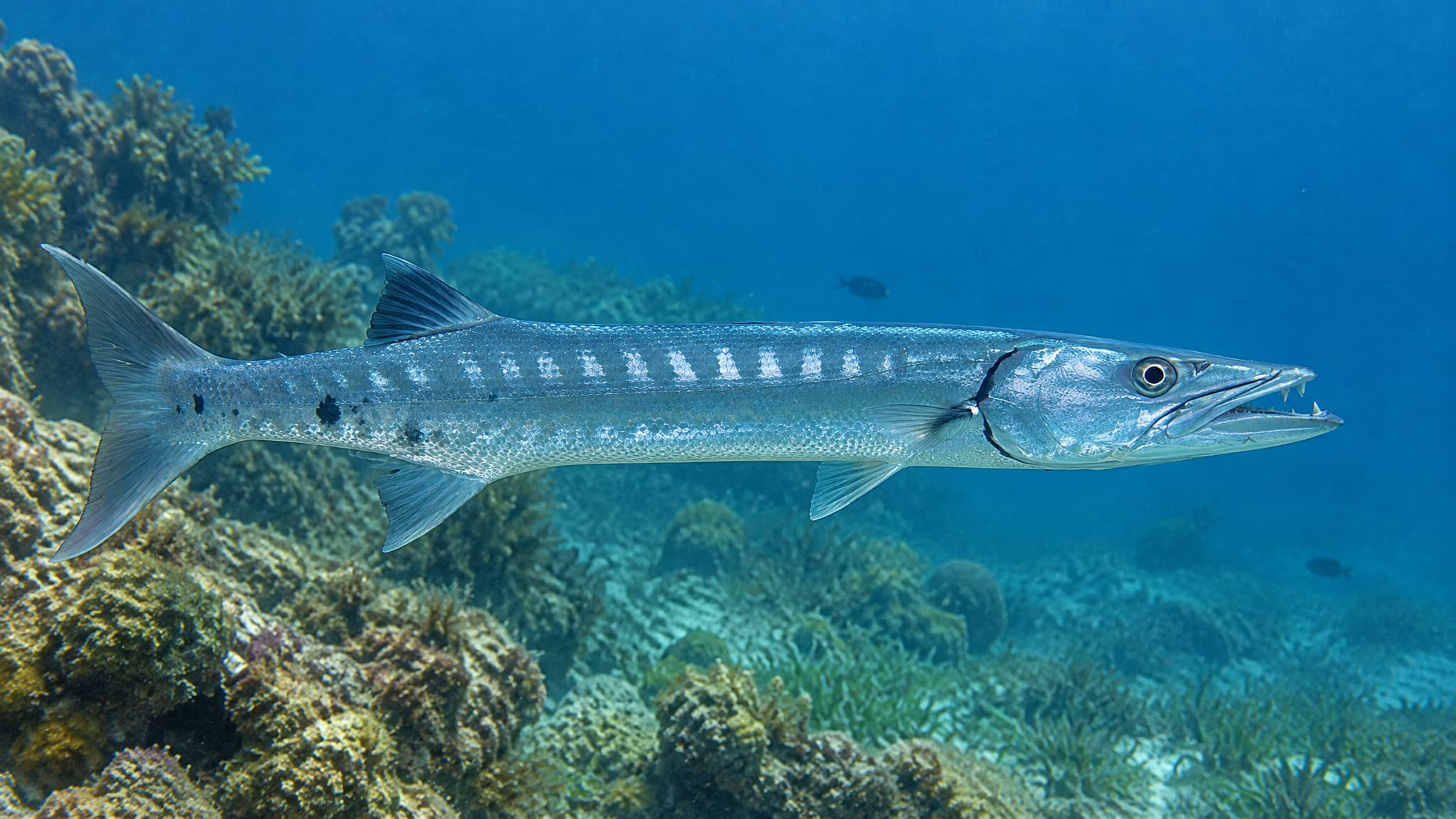
A Great Barracuda swims in profile to the right above a coral reef, showing its elongated silvery body, pointed jaws, prominent eye, and sharp teeth.
The great barracuda (Sphyraena barracuda) is the largest and best-known member of the barracuda family, Sphyraenidae. It has a long, nearly cylindrical, slightly compressed body, a pointed head, large eyes and a projecting lower jaw lined with large, sharp teeth. Adults are silvery with grey-green backs, around 20 dark oblique bars on the upper flanks and scattered black blotches on the lower sides; the tail is dark with white tips. Individuals commonly reach about 1.4 m and may grow to 2 m and 50 kg.
The species lives in tropical and warm-temperate seas worldwide, including the Indo-Pacific and the Atlantic. In the western Atlantic it ranges from Massachusetts and Bermuda through the Gulf of Mexico and Caribbean to Brazil, while it is only a vagrant in the eastern Pacific. It uses coral and rocky reefs, seagrass beds, mangrove edges, lagoons and open coastal waters from the surface to depths of around 300 m.
Great barracudas are ambush and pursuit predators that rely on vision and bursts of speed. They feed mainly on fishes such as mullets, jacks, grunts, herrings, anchovies and needlefishes, and also take squid, octopus and shrimp from both the bottom and the water column. Juveniles often gather in loose groups, whereas large adults are usually solitary, active by day and known for curiously shadowing divers.
Spawning is thought to occur in deeper offshore waters from spring to autumn. Eggs and larvae drift in the plankton, and young fish settle into shallow, vegetated estuaries and mangroves that offer food and shelter. There is no parental care. Sexual maturity is reached at roughly two to four years of age, and aged specimens from Florida reached more than 18 years.
As a top predator, the great barracuda helps regulate populations of smaller reef and coastal fishes, while juveniles are preyed on by sharks, groupers and other large predators. It is a valued game fish, but large individuals from some reefs accumulate ciguatoxins and can cause ciguatera poisoning, so their sale is restricted in some places.
The IUCN lists the species as Least Concern because of its huge range and lack of evidence for global decline. Local pressures include recreational and commercial fishing and the degradation of mangroves and seagrass nurseries.