Green moray
Gymnothorax funebris
 AI-generated
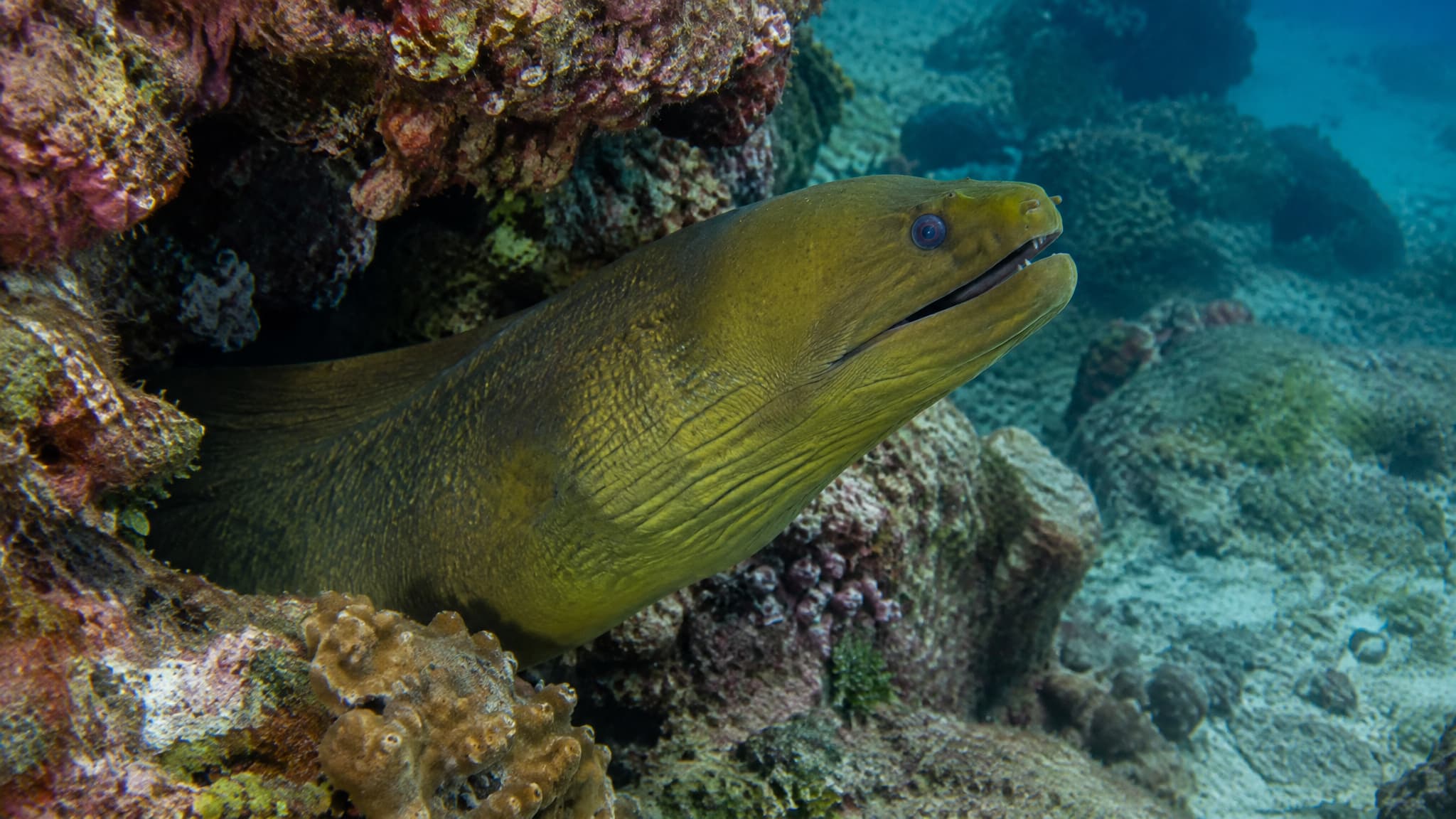
A green moray rests in a coral-reef crevice, facing right with its mouth open and elongated head and tubular nostrils clearly visible.
The green moray (Gymnothorax funebris) is a very large marine moray eel of the western Atlantic. It has an elongated, rear-compressed body, a pointed snout, strong canine-like teeth, and a dorsal fin that begins on the head and merges with the fin around the tail. Adults are generally uniform dark olive-green to brown; the green appearance is enhanced by yellowish mucus covering their skin. Individuals may reach about 2.5 m in total length and 29 kg, although many are smaller.
It occurs from the northeastern United States and Bermuda through the Gulf of Mexico and Caribbean to Brazil, with records also reported in the eastern Atlantic. Green morays are chiefly bottom-dwelling residents of shallow coastal waters, especially coral and rocky reefs, but also enter mangroves, estuaries, and occasionally brackish habitats. They usually shelter in holes, ledges, and crevices, often showing only the head while repeatedly opening the mouth to move water across the gills.
A solitary, mainly nocturnal carnivore, this eel hunts fishes, mobile crustaceans such as crabs and shrimps, and cephalopods. Its keen chemical senses help it locate prey in dark reef structure. As a sizable predator, it helps shape local food webs; it may also be cleaned by small fishes or shrimp that remove material from its skin.
Reproductive details remain incompletely known. Fertilization is external, and eggs produce transparent, leaf-shaped leptocephalus larvae that live pelagically before transforming into juvenile eels and settling into benthic habitat. Species-specific longevity has not been established reliably. The green moray is assessed as Least Concern globally by the IUCN, although population trend is unknown and the assessment notes a need for updating. Local pressures can include reef and mangrove degradation, collection, and fishing; large individuals may accumulate ciguatoxins and should not be assumed safe to eat.