Guppy
Poecilia reticulata
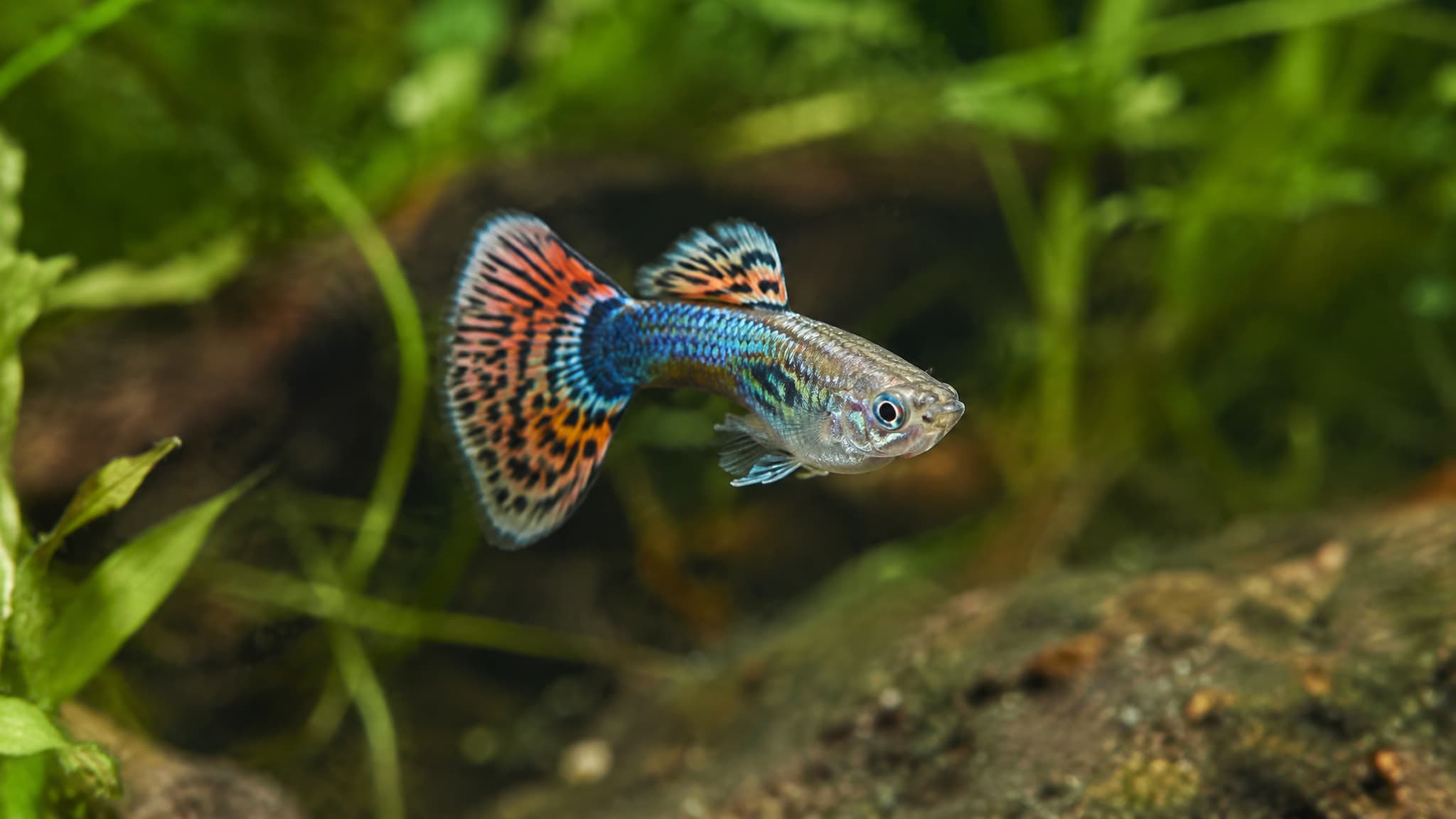 AI-generated
A colorful male guppy is shown in right-facing side profile, swimming among aquatic plants and rocks in an aquarium. Its large patterned fan-shaped tail, dorsal fin, and iridescent blue-green body are clearly visible. 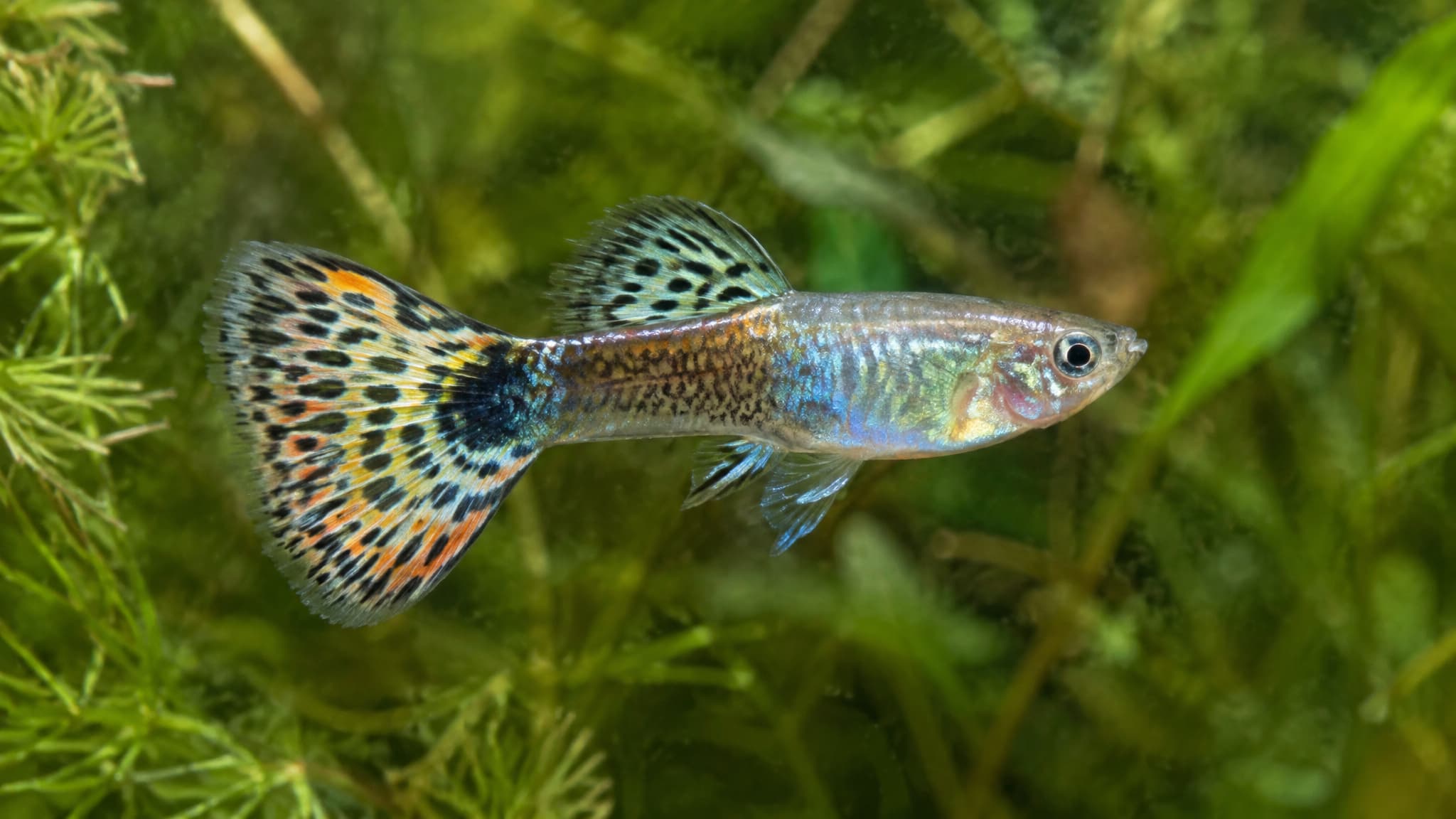 AI-generated
A guppy swims horizontally to the right in a planted aquarium, with an ornate spotted tail, translucent fins, and a shimmering blue-green body.
The guppy (Poecilia reticulata) is a small livebearing fish in the family Poeciliidae. It is also called the millionfish or rainbow fish, and it is one of the world's best-known aquarium species. The sexes look very different. Males are small and slender, with bright spots, stripes and blotches in red, orange, blue, green, yellow or black, and have large fins. Females are larger and deeper-bodied, with a plain grayish or silvery color. In males, the anal fin is modified into a gonopodium, an organ used for internal fertilization.
The species is native to northeastern South America and nearby islands, including Venezuela, Trinidad, Barbados, the Guianas and northern Brazil. Wild guppies live in many kinds of habitat, from turbid lowland ponds, ditches and canals to clear mountain streams. They usually favor small, densely vegetated streams with little predation. They mostly live in fresh water but tolerate a wide salinity range, so they can also live in brackish water. They need fairly warm water, which limits where introduced populations can survive.
Guppies are opportunistic omnivores that feed at the bottom, in midwater and near the surface. They eat small invertebrates such as insect larvae, plankton, algae and organic detritus. They are peaceful and social, and in captivity they do well in groups in planted tanks. Because males court and mate with many partners, guppies are a classic model organism for studying sexual selection, color evolution and genetics, especially in wild populations on Trinidad.
Reproduction is fast. Fertilization is internal, and females can store sperm and produce several broods from a single mating. After a pregnancy of about three to four weeks, they give birth to live, fully formed young, and they can breed all year. Neither parent cares for the young, and adults may eat their own fry. Sexual maturity comes within a few months. Guppies usually live about 2 to 3 years, and up to 5 years has been recorded.
Guppies have been introduced to every continent except Antarctica, mainly to control mosquitoes. Studies show they had little or no measurable effect on mosquito populations. Introduced populations can harm native fishes, such as small cyprinids and killifishes, through competition and predation. In its native range the species is abundant, and it is listed as Least Concern on the IUCN Red List.
In collections
Ideal water
The water this fish does best in, as kept in aquariums.
- Water type
- Freshwater
- Brackish
- Temperature
- 18–28 °C
- pH
- 7.0–8.0
- neutral to alkaline
- General hardness
- 9–19 dGH
- Carbonate hardness
- 8–20 dKH