Clay robber frog
Haddadus binotatus
 AI-generated
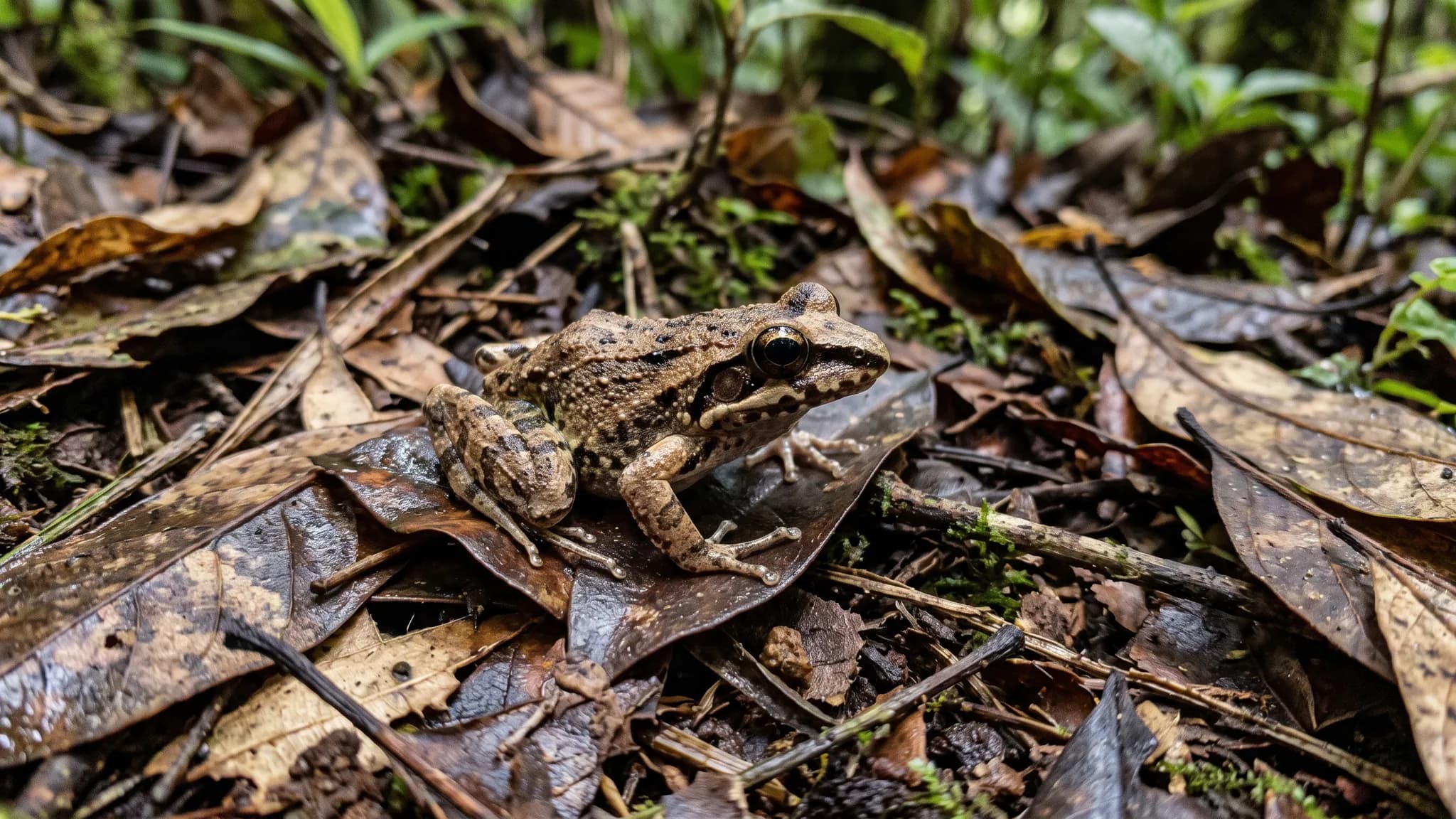
A mottled brown frog rests on wet leaf litter.
Haddadus binotatus, commonly known as the clay robber frog, is an amphibian species endemic to Brazil. Belonging to the family Craugastoridae, it was historically classified as Eleutherodactylus binotatus in the family Brachycephalidae. It was later moved to the newly established genus Haddadus based on unique morphological features, such as possessing a first finger that is notably larger than the second.
This medium-to-large frog typically measures between 35 and 65 millimeters in snout-to-vent length. Its dorsal coloration consists of beige, gray, or brown hues, serving as excellent camouflage against the dry, decomposing leaves of the forest floor. A highly distinguishing characteristic is the frequent presence of a pair of small black spots aligned symmetrically in the middle of its back, which directly inspired its specific epithet, binotatus.
As a strictly forest-dwelling species, the clay robber frog is widely distributed throughout the Brazilian Atlantic Forest biome. Its extensive geographic range extends from the southern region of Bahia down to Rio Grande do Sul. Predominantly terrestrial, this frog inhabits the dense leaf litter on the forest floor, although it is occasionally observed resting on low vegetation within the interior or along the edges of both primary and mature secondary forests.
Haddadus binotatus is an opportunistic predator with a varied diet, targeting energy-dense prey suited to its relatively large body size. Studies analyzing stomach contents indicate it preys on at least 19 different types of invertebrates, with orthopterans (grasshoppers and crickets), blattodeans (cockroaches), coleopterans (beetles), and spiders forming the bulk of its diet. Behaviorally, it employs a distinct defense mechanism: when physically touched or handled by a predator, the frog is known to urinate to startle and deter the attacker.
The reproductive strategy of this species is notable because it completely bypasses the aquatic tadpole stage through direct development. Females deposit large eggs into terrestrial nests hidden among fallen leaves or under decaying logs, and the offspring hatch fully formed as miniature adult frogs. Because it thrives in both primary and secondary forests and remains highly abundant despite historical habitat loss in the Atlantic Forest, the species is classified as Least Concern (LC) by the IUCN and Brazil's ICMBio.