Harlequin Rasbora
Trigonostigma heteromorpha
 AI-generated
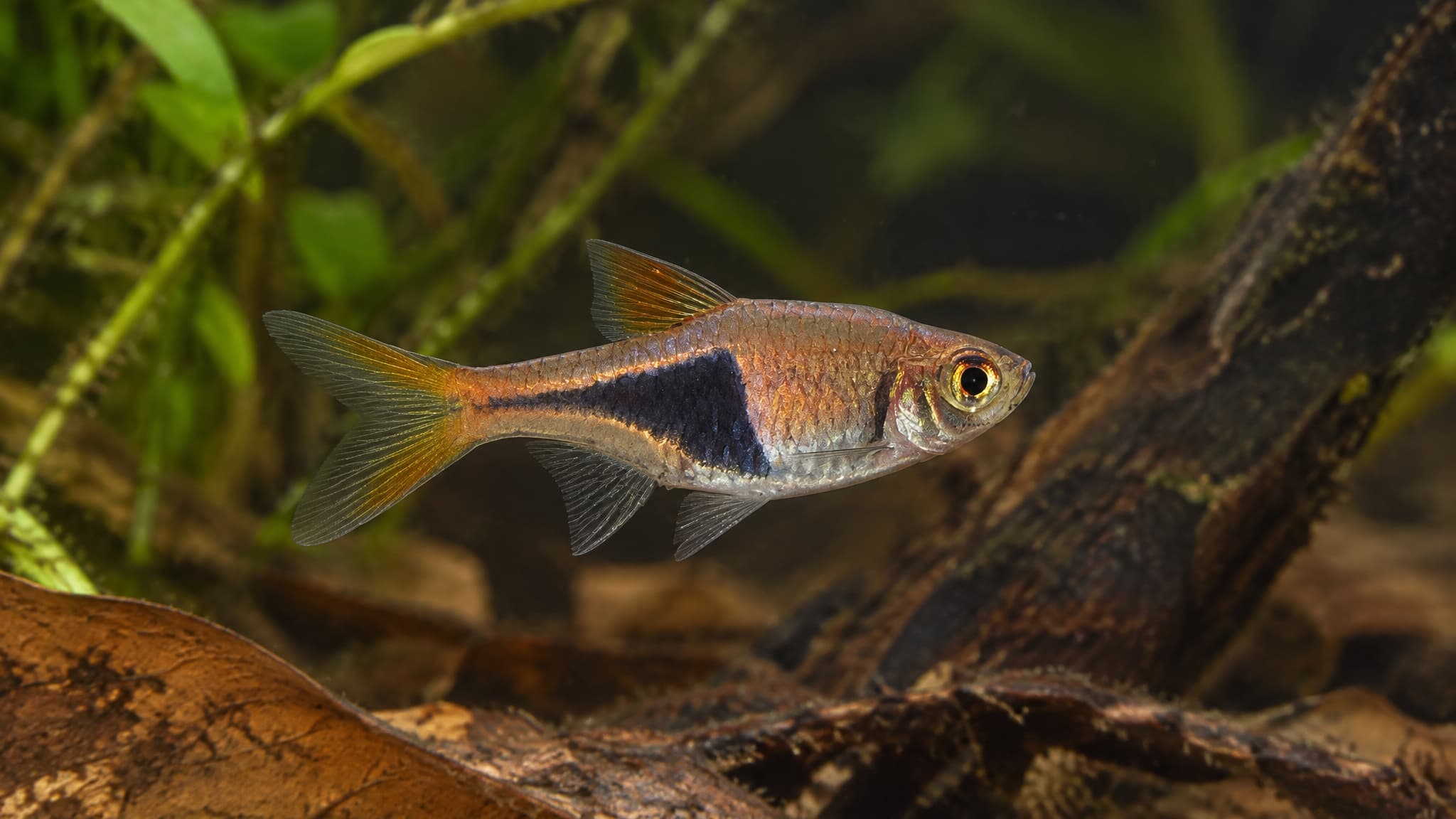
A Harlequin Rasbora is shown in clear side profile, swimming in a planted freshwater aquarium above submerged wood, with a copper-brown body, dark triangular flank patch, translucent fins, and a prominent eye.
The harlequin rasbora (Trigonostigma heteromorpha) is a small, deep-bodied freshwater fish in the family Danionidae, subfamily Rasborinae. It reaches about 5 cm in total length. Its body is a coppery to pinkish orange with a silvery sheen. The best-known mark is a dark, wedge-shaped patch on the rear half of the flank that narrows toward the tail base. This mark gives the genus its name, which comes from the Greek words for "three corners" and "signal". Compared with its close relatives T. espei and T. hengeli, this species has the deepest body and the broadest, darkest triangle. It was first described as Rasbora heteromorpha in 1904 and was moved to Trigonostigma in 1999.
The species lives in Southeast Asia, from southern Thailand through Peninsular Malaysia and Singapore to Sumatra. The type locality is in the Malaysian states of Negeri Sembilan and Selangor. It lives in forest streams and peat swamp forests. Waterlogged soil there slows the decay of leaf litter, so humic acids leach into the water. The result is tea-stained blackwater that is soft, acidic and low in minerals.
Harlequin rasboras are peaceful schooling fish that swim near the surface and in midwater. In primary peat swamps they have been recorded in schools of more than 100 fish. They feed mainly on worms, small crustaceans and insects. FishBase estimates a trophic level of about 3.3, which places them among the small predators of invertebrates in their streams.
The harlequin rasbora breeds in a way that sets its genus apart. Most rasboras scatter their eggs, but this species lays adhesive eggs on the underside of broad leaves, such as those of Cryptocoryne or Aponogeton. The pair turns upside down beneath the leaf and releases about 6 to 12 eggs each time. They repeat this many times during one spawning. No one has measured the species' lifespan systematically, but well-kept aquarium fish are reported to live about five to eight years.
The IUCN Red List classifies the species as Least Concern. FishBase rates it as highly resilient and only slightly vulnerable to fishing. The fish was first exported for aquariums in the early 1900s and is still one of the classic species of the hobby. In the wild it depends on intact peat swamp forests and the soft, acidic water they produce.
In collections
Ideal water
The water this fish does best in, as kept in aquariums.
- Water type
- Freshwater
- Temperature
- 22–25 °C
- pH
- 5.0–7.0
- acidic to neutral
- General hardness
- 5–12 dGH