Roman Snail
Helix pomatia
 AI-generated
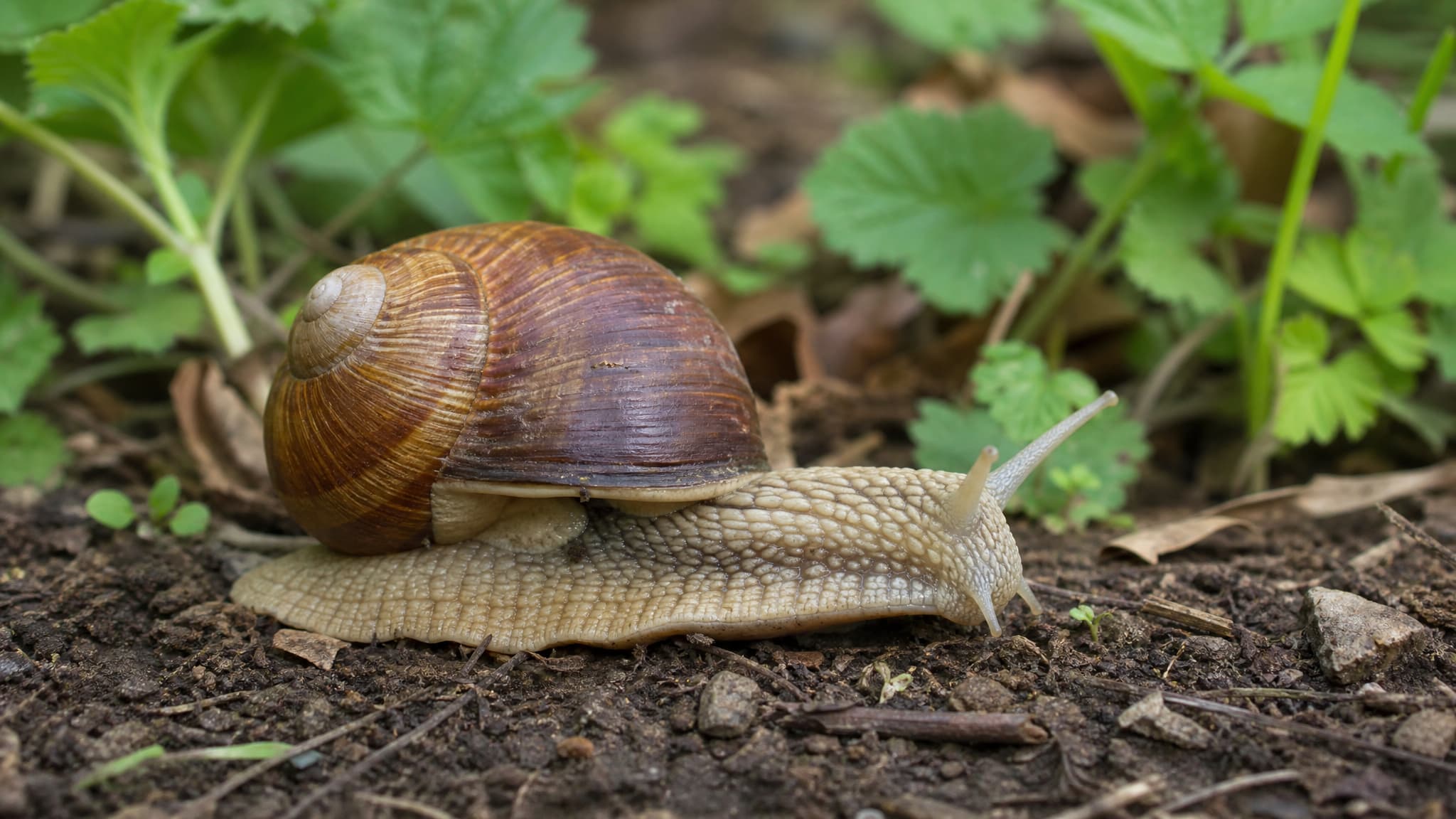
A Roman snail crawls across dark soil beneath green foliage, with its rounded brown, banded shell and extended upper tentacles clearly visible.
Helix pomatia, commonly known as the Roman snail, Burgundy snail, or escargot (specifically Escargot de Bourgogne in France), is a large, air-breathing terrestrial gastropod mollusk belonging to the family Helicidae. It is one of Europe's largest terrestrial land snails, best identified by its robust, globular shell that typically measures 30 to 50 millimeters in both height and width. The shell exhibits a creamy white to yellowish-brown or light brown coloration, generally accented with three to five pale or darker spiral bands. Upon reaching adulthood, the shell features four and a half to five whorls. The snails possess a muscular foot that secretes mucus to facilitate low-friction movement, as well as two pairs of tentacles on their heads—the upper pair is equipped with simple eyes for light detection, and the lower pair utilizes chemoreceptors to sense taste and smell.
Native to the temperate regions of Central, Western, and Southeastern Europe, the Roman snail thrives in a variety of environments, including deciduous forests, vineyards, hedgerows, scrublands, and overgrown gardens. A fundamental ecological requirement for their habitat is the presence of friable, limestone-based (calcareous) soils, as calcium carbonate is essential for the healthy development and maintenance of their large shells. Although indigenous to mainland Europe, the species was historically introduced to other regions, notably parts of North America and the United Kingdom, where they were purportedly brought by the Romans.
As nocturnal and crepuscular herbivores, Roman snails forage predominantly from sunset to midnight, fulfilling a role as primary consumers. Their diet consists of leaves, fruits, flowers, and decaying plant matter. To survive the freezing winter months, H. pomatia undergoes hibernation. The snails burrow into loose soil, position their shell opening upwards, and secrete a thick, calcareous mucus plug called an epiphragm to seal themselves safely inside until spring.
Like many land snails, H. pomatia are simultaneous hermaphrodites, meaning each individual possesses both male and female reproductive organs. Mating takes place in the spring and involves an elaborate courtship process that can last several hours, famously culminating in the exchange of a calcareous "love dart" that stimulates reproduction. Following copulation, a snail will dig a shallow underground chamber to lay a clutch of 30 to 65 eggs, which hatch into miniature snails after three to four weeks, eventually growing and surviving multiple winters into adulthood.
Globally, the International Union for Conservation of Nature (IUCN) assesses Helix pomatia as a species of "Least Concern" due to its widespread distribution. However, localized populations have faced steep declines due to intensive agricultural practices, habitat destruction, and historical over-harvesting for the food industry. Consequently, the species is legally protected in various European nations; France strictly prohibits commercial collection during the spring breeding season, and the UK fully protects it under Schedule 5 of the Wildlife and Countryside Act 1981. Highly revered as a gourmet delicacy, the modern escargot industry balances culinary demand with conservation by relying on highly regulated seasonal wild harvesting and sustainable snail farming known as heliciculture.