Glowlight tetra
Hemigrammus erythrozonus
 AI-generated
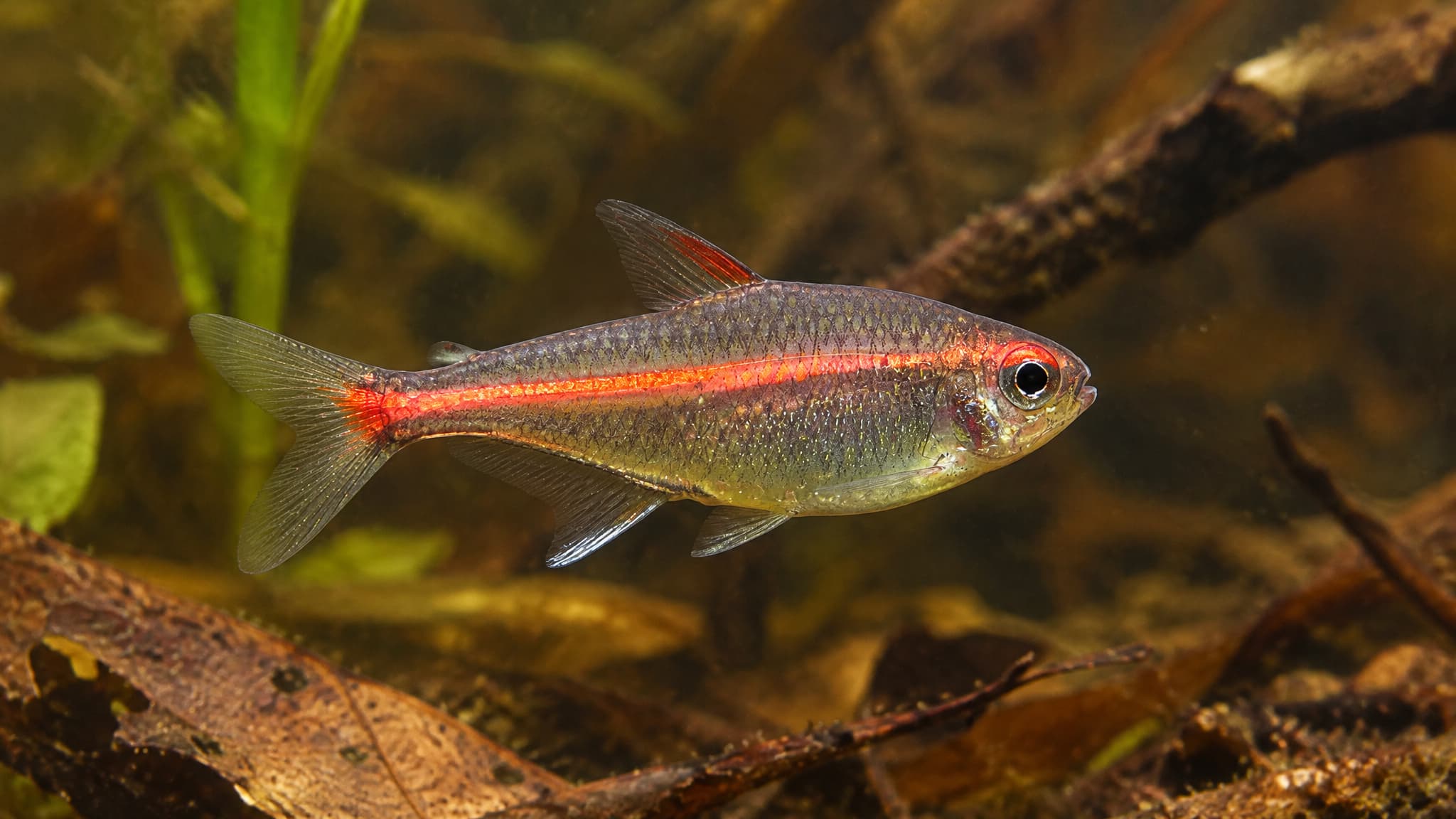
A Glowlight tetra is shown in right-facing side profile, swimming in a planted aquarium among driftwood and leaf litter; its translucent fins and bright orange-red lateral stripe are clearly visible.
The glowlight tetra (Hemigrammus erythrozonus) is a small South American characin described by Marion Durbin in 1909 and one of the most familiar tetras in the aquarium hobby. It belongs to the order Characiformes and, under the 2024 reclassification of the American tetras followed by FishBase, to the family Acestrorhamphidae, although many aquarium references still list it under Characidae. The genus Hemigrammus is widely regarded as in need of revision, so its generic placement may change in the future.
Its common name comes from the glowing orange-red stripe that runs along the flank from the snout to the base of the tail, set against a translucent silvery body; the other fins are silvery to clear. FishBase gives a maximum total length of 3.3 cm while noting that figure is questionable, and Seriously Fish gives a maximum standard length of 4 cm, with some sources citing up to 5 cm. Mature females are rounder in the belly and tend to grow slightly larger than males.
In the wild the species is known mainly from the Essequibo River basin in Guyana, and Wikipedia also mentions the Courantyne River on the border with Suriname. It lives in forested tributaries away from the main channel, where the water is stained dark brown by tannins from decaying plant matter and is often strongly acidic. Wild fish are not exported; the fish sold in the trade are bred in large numbers on commercial farms.
The glowlight tetra is a peaceful, lively shoaling fish that is best kept in groups. FishBase lists worms, small crustaceans and plant material in its diet, and Wikipedia notes that wild fish eat aquatic insect larvae, so it is treated as an omnivorous micro-predator. In aquariums it accepts almost any small food, from flakes and granules to live or frozen bloodworm, Daphnia and brine shrimp.
It is an egg scatterer that gives no parental care, and adults readily eat their own eggs. A typical spawning produces 120 to 150 eggs, usually laid among fine-leaved plants in soft, acidic, dimly lit water. The eggs hatch in about 24 to 36 hours and the fry become free-swimming 3 to 4 days later. Lifespan figures come only from aquarium sources, which give 2 to 4 years or 3 to 5 years.
The IUCN assesses the glowlight tetra as Least Concern. FishBase rates its resilience as high and its vulnerability to fishing as low, and because the aquarium trade relies on captive-bred fish, collection places little pressure on wild populations.
Ideal water
The water this fish does best in, as kept in aquariums.
- Water type
- Freshwater
- Temperature
- 24–28 °C
- pH
- 6.0–8.0
- acidic to alkaline
- General hardness
- 5–12 dGH