Longsnout seahorse
Hippocampus reidi
 AI-generated
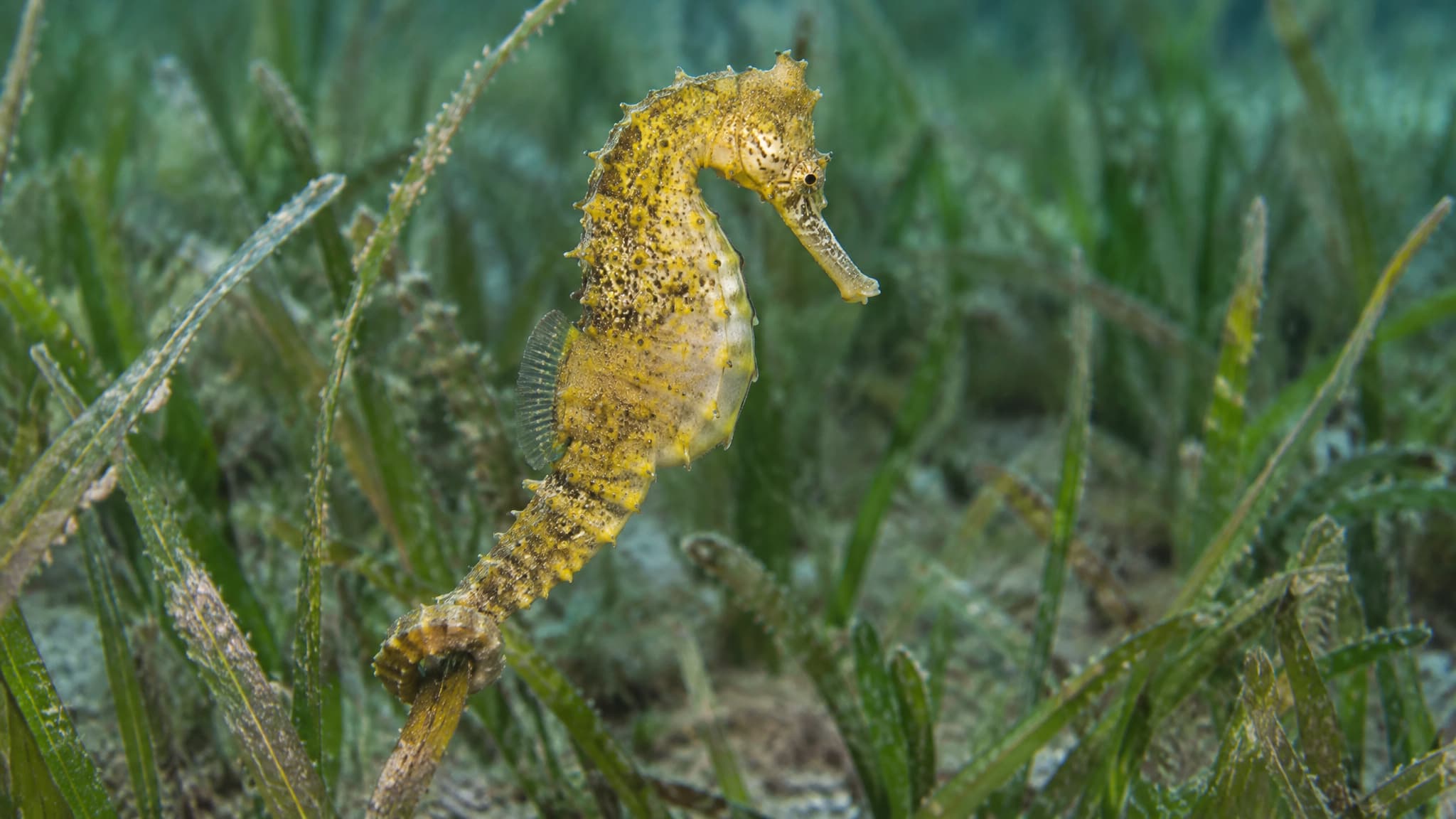
A yellow, spiny seahorse holds an upright, curled posture with its tail wrapped around seagrass in a shallow underwater meadow; its elongated snout, prominent eye, bony rings, and small dorsal fin are visible.
The longsnout seahorse (Hippocampus reidi) is a distinctive western Atlantic ray-finned fish in the pipefish and seahorse family, Syngnathidae. Its upright body is encased in bony rings and ends in a grasping, finless tail used to anchor it to vegetation and other underwater holdfasts. Adults have a narrow body, a long, sturdy snout, a rounded or sometimes convoluted coronet on the head, and generally low, rounded spines. They may reach about 17.5 cm in height.
Color is highly variable—black, yellow, orange, red, brown, or pale—and individuals commonly show dark spotting and small white dots, especially on the tail. This camouflage can change rapidly to match nearby structure. Its slender build and long snout help distinguish it from the lined seahorse (H. erectus), which is typically deeper-bodied and has a more angular, spiny coronet.
The species occurs in the western Atlantic, from North Carolina and Bermuda through the Caribbean and along the coast of South America to southern Brazil. It occupies shallow coastal waters, including seagrass beds, mangroves, gorgonian and coral areas, macroalgal beds, estuaries, and floating Sargassum. A weak swimmer, it usually remains attached to a support and is most often active in daylight.
Longsnout seahorses are ambush predators. Their toothless tubular snout produces suction that draws in small live prey, particularly shrimp, amphipods, mysids, zooplankton, and other small crustaceans; prey is swallowed whole. In turn, camouflage and bony armor may deter predators, although larger fishes and rays can eat them. By feeding on small crustaceans in structured coastal habitats, they form part of nearshore food webs.
Pairs may maintain strong bonds, with elaborate courtship involving color changes, pouch displays, and coordinated swimming. The female transfers eggs into the male's brood pouch, where fertilization and development occur; after roughly two weeks, the male releases fully formed young. Reported lifespan is commonly one to four years. Globally, the species is Near Threatened because populations are declining under pressure from habitat degradation, bycatch, and collection for aquaria, curios, and traditional uses; all seahorses are included in CITES Appendix II.