Hogfish
Lachnolaimus maximus
 AI-generated
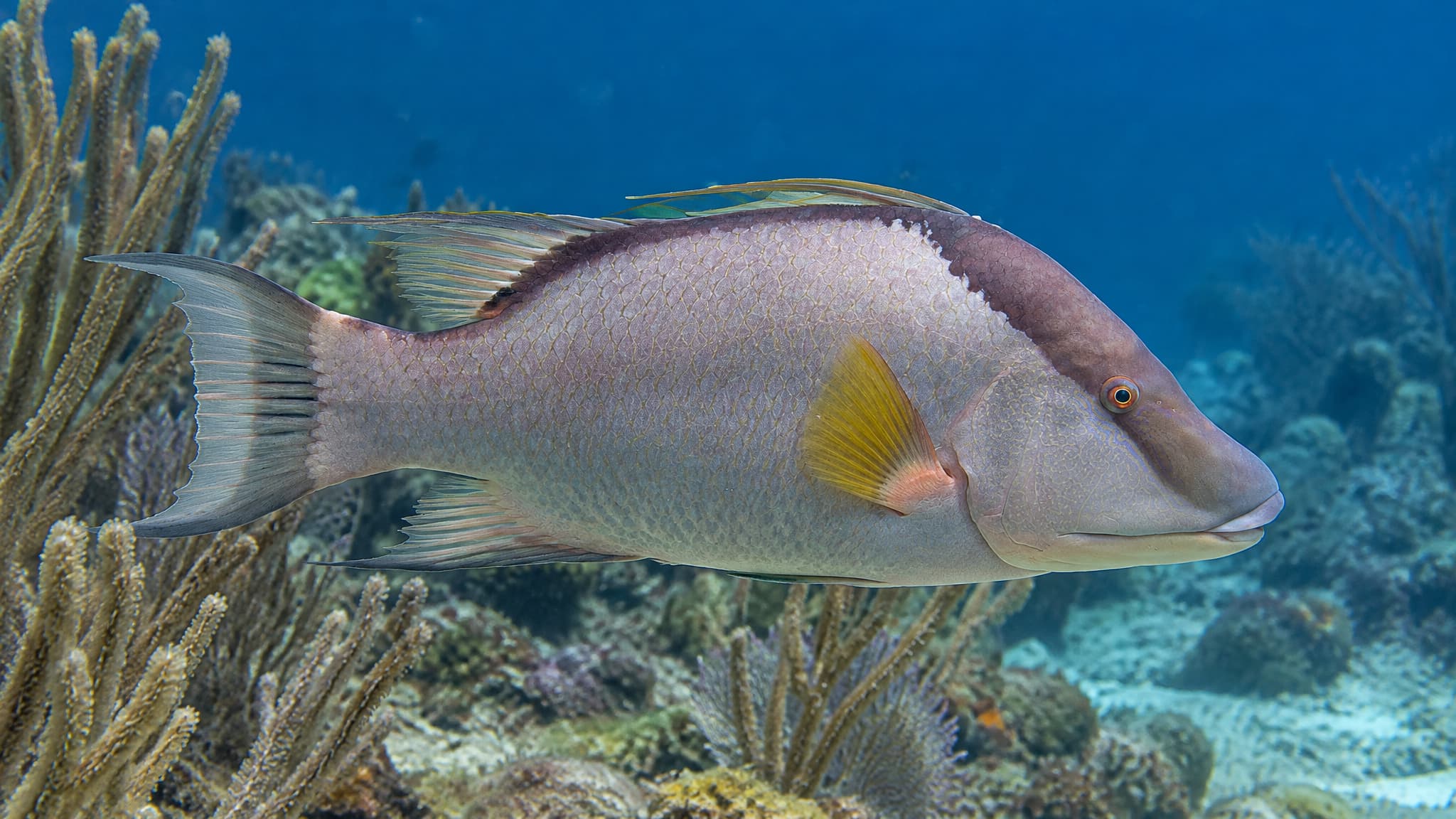
A hogfish swims horizontally to the right above a coral reef, showing a deep, scaled body, elongated pig-like snout, thick lips, and a yellow pectoral fin. Its long dorsal fin and forked tail are visible against the blue water.
The hogfish (Lachnolaimus maximus) is the largest wrasse in the western Atlantic and the only living member of its genus. Its body is deep, strongly flattened from side to side and oval in outline. Adults have a long, pig-like snout. The first three spines of the dorsal fin are greatly lengthened into filaments, and there is a dark blotch near the rear of the dorsal fin. The tail has extended upper and lower lobes, and the iris is bright red. Adults can reach about 90 cm in length and roughly 11 kg in weight.
The species is native to the western Atlantic, from Nova Scotia south through Bermuda, the Gulf of Mexico and the Caribbean to northern South America. Adults live over open sandy or rubble bottoms and around coral reefs, and they are often found where gorgonians (sea fans) are plentiful. Larvae drift in the plankton for about four weeks, then settle in shallow inshore nursery areas such as seagrass beds.
Hogfish feed mainly on mollusks, and also eat crabs, sea urchins and other bottom invertebrates. They use their long snout to root through sediment for buried prey, and this rooting behavior gave the fish its common name. Like other wrasses, the hogfish can change color quickly. Researchers have found light-sensitive opsin proteins in its skin, which may help it track its own color changes.
The hogfish is a protogynous hermaphrodite: every fish starts life as a female, and some later become males. A dominant male defends a territory and a harem of about 5 to 15 females, spawning with each one in the late afternoon. In Florida waters the breeding season runs from about November to June. The eggs float freely and get no parental care. Many fish live around 11 years, but stock assessments have recorded individuals as old as 23.
As a predator of bottom invertebrates, the hogfish helps shape the invertebrate communities on reefs and hard bottoms. Its flesh is highly prized, so it is targeted by both commercial and recreational fishers, especially spearfishers. Eating it has occasionally been linked to ciguatera poisoning. Fishing pressure has led the IUCN to list it as Vulnerable, and catches in US waters are regulated.