Baltic isopod
Idotea balthica
 AI-generated
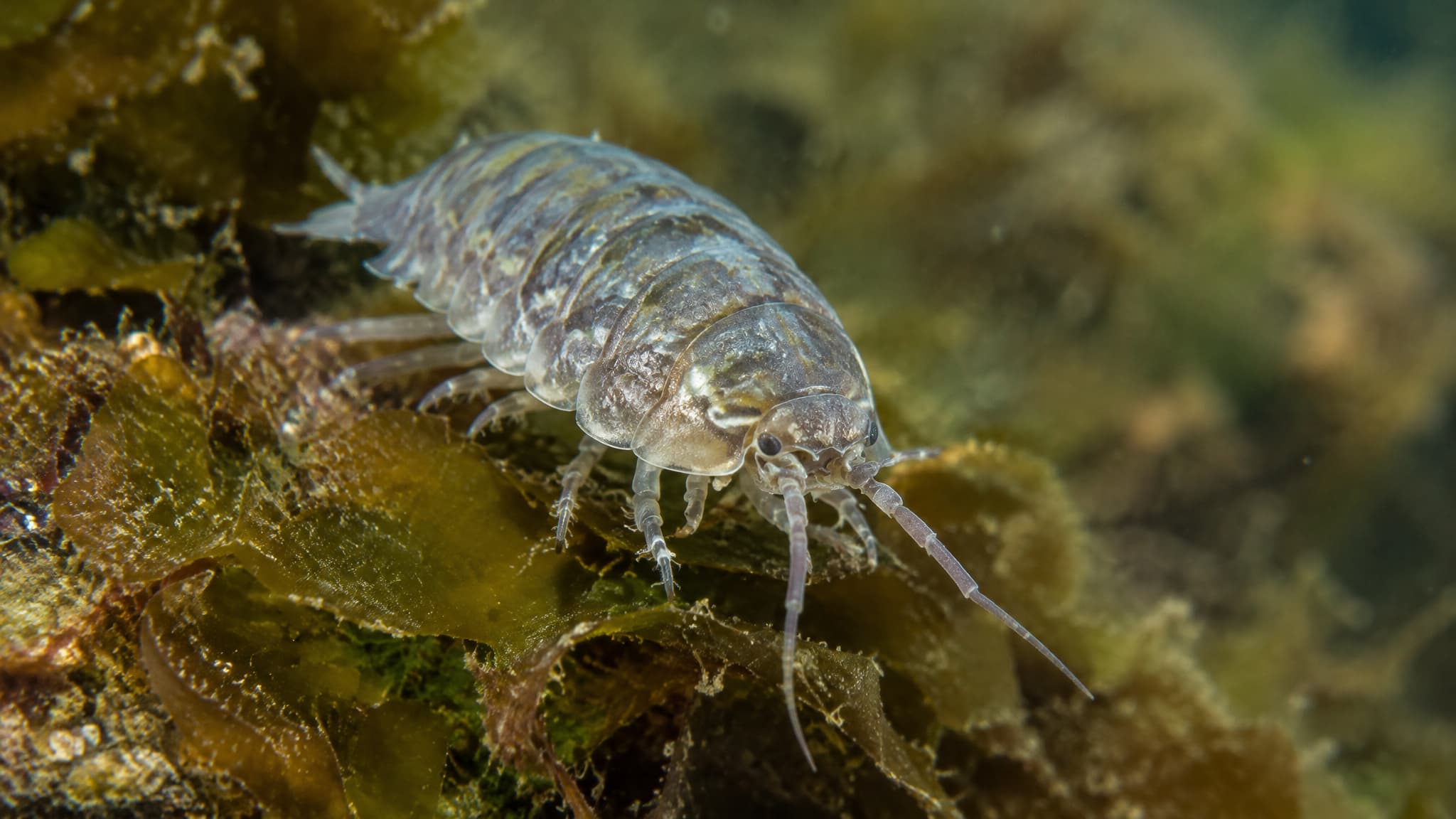
A Baltic isopod crawls across brown-green seaweed underwater, showing a segmented body with overlapping side plates, dark eyes, and long antennae.
The Baltic isopod (Idotea balthica) is a small marine crustacean of the family Idoteidae, also known as the smooth seaweed isopod. Its body is flattened and oblong-oval, with two eyes, short antennules and a pair of antennae. Adults are recognized by the tail-piece (pleotelson), which ends in three points with the middle one longest; these points appear only as the animal grows. Males are usually 1 to 3 cm long and can reach about 4 cm, while females stay under about 1.8 cm.
Colour is famously variable. Individuals range from plain green or brown to patterns with white spots, stripes or black and silver markings, and females are often darker than males. The isopod can also lighten or darken by expanding or contracting its pigment cells. Predation by fish and crabs is thought to help maintain this colour polymorphism, which keeps the animals hidden against seaweed.
The species lives along temperate coasts of the North Atlantic, from northern Norway and the inner Baltic Sea south to the Mediterranean and Black Sea, and it is also recorded on the North American side of the Atlantic. It is mainly subtidal but also occurs on the lower shore, down to about 60 m, clinging to seaweeds and seagrasses on rocky shores and in lagoons. In the brackish Baltic it is most common in thick belts of bladder wrack (Fucus vesiculosus) and in eelgrass beds.
The Baltic isopod is a grazer that feeds mostly on brown and green algae and seagrass, and it can live on bladder wrack alone. It tends to stay hidden by day and move between patches of algae at night to find food or mates, balancing food intake against the risk of being eaten. Males move around more and take greater risks than females.
Males compete for females, and larger males usually win. A male guards a female by carrying her for several days before her moult, when she becomes ready to mate, although females often resist and influence the outcome. Eggs are brooded in a pouch under the female's body and hatch as small juveniles, with no free-swimming larval stage. In the Baltic, breeding takes place in the warmer months.
In the species-poor Baltic Sea it is one of the most important herbivores, and dense populations can graze bladder wrack heavily, while it is also key food for fish such as herring and perch. It has not been assessed by the IUCN, but warming and falling salinity in the Baltic, along with the loss of seagrass beds, may threaten local populations.