Japanese Giant Salamander
Andrias japonicus
 AI-generated
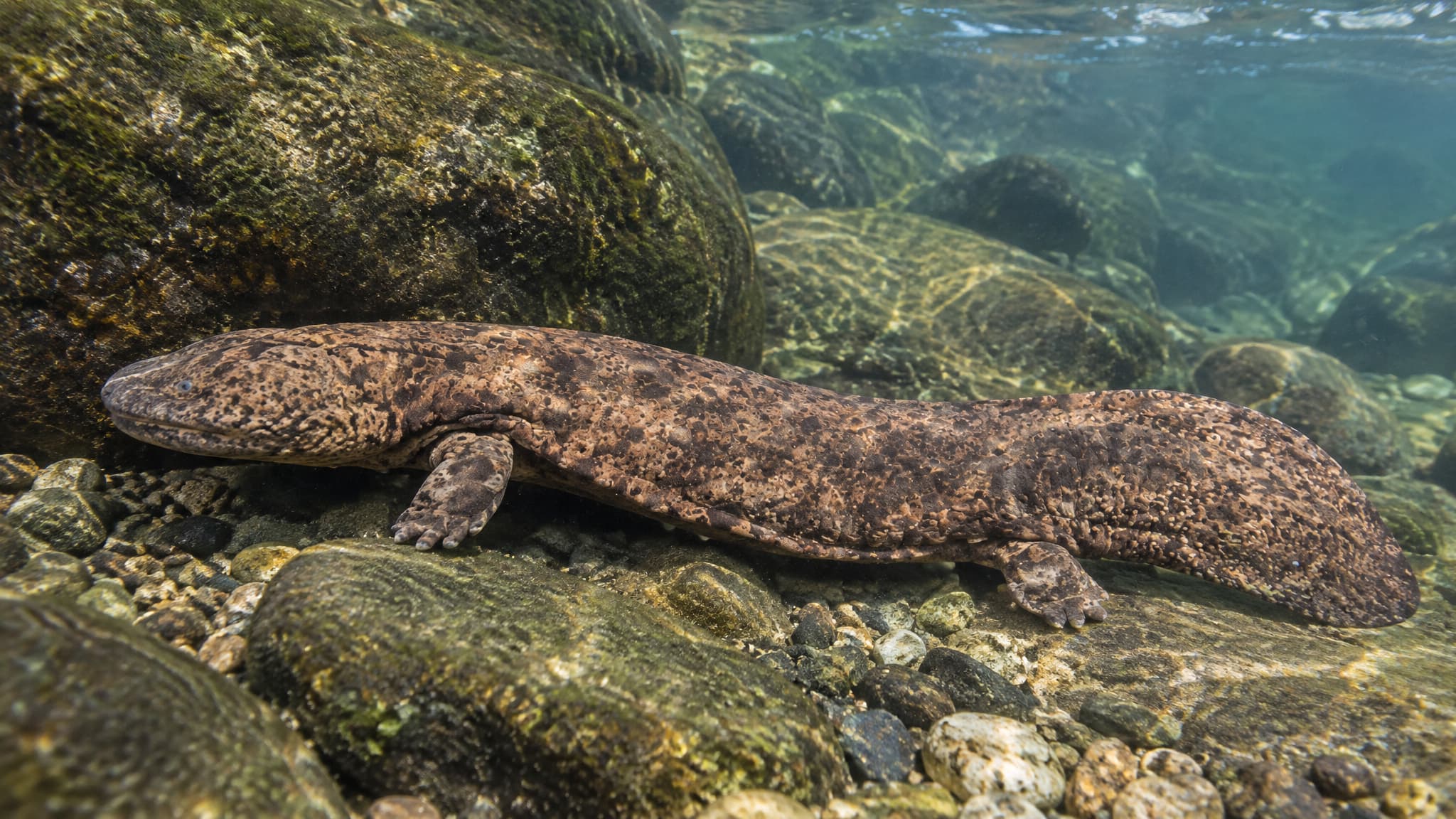
A Japanese giant salamander lies horizontally on the rocky bed of a clear stream, with its broad flattened head to the left, small visible eye, short limbs, and long tapering tail extending to the right. Its mottled brown skin and rounded body folds are clearly visible underwater.
The Japanese giant salamander (Andrias japonicus) is one of the largest living amphibians. Together with its Chinese relatives, it belongs to the family Cryptobranchidae. Adults can reach about 1.5 m in length and weigh up to about 25 kg. The body is heavy and flattened, the head is broad and flat, and the mouth is wide. The wrinkled skin is covered in tubercles and is mottled reddish-brown to dark brown, which helps it blend in with rocky stream beds. Adults have no external gills and breathe mostly through their skin.
The species is endemic to Japan. It lives in western Honshu, from around Gifu Prefecture westward, and in parts of Shikoku and northern Kyushu. It is fully aquatic and stays in water its whole life. It lives in cool, clear, well-oxygenated streams and rivers, from small headwater creeks to larger river channels. The range is badly fragmented.
The Japanese giant salamander is nocturnal and mostly stays in one area outside the breeding season. It walks along the stream bottom and uses side-to-side body movements for quick bursts of speed. It is a generalist predator that eats freshwater crabs and other crustaceans, fish, insects, worms, frogs and sometimes small mammals. It catches prey by opening its mouth suddenly to suck it in. Its metabolism is very slow, so it can go weeks without eating. When threatened, it can release a strong-smelling milky secretion.
Breeding takes place in late August and September. Large males called den-masters take over burrows in stream banks and defend them against other males. Females lay strings of several hundred eggs inside these burrows, and more than one female may use the same den. The den-master guards the eggs and fans them with his tail to supply oxygen. The larvae hatch after about 40 to 60 days, depending on water temperature. This salamander grows slowly throughout its life and can live for more than 50 years.
As a top predator in mountain streams, it helps control populations of invertebrates, fish and amphibians. The IUCN lists it as Vulnerable. Main threats include dams and weirs that block its migrations, river engineering and habitat loss. A serious and growing threat is hybridization with introduced Chinese giant salamanders, especially around Kyoto. The species has been protected in Japan for decades and is a designated Special Natural Monument.