Lined Seahorse
Hippocampus erectus
 AI-generated
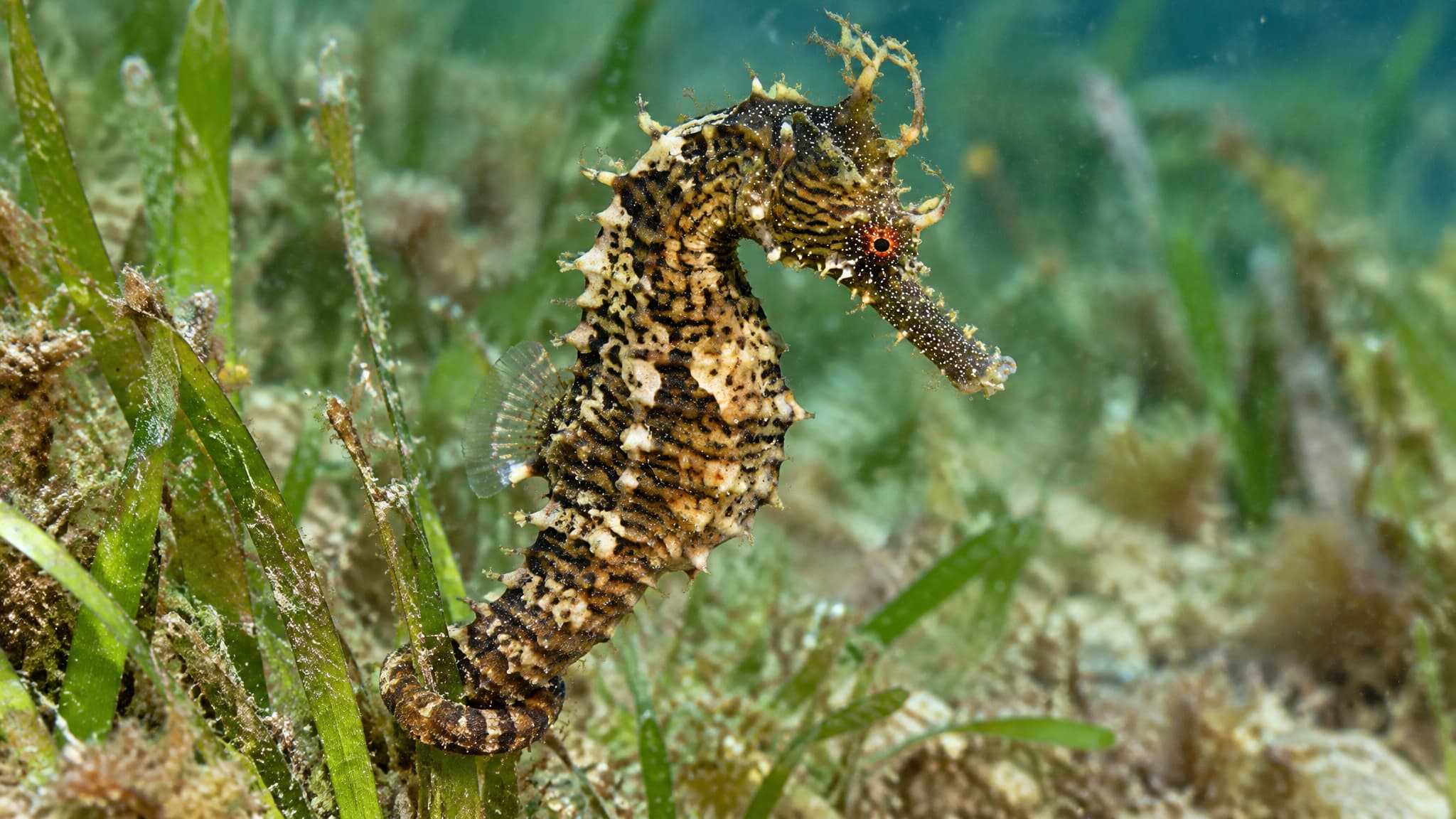
A lined seahorse is shown in profile, upright among seagrass, with its curled tail wrapped around a blade. Its elongated snout, spiny body, mottled dark-and-gold patterning, and small dorsal fin are clearly visible.
The lined seahorse (Hippocampus erectus), also called the northern or spotted seahorse, is one of the larger seahorses of the Atlantic. Adults usually measure about 15 cm, and some reach roughly 18 cm. Like all seahorses, it has an upright body covered in bony plates, a head that looks like a horse's, a tube-shaped snout and a tail that can grip. It gets its name from the fine pale lines that often run along its neck. Its colour varies widely, from grey and black to orange, red, green or yellow, and it can change shade to match its surroundings.
The species lives along the western Atlantic. Its range runs from Nova Scotia and Cape Cod through the Gulf of Mexico and the Caribbean down to Brazil and Argentina. It is a strictly marine, bottom-dwelling fish. It lives in seagrass beds, floating and attached seaweed, mangrove roots, sponges and coral or rocky reefs. It is most common in shallow water but has been recorded down to about 100 m.
The lined seahorse is active by day and swims weakly. It moves mainly by fluttering its dorsal fin and steering with its pectoral fins. Most of the time it holds onto seaweed or other structures with its tail. It hunts by ambush: when small crustaceans and other tiny invertebrates drift past, it sucks them in with a quick snap of its snout. Young seahorses feed almost nonstop and may eat thousands of tiny shrimp in a single day.
As in all seahorses, the male carries the young. During courtship the pair make clicking sounds. The female then places a few hundred eggs, typically about 250 to 650, into the male's brood pouch. He fertilizes and protects them until fully formed miniature seahorses are born. The young get no further care after birth. Lifespan is short, generally about one to four years.
As a small predator, it helps control populations of small crustaceans. In turn, it is eaten by larger fish, crabs and seabirds. It is also a useful sign of how healthy seagrass and other coastal habitats are.
The IUCN lists H. erectus as Vulnerable. Threats include accidental capture in shrimp trawls, harvesting for the dried traditional-medicine trade and the live aquarium trade, and damage to seagrass and other coastal habitats. International trade is regulated under CITES Appendix II.