Common Earthworm
Lumbricus terrestris
 AI-generated
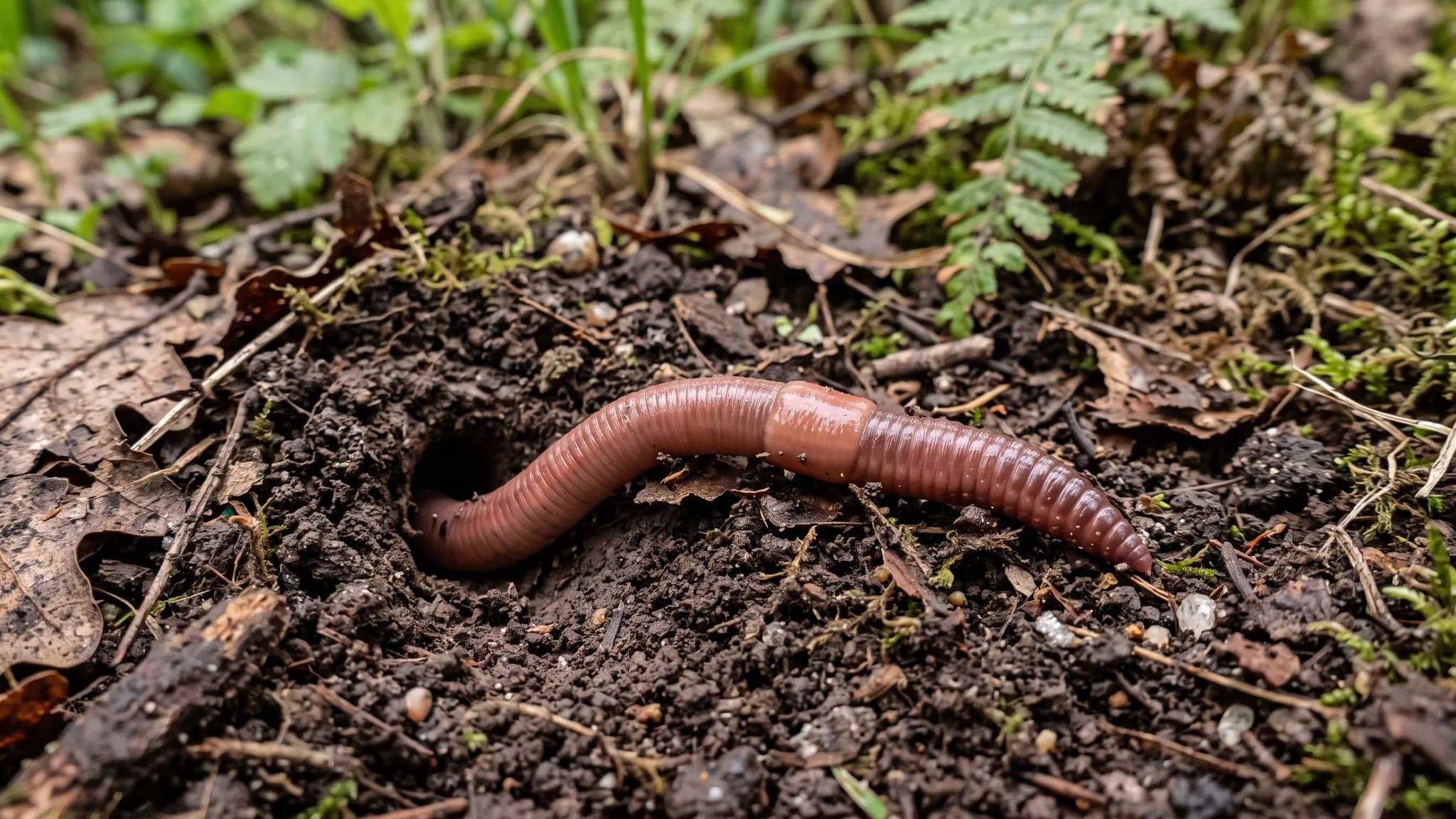
A common earthworm emerging from a burrow in dark, moist soil surrounded by leaf litter and small plants.
Lumbricus terrestris, widely known as the common earthworm, lob worm, or nightcrawler, is a globally recognized species belonging to the family Lumbricidae. Adults typically reach 20 to 25 centimeters in length and feature a cylindrical body comprising approximately 150 segments. They display a brownish-red or reddish-gray coloration. Lacking eyes, limbs, and lungs, they respire directly through their moist cuticle, making a consistently damp environment vital for their survival. They possess photoreceptors at their anterior end that make them highly sensitive to light; prolonged sunlight exposure can paralyze or kill them. Sexually mature individuals are distinguished by a clitellum, a swollen, glandular band near the head crucial for reproduction.
Originally native to Western Europe, this species has become cosmopolitan. Human agricultural expansion has unintentionally introduced L. terrestris to temperate regions across the globe. As an anecic earthworm, it constructs semi-permanent, deep vertical burrows that can extend over 2 meters into the soil profile. They rely on these deep burrows to maintain humidity and facilitate gas exchange when surface conditions are dry.
Nightcrawlers are predominantly nocturnal surface foragers, a behavior that earned them their common name. They emerge at night to drag decaying organic matter—such as dead leaves, grasses, and soil humus—down into their burrows. Lacking teeth, they process these organic particles using a muscular crop and gizzard, aided by powerful digestive enzymes and symbiotic bacteria. The end product of this digestion is nutrient-rich fecal casts deposited on the soil surface.
Lumbricus terrestris is a simultaneous hermaphrodite, meaning each individual possesses both male and female reproductive organs. However, they cannot self-fertilize and must mate. Pairs align and use their clitella to secrete a mucous tube for sperm exchange. After mating, each worm produces a lemon-shaped egg capsule, or cocoon, which is deposited in the soil. These cocoons protect the developing embryos until environmental conditions trigger them to hatch as fully formed miniature juveniles.
In native and agricultural ecosystems, the common earthworm is a highly beneficial ecosystem engineer. Its bioturbation enhances soil macroporosity, aeration, water infiltration, and structural stability, while its vermicast boosts nutrient availability and microbial diversity. However, in historically earthworm-free habitats like the northern hardwood forests of North America, introduced nightcrawlers are considered an invasive threat. They rapidly consume the natural leaf litter layer, altering soil chemistry and impairing the regeneration of native plant species and microarthropod communities.