Malabar pufferfish
Carinotetraodon travancoricus
 AI-generated
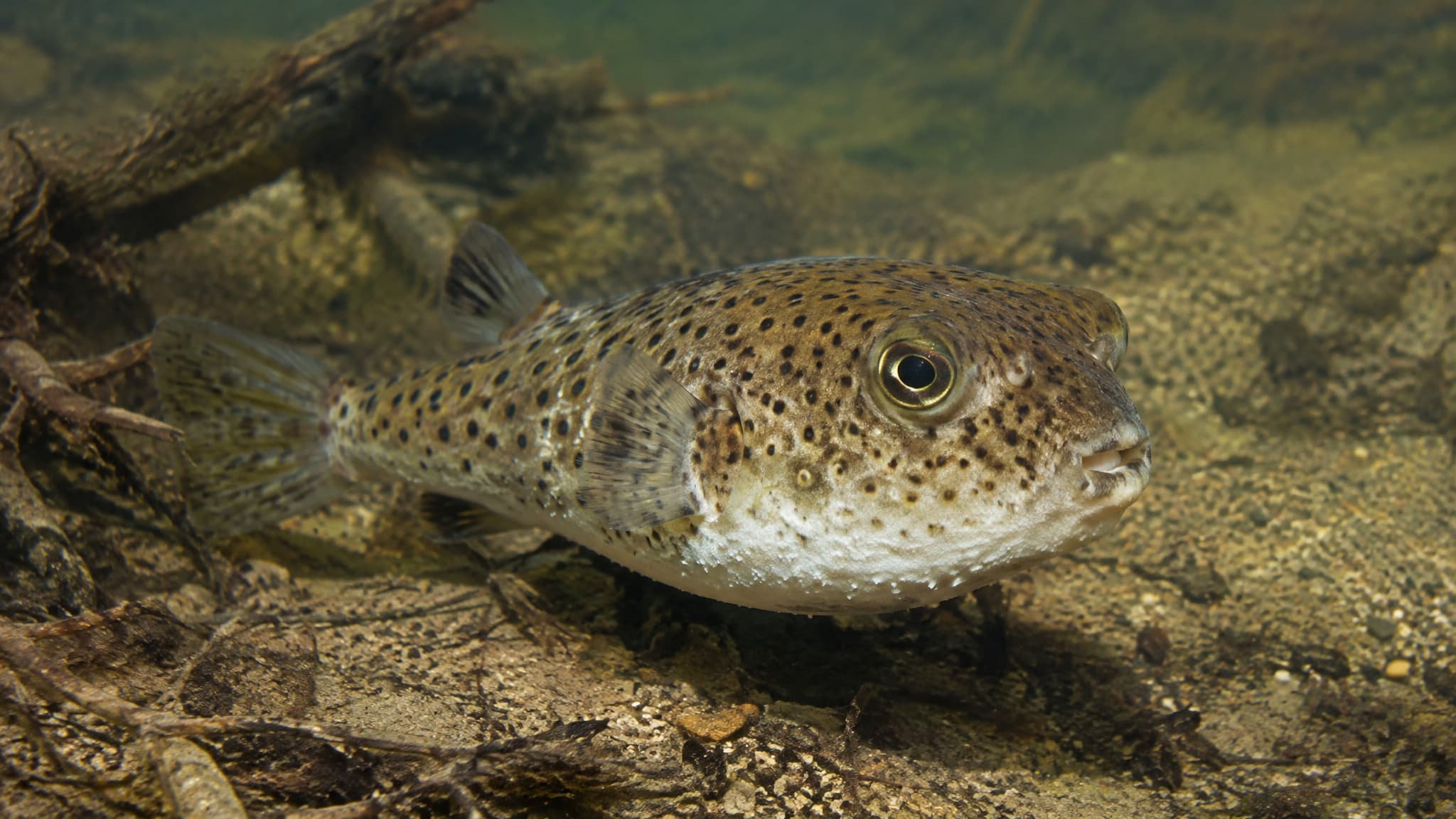
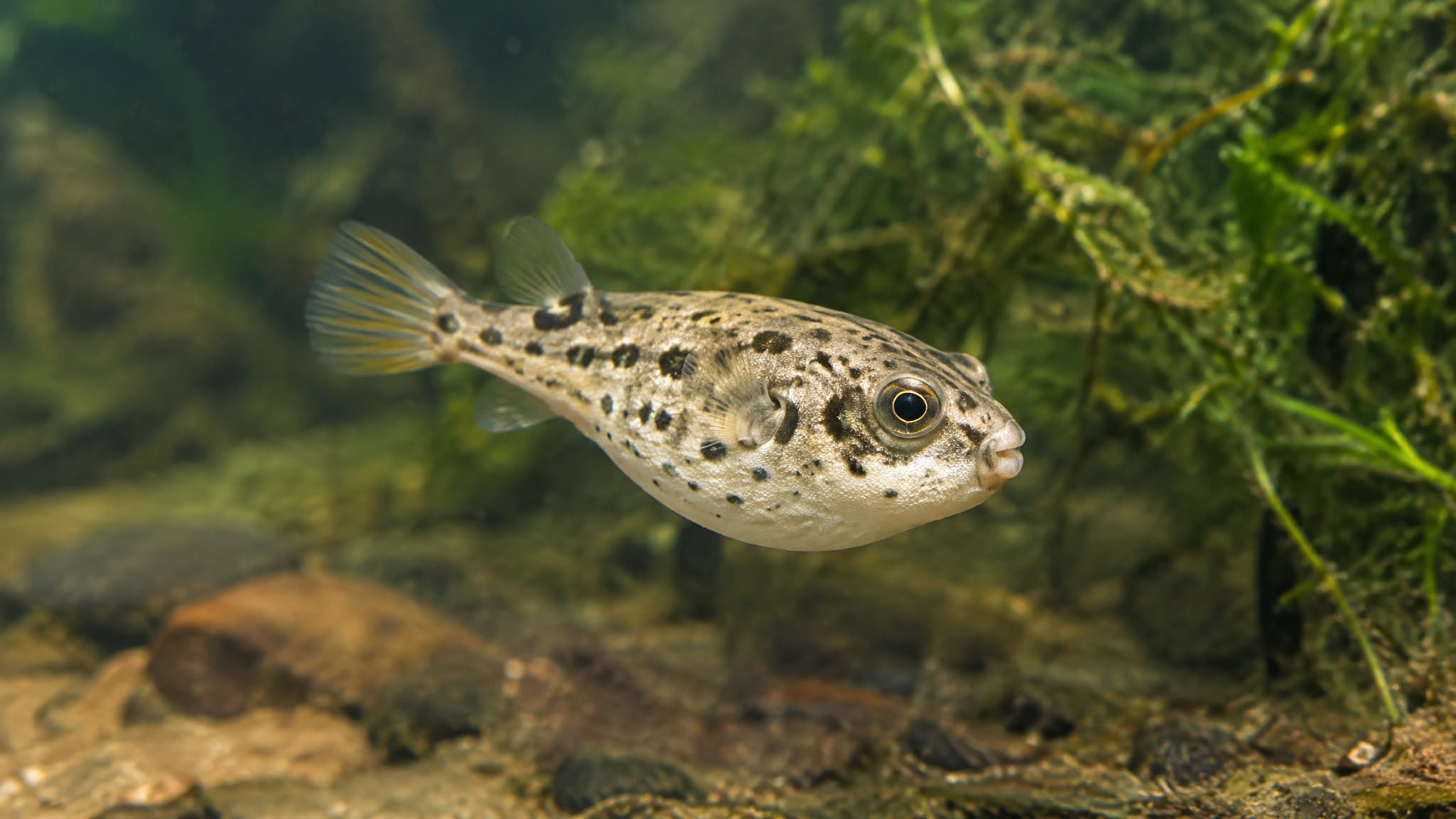
A spotted pufferfish swims to the right in a planted freshwater aquarium above a rocky substrate. Its rounded cream-gold body, prominent eye, small translucent fins, and dark blotches are clearly visible.
Identification. The Malabar pufferfish, also called the pea puffer, is a minute freshwater puffer with a compact, rounded body, large mobile-looking eyes, and a beak formed by fused teeth. It is usually under 2.5 cm long, though records reach about 3.5 cm total length. Its living coloration is variable but commonly greenish to yellowish above with irregular dark blotches or spots and a paler underside. The species is easily confused in trade with other Carinotetraodon, particularly C. imitator, so a trade name alone is not always sufficient for identification.
Range and habitat. This species is endemic to southwestern India, in rivers draining the Western Ghats. It is a tropical, demersal freshwater fish associated with riverine habitats, including areas with dense aquatic vegetation. Vegetated margins provide cover, spawning substrate, and concentrations of small food organisms.
Food and behavior. Feeding research indicates an omnivorous diet early in life, with adults showing a preference for locally produced animal prey—especially aquatic insects and crustaceans. Thus, this small fish links invertebrate production to higher levels of the freshwater food web. Its small size should not be mistaken for ecological insignificance: it is an active forager adapted to structurally complex, plant-rich waters.
Reproduction and conservation. Studies from the Pampa River found mature fish in most months, with peak spawning from May through August during the southwest monsoon. Females mature at roughly 18 mm total length and produce relatively few eggs; eggs are deposited among vegetation. Lifespan in the wild is not well established. The IUCN status is Vulnerable. Habitat alteration and collection for the international aquarium trade are documented conservation concerns, making protection of connected, vegetated freshwater habitats important for the species.