Tobacco hornworm
Manduca sexta
 AI-generated
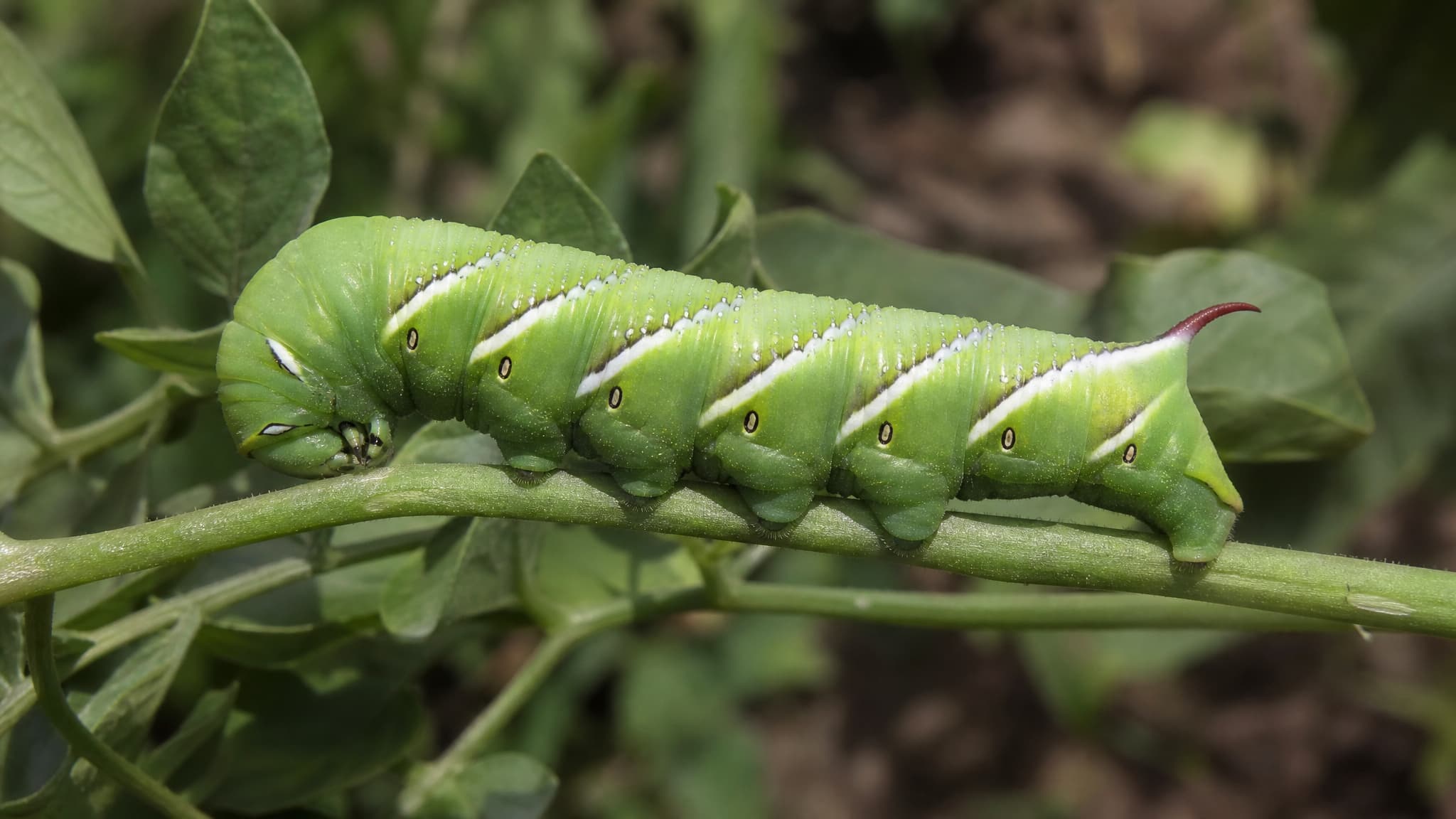
A green tobacco hornworm rests lengthwise on a plant stem, showing its segmented body, diagonal white stripes with dark edging, prolegs, and curved reddish tail horn. Leaves and soft-focus vegetation form the background.
Introduction and Identification Manduca sexta, commonly known as the tobacco hornworm in its larval stage and the Carolina sphinx moth or tobacco hawk moth as an adult, is a prominent species of moth in the family Sphingidae. The larvae are large, green caterpillars easily recognized by a pointed, reddish "horn" at their posterior end and seven diagonal white lines with black borders, which distinguish them from the closely related tomato hornworm. Upon reaching adulthood, they transform into heavy-bodied moths that mimic hummingbirds in flight, showcasing mottled gray-brown forewings and abdomens vividly marked with alternating yellow and black bands.
Distribution and Habitat This highly adaptable species enjoys a vast geographic distribution across the Americas. Its range extends from the United States—spanning from the East Coast to the Great Plains and southwestern borders—down through the Caribbean and into South America as far south as Chile. Manduca sexta thrives in a variety of environments, particularly favoring disturbed areas, agricultural fields, and any region where its primary host plants are naturally abundant.
Diet and Ecological Interactions The diet of Manduca sexta is highly specialized. The larvae feed almost exclusively on plants within the nightshade family (Solanaceae), including tobacco, tomatoes, potatoes, eggplants, and peppers. Notably, these caterpillars possess the unique ability to safely consume and selectively sequester toxic nicotine from tobacco plants, using it as a chemical defense against predators. Their relationship with host plants is complex; wild tobacco plants (Nicotiana attenuata) emit the chemical (E)-α-bergamotene at night to attract the adult moths for pollination, but release the same compound during the day to summon natural predators when the caterpillars are actively feeding on their leaves.
Reproduction and Lifespan The life cycle of the tobacco hornworm is remarkably rapid, typically lasting between 30 and 50 days, allowing for up to four generations per year in warmer climates. The cycle begins with the egg stage, followed by five developmental larval stages (instars) that span 15 to 20 days. The larvae then drop to the soil to pupate for two to five weeks. Finally, they emerge as adults, though this final stage is short-lived, with the moths surviving for only five to ten days to mate and lay eggs. During their development, larvae are heavily targeted by parasitoid braconid wasps, whose emerging larvae spin highly visible white cocoons on the host's back.
Scientific Significance Beyond its ecological role and status as an agricultural pest, Manduca sexta serves as a premier model organism in biological and preclinical research. Because of its large size, manageable life cycle, and fully mapped genome, it is extensively used in entomology, neurobiology, and flight mechanics. Recently, it has emerged as an important invertebrate model for studying human conditions, including muscle aging (sarcopenia), immunology, and fungal pathogenesis, as well as serving as a novel subject for advanced in vivo preclinical imaging like MRI and PET scans.