Marbled Hatchetfish
Carnegiella strigata
 AI-generated
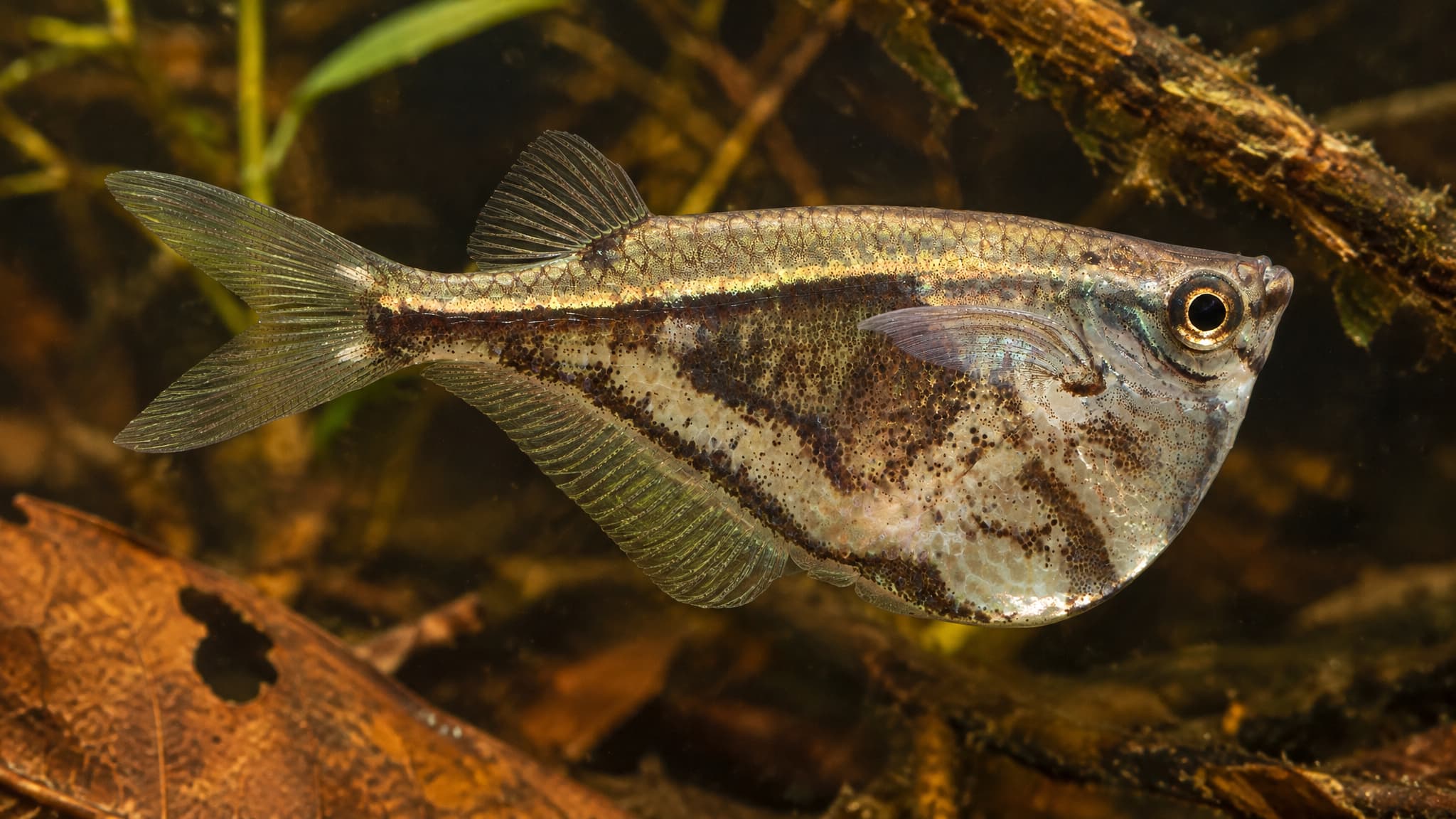
A marbled hatchetfish swims horizontally in a planted aquarium among driftwood and leaf litter, showing its deep hatchet-shaped body, large eye, upturned mouth, and translucent fins. The fish is viewed broadside with its tail to the left and head to the right.
The marbled hatchetfish (Carnegiella strigata) is a tiny South American characin with a deep, keel-shaped belly that gives the body a triangular, hatchet-like outline. It reaches a maximum standard length of about 3.5 cm, which still makes it the largest member of its genus. The body is golden silver, crossed by a pale stripe from head to tail, and the lower flanks carry a dark brown marbled pattern of diagonal bands. Colour, body depth and fin ray counts vary noticeably between populations.
The species lives in the Amazon and Orinoco basins and in coastal rivers of the Guianas, with records from Brazil, Bolivia, Peru, Ecuador, Colombia, Venezuela, Guyana, Suriname and French Guiana. It appears to be restricted to blackwater habitats: soft, acidic streams stained tea-brown by humic substances, shaded by dense overhanging vegetation and floored with branches, roots and leaf litter. In the Rio Negro, where water levels can rise by up to 15 m in the wet season, the fish move into tributaries and flooded forest to feed and spawn.
This is a pelagic, gregarious fish that swims in groups just below the surface. It is a surface predator of small invertebrates, taking terrestrial and aquatic insects, crustaceans and zooplankton. When threatened it can leap clear of the water, but it does not truly fly: studies show the large pectoral fins work only during the jump itself, and the fish can manage only one or two such escapes before it needs to rest.
Females are larger and have a fuller abdomen than males. Eggs fall to the bottom or onto vegetation and hatch after about 36 hours at 25 °C. Breeding in captivity has rarely been recorded, so nearly all fish in the aquarium trade are caught in the wild, mostly in the Rio Negro basin of Brazil.
The IUCN lists the marbled hatchetfish as Least Concern (assessed in 2020). The effect of the ornamental fish trade on wild subpopulations is not known. Several former subspecies are now treated as synonyms, but genetic work has found two distinct lineages in the Rio Negro that may one day be recognized as separate species.
Ideal water
The water this fish does best in, as kept in aquariums.
- Water type
- Freshwater
- Temperature
- 24–28 °C
- pH
- 5.0–8.0
- acidic to alkaline
- General hardness
- 5–19 dGH