Black phantom tetra
Megalamphodus megalopterus
 AI-generated
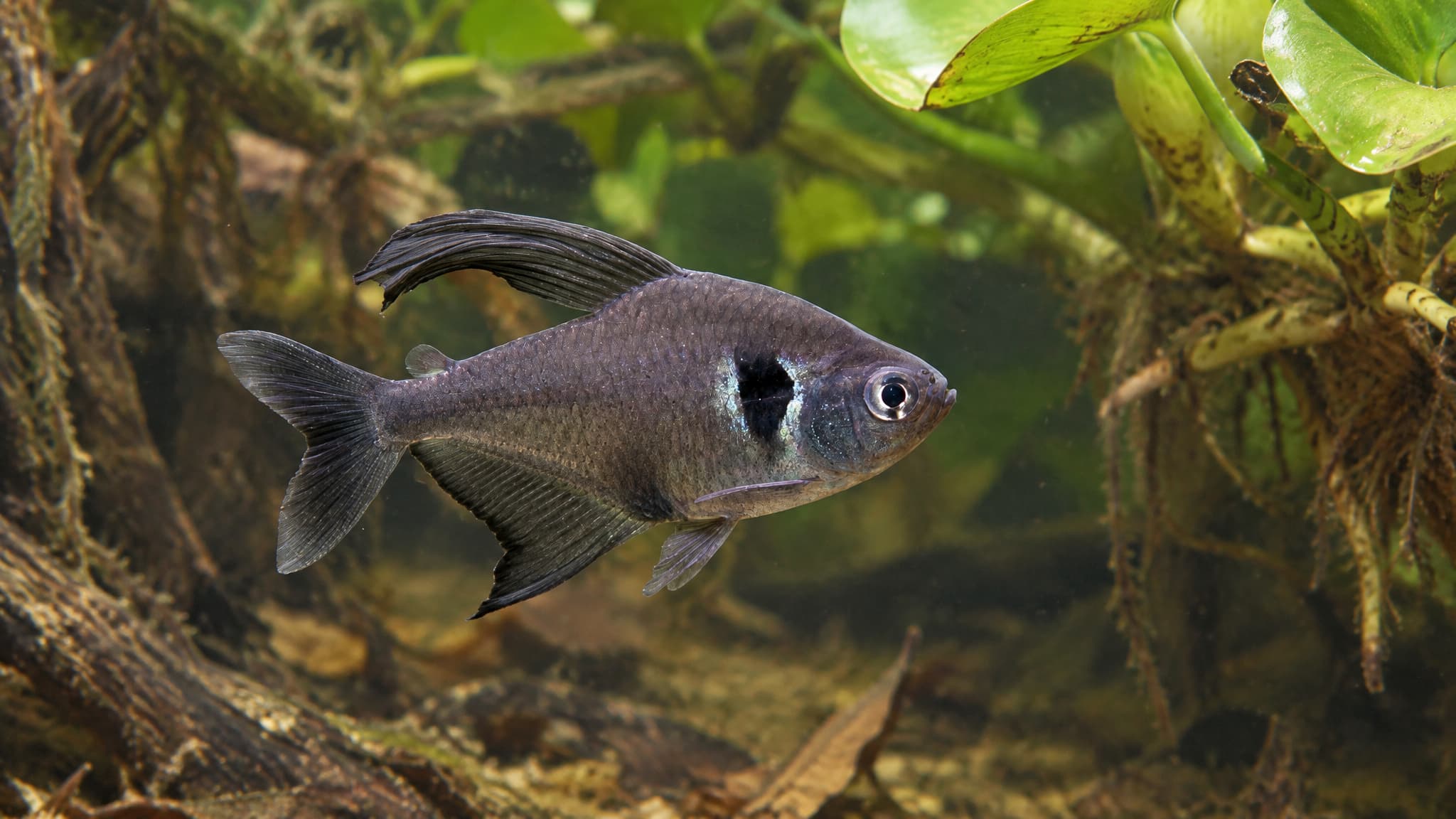
A black phantom tetra swims in profile through a planted freshwater aquarium, with its dark body, prominent black shoulder patch, reflective eye, and elongated fins clearly visible.
The black phantom tetra (Megalamphodus megalopterus) is a small South American characin long known in the aquarium hobby as Hyphessobrycon megalopterus. Described by Carl H. Eigenmann in 1915 from Cáceres, in Mato Grosso, Brazil, it was returned to the genus Megalamphodus in 2024 after phylogenomic work on the American tetras, and it is now placed in the family Acestrorhamphidae. Its species name means "large-finned", a fitting nod to the tall dorsal fin of the males.
It is a compact, deep-bodied fish that reaches a maximum standard length of about 3.6 cm, although some sources cite up to 4.4 cm. The body is light grey to almost black, and a black shoulder blotch edged with iridescent silver sits just behind each gill cover. The sexes are easy to tell apart: males have black, enlarged dorsal, pelvic and anal fins with no red, while females are deeper-bodied and show reddish pelvic, anal and adipose fins. Wild populations vary in colour; the black form comes from the Guaporé basin, whereas fish in the southern Pantanal are naturally reddish.
The species lives in the upper Guaporé (Iténez) and upper Paraguay river basins of Bolivia and Brazil, including the Pantanal wetland. It favours still or slow-moving water on floodplains, such as backwaters, ponds, small lakes and quiet tributaries, where it gathers among marginal vegetation, roots, fallen branches and floating water hyacinth.
It is a peaceful shoaling fish that often forms mixed schools with other small characins, such as the serpae tetra (Megalamphodus eques), foraging near the shore. Its natural diet includes worms, small insects and crustaceans, and it has been described as omnivorous, possibly also taking filamentous algae and fallen fruit. Males form temporary dominance hierarchies and display to one another with spread fins.
Breeding takes place in the wet season, when the floodplains fill. It is an egg-scattering free spawner that gives no parental care, and adults may eat their own eggs. In aquariums it usually lives about 3 to 5 years.
The black phantom tetra is assessed as Least Concern by the IUCN. It is popular in the aquarium trade, but almost all fish sold are captive-bred, which limits pressure on wild stocks; a long-finned variety has also been developed by breeders.
Ideal water
The water this fish does best in, as kept in aquariums.
- Water type
- Freshwater
- Temperature
- 22–28 °C
- pH
- 6.0–7.5
- acidic to neutral