Menelaus Blue Morpho
Morpho menelaus
 AI-generated
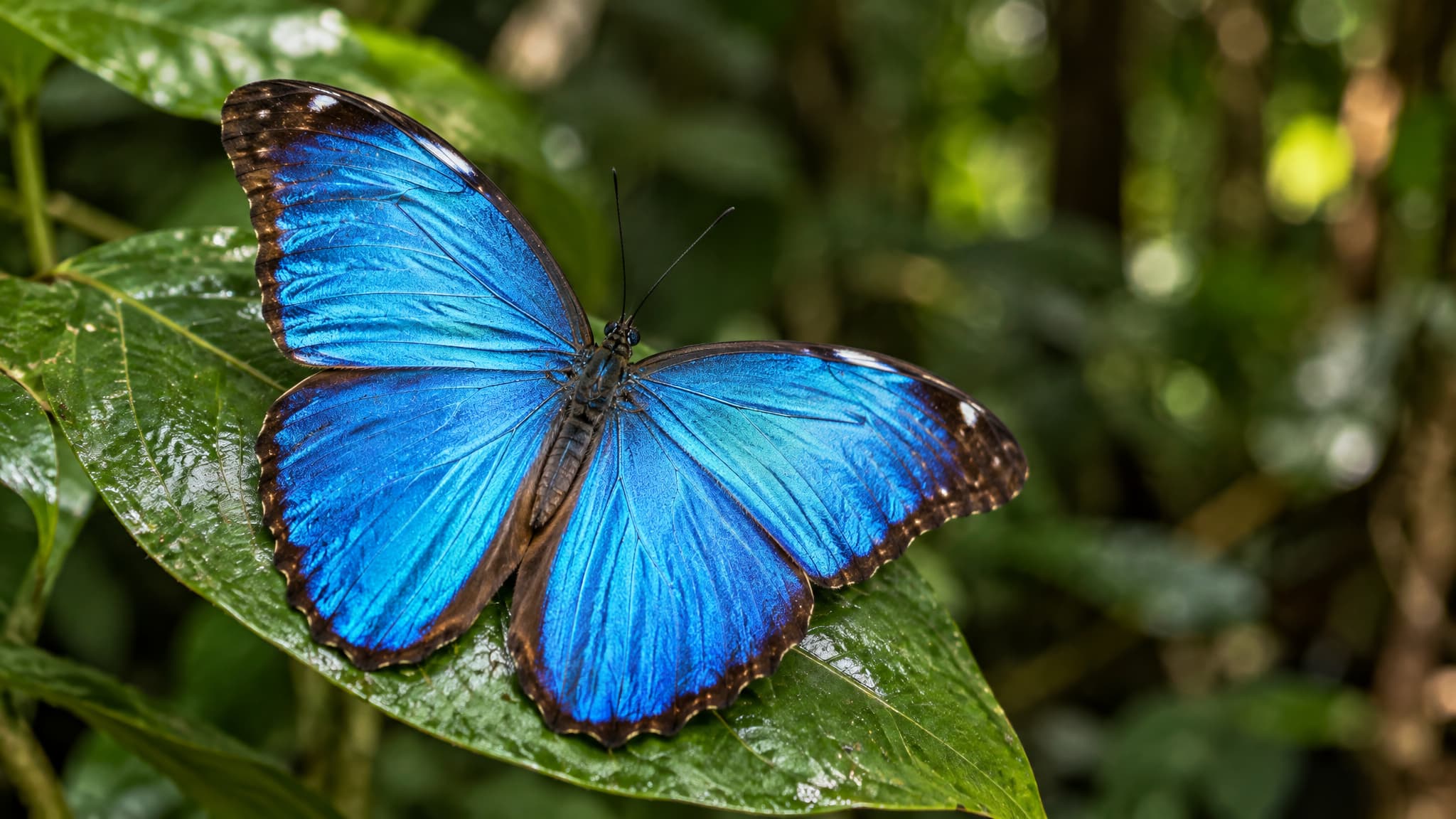
A Menelaus blue morpho rests on a glossy green leaf with its vivid blue wings spread, showing dark margins, clear wing veins, a slender dark body, and long antennae.
The Menelaus blue morpho (Morpho menelaus) is one of the best-known butterflies of the Neotropics, described by Linnaeus in 1758. Its wingspan is about 95 to 120 mm. The upper side of both wings is a brilliant, metallic blue edged in black or dark brown. This blue is structural rather than pigmentary: ridged scales reflect and reinforce blue light. Males are the bluer sex, with a narrow dark border, while females are larger, rarer and duller, with a broad brown border carrying pale spots. The underside is mottled brown with a row of eyespots, so a resting butterfly with closed wings is well camouflaged.
The species lives mainly in South America, from the Guianas, Venezuela and Colombia through Ecuador, Peru and Bolivia to Brazil, including the Amazon basin and the Cerrado. It favours humid, closed-canopy forest, both old-growth and mature secondary forest, from sea level to about 1,400 m. Adults are most often seen along streams, rivers, trails and forest gaps. Females keep to the shady understory, while males patrol clearings and the canopy.
Adults do not visit flowers. They feed on the juices of fermenting fallen fruit, tree sap and fungi, and take minerals from damp sand and mud. The flight is slow and bouncing, and the alternating flash of the blue upper side and the brown underside makes the butterfly hard to follow. Males patrol set routes and investigate anything blue. Underside eyespots can draw attacks away from the body; recorded predators of adults include jacamars, motmots and flycatchers.
Females lay small, pale green, dome-shaped eggs in small clusters on the undersides of host leaves, mainly woody legumes (Fabaceae) such as Dalbergia, Machaerium and Pterocarpus, and also Erythroxylum. The eggs hatch in roughly 8 to 14 days. The red-brown caterpillars with green patches are social, pass through five instars and reach about 50 mm; their bristles are irritating and a gland behind the head releases a foul-smelling fluid. The jade-green chrysalis hangs for about 2 to 3 weeks. The whole life cycle takes about 115 days, and adults live about 3 to 4 weeks.
As a fruit-feeder and leaf-eating larva, the species is part of the forest's food webs and serves as prey for birds, lizards, frogs, spiders and wasps. It is not assessed on the IUCN Red List and is not considered globally threatened, but it suffers from deforestation. During the 20th century it was heavily collected for decorative wing art, which led several countries to regulate its capture and export; today butterfly houses are mostly supplied by farms. Around 18 subspecies are recognized.