Ram cichlid
Mikrogeophagus ramirezi
 AI-generated
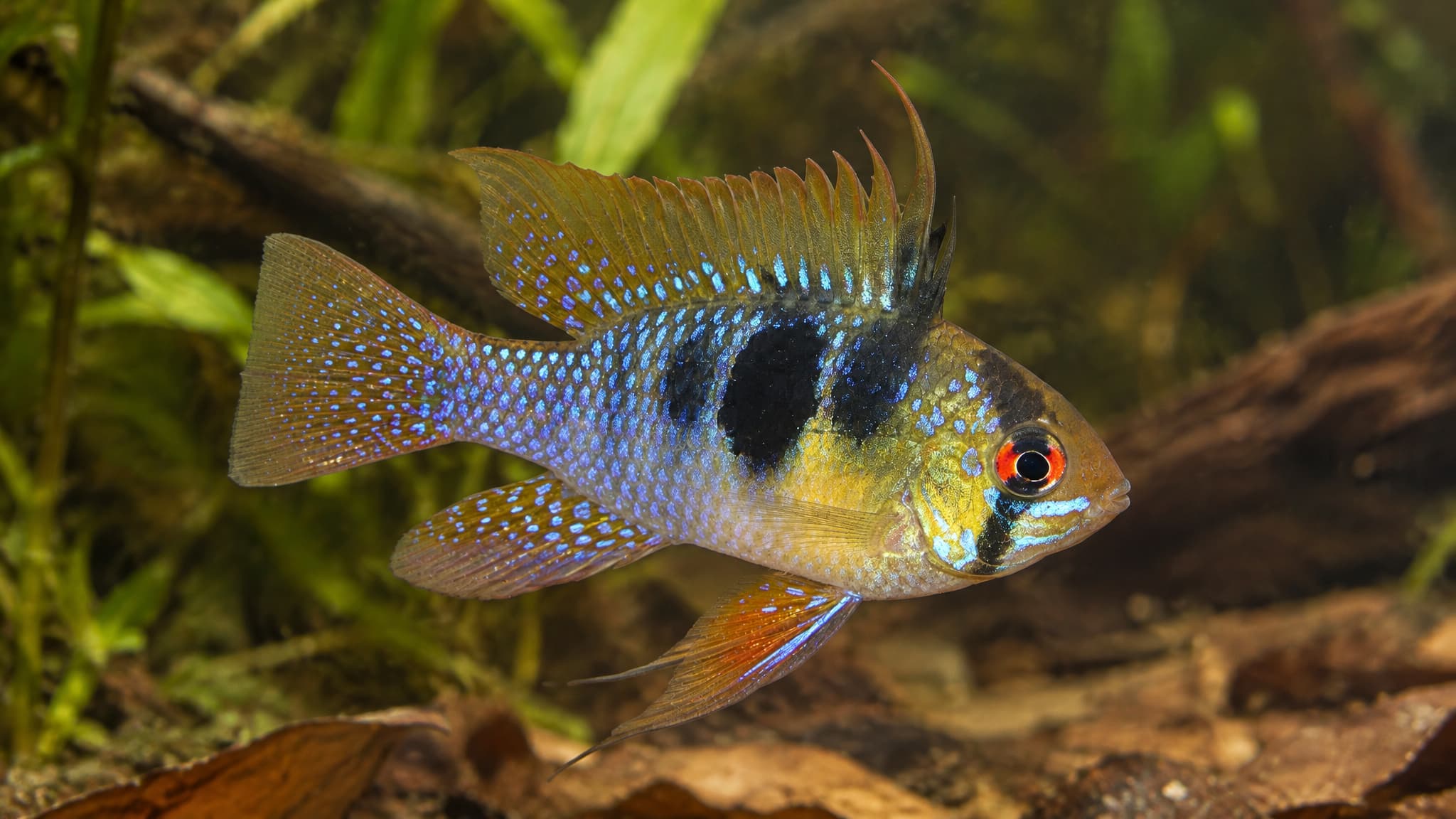
A Ram cichlid is shown in right-facing side profile in a planted aquarium, hovering above a substrate with driftwood. It has a tall spiny dorsal fin, vivid blue spotting, a dark mid-body blotch, and a red-rimmed eye.
The ram cichlid (Mikrogeophagus ramirezi), also sold as the blue ram, German blue ram or butterfly cichlid, is a small South American cichlid described by Myers and Harry in 1948. It was first named Apistogramma ramirezi and has passed through several genera before settling in Mikrogeophagus. The name honours Manuel Ramirez, one of the first people to collect and import it for the aquarium trade.
It is a compact, deep-bodied fish that reaches about 4 cm in standard length, with FishBase recording a maximum of 4.2 cm. Males are a little larger than females, carry longer, more extended dorsal fin rays and show more intense colour. Females usually develop a pink to red patch on the belly, especially as spawning approaches, and have a blue sheen around the dark spot below the dorsal fin.
The species is endemic to the Orinoco River basin, in the llanos savannas of Venezuela and Colombia. This is a vast seasonally flooded landscape of grassland and gallery forest with marked wet and dry seasons. The fish lives in slow, warm, acidic and very soft water, clear or stained by tannins, usually where aquatic or submerged plants offer cover.
Rams feed close to the bottom, taking mouthfuls of fine substrate and sifting out small food organisms. In aquariums it does best on live and frozen foods such as bloodworms, brine shrimp and water fleas. Juveniles live in groups, but adults form monogamous pairs that hold a territory, and males do not tolerate rival males.
Both parents care for the brood. The female lays rows of adhesive eggs, 0.9 to 1.5 mm across, on a flat stone or in a pit in the gravel, and clutches usually hold 150 to 300 eggs, with up to 500 reported. Eggs hatch in about 40 hours at 29 °C, and the larvae stay in place for about five days before swimming in a school guarded by the parents. In aquariums, rams live up to about 3 years.
The IUCN lists the ram cichlid as Least Concern. Most fish in the trade are bred in captivity, including gold, electric blue, long-finned and balloon-bodied strains, many of which have lower fertility, weaker health and poorer brood care than wild-type fish.
Ideal water
The water this fish does best in, as kept in aquariums.
- Water type
- Freshwater
- Temperature
- 27–30 °C
- pH
- 5.0–6.0
- acidic
- General hardness
- 5–12 dGH