Moon Jellyfish
Aurelia aurita
 AI-generated
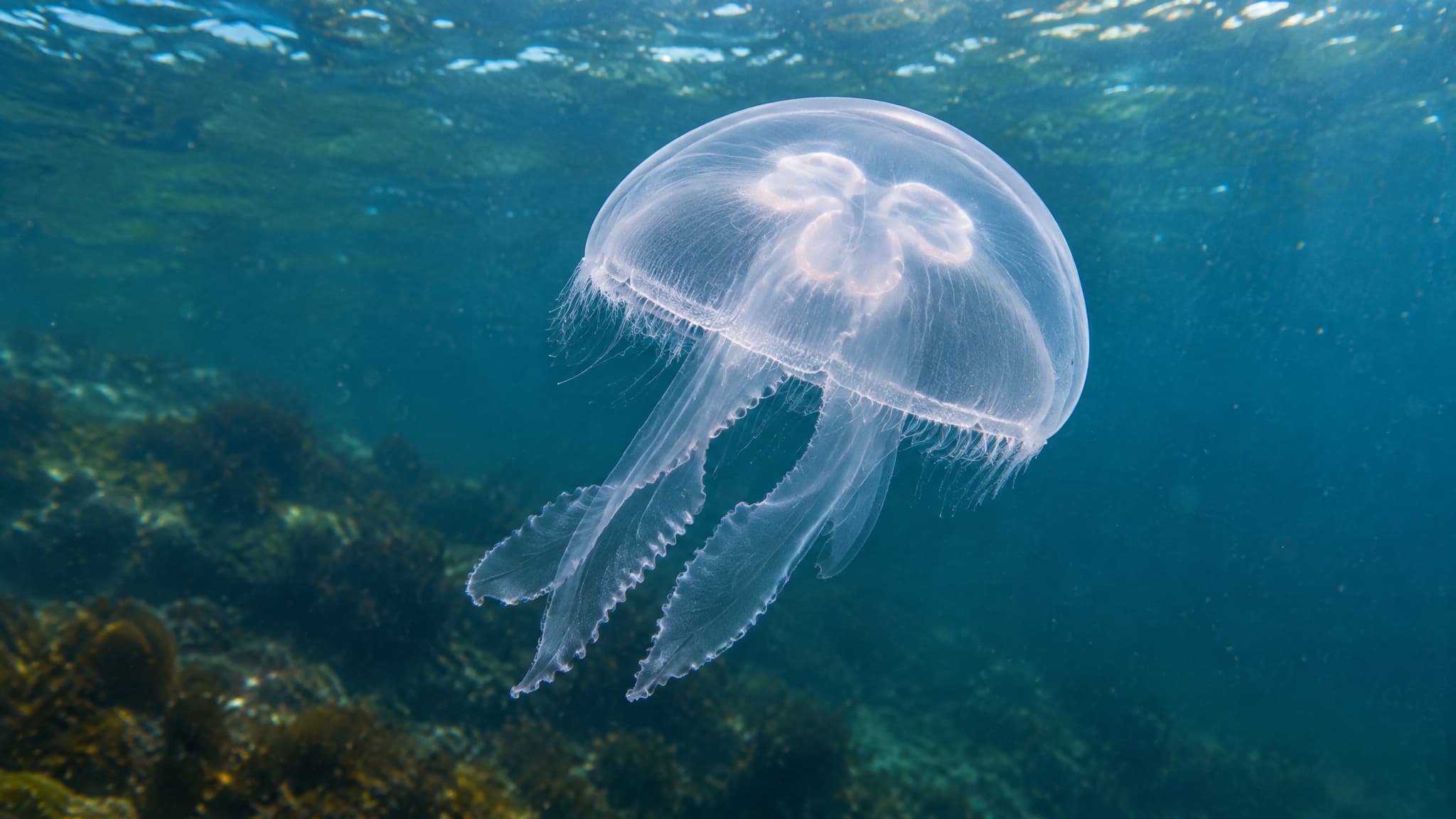
A translucent moon jellyfish drifts in clear blue water above a rocky seabed, with a rounded bell, four pale internal structures, and trailing oral arms and fine tentacles visible.
The moon jellyfish (Aurelia aurita) is a true jellyfish of the family Ulmaridae and the type species of its genus. Its smooth, saucer-shaped bell is nearly colourless and usually grows to about 25 cm across, though it can reach 40 cm. Four horseshoe-shaped gonads, often violet, pink or yellowish, show clearly through the top of the bell, and the margin carries a fringe of many short tentacles 1 to 5 cm long. Four thick oral arms hang beneath the centre.
Under the current taxonomy, A. aurita is native to the Northeast Atlantic, with its type locality at Helgoland, Germany. It is recorded from the North, Baltic, Black and Caspian seas, Greenland, northeastern USA and Canada, the Northwest Pacific and South America, where introductions have spread it, including a record at Ushuaia, Argentina. It lives in coastal and upper epipelagic waters, drifts into estuaries and harbours, and is especially common in Scottish sea lochs. It is Britain's most common jellyfish, yet it appears sporadically: some years bring huge local swarms, others almost none.
The moon jellyfish eats plankton. Copepods, small molluscs, fish eggs and smaller jellyfish become caught on the bell and tentacles, and the oral arms carry the food to the stomach. Medusae swim by pulsing the bell, which keeps them near the surface, and dense swarms can colour the sea red and slow small boats.
Sexes are separate. Males release sperm, which females take in, and the eggs are brooded in small pits on the oral arms until they hatch as planula larvae. Planulae settle on hard surfaces and become tiny polyps that bud off young jellyfish called ephyrae. Breeding peaks in summer and autumn, and adults mature at 4 to 12 months. Medusae in the wild average about 12 months of life, with a maximum of about 2 years, while polyps in captivity have lived up to 25 years.
Moon jellyfish are eaten by seabirds, other jellyfish, chum salmon, butterfish, ocean sunfish and leatherback sea turtles, and they carry amphipods such as Hyperia galba. Large blooms compete with fish for plankton, eat fish larvae and can clog power plant intakes. The species has not been evaluated by the IUCN Red List.