Neon Goby
Elacatinus oceanops
 AI-generated
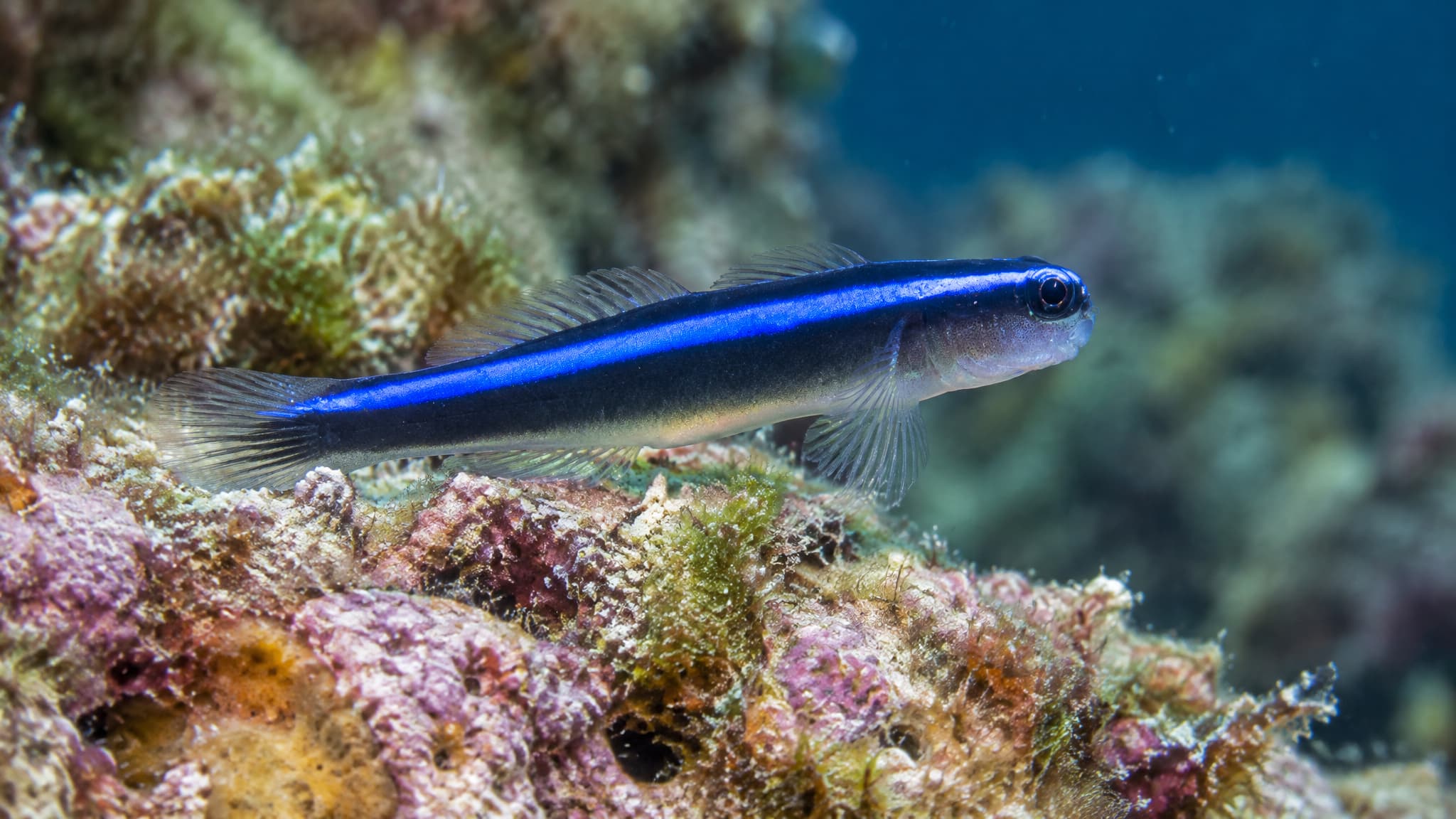
A Neon Goby is shown in side profile, hovering just above a rocky, algae-covered coral reef in clear blue water. Its elongated dark body, vivid electric-blue stripe, rounded head, large eye, and translucent fins are clearly visible.
The neon goby (Elacatinus oceanops) is a tiny marine goby of the western Atlantic and the type species of its genus. It reaches only about 5 cm in total length and has an elongate body with a shark-like snout overhanging the mouth. Its dark body is marked by a vivid electric-blue stripe running from in front of the eye toward the tail, above a broad dark lower stripe, making it one of the most recognizable small reef fishes.
This goby is a resident of coral reefs in southern Florida, including the Florida Keys, and parts of the western Caribbean toward Belize. It lives close to the bottom on coral heads, rocks and sponges at depths of roughly 1 to 45 m, usually staying within a few metres of a favoured spot in warm subtropical to tropical water.
The neon goby is a specialised cleaner fish. Pairs set up cleaning stations on coral heads, signalling to larger reef fishes with short darting displays and then picking external parasites from their bodies. Even predatory fishes generally tolerate these services rather than eating the goby. When parasites are scarce, a hungry goby may occasionally nip mucus or scales, a form of cheating that can drive clients away.
Neon gobies are usually encountered in male-female pairs. Eggs are laid in a sheltered crevice, empty shell or similar cavity and guarded by the parents until they hatch, after which the larvae spend a period drifting in open water before settling onto the reef. The species is short-lived, with a typical natural lifespan of about two years.
By removing parasites from many other fishes, the neon goby plays a valuable role in the health of Caribbean reef communities. It is also a long-standing favourite of the marine aquarium trade, and captive-bred individuals are now widely available, easing pressure on wild populations. The IUCN classifies the species as Least Concern, although it depends on healthy reef habitat that faces broader threats.
In collections
Ideal water
The water this fish does best in, as kept in aquariums.
- Water type
- Marine
- Temperature
- 21–28 °C
- pH
- 8.1–8.4
- alkaline
- Carbonate hardness
- 8–12 dKH
- Specific gravity
- 1.020–1.025