Oscar
Astronotus ocellatus
 AI-generated
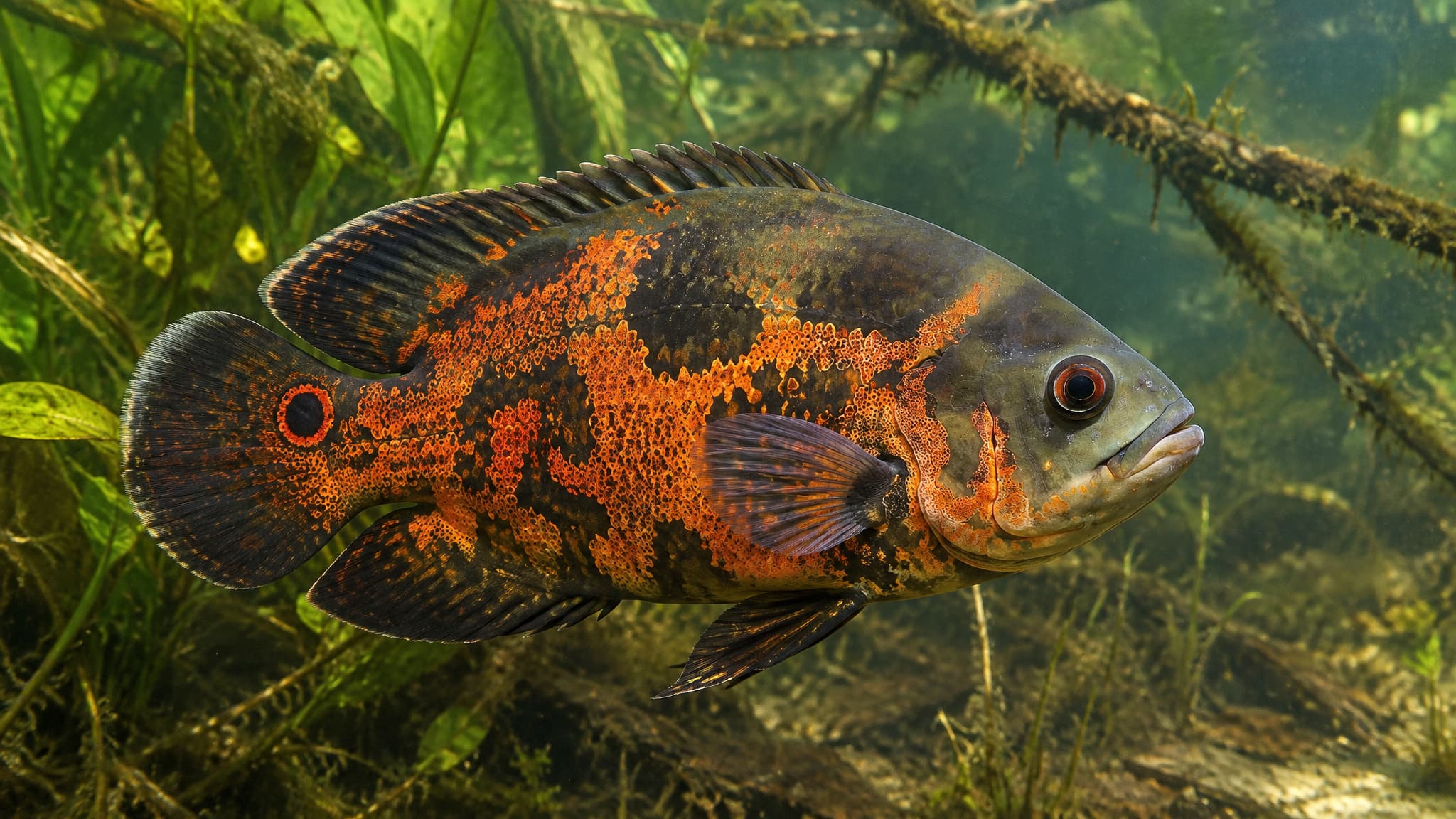
An Oscar is shown in side profile, swimming through a planted freshwater setting, with a deep-bodied form, orange-and-black mottling, a rounded tail ocellus, and an extended dorsal fin.
The oscar (Astronotus ocellatus) is a large South American cichlid, also called the tiger oscar, velvet cichlid or marble cichlid. It has a short, deep, oval body, a large mouth with thick lips, and densely scaled bases on its dorsal and anal fins. Wild fish are dark with orange tones along the lower flanks and the edge of the gill cover. A black spot ringed in orange, called an ocellus, usually sits at the base of the tail. Scientists think this eyespot may help reduce fin-nipping by piranhas. Oscars commonly reach about 24 cm, with a record of about 46 cm total length and 1.6 kg.
The species is native to the Amazon basin and nearby drainages, including the Orinoco. It has been recorded in Brazil, Peru, Colombia, Venezuela, Bolivia, Ecuador and French Guiana. It prefers quiet, shallow water over mud or sand, such as floodplain lakes, ponds and canals, often under floating plants. It has been introduced into reservoirs in northeastern Brazil, and feral populations are established in south Florida, Hawaii and Puerto Rico.
Oscars are mainly carnivorous. They eat small fish, crayfish, shrimp, snails, worms and insect larvae, and they also take some plant material. They are territorial: they can form dominance hierarchies and chase rivals away. They also have a typical display called tail flutter. Aquarists value them for their personality and their habit of responding to their keepers.
Oscars are biparental substrate spawners. A pair cleans a hard surface, such as a rock, lays its eggs there, and both parents guard the eggs and young. Sexual maturity comes at about 10 to 14 months. A single spawn can contain hundreds to around two thousand eggs. Wild lifespan is poorly documented, but oscars in aquariums typically live 10 to 20 years.
As a mid-level predator, the oscar helps control populations of invertebrates and small fish. Researchers have tested it as a predator of mosquito larvae, and it hosts a wide variety of parasites. In Amazonia it is an important food fish for small-scale fishers.
The IUCN listed the oscar as Least Concern in 2020. Its main conservation concern is not decline but its spread as an introduced species outside its native range.
In collections
Ideal water
The water this fish does best in, as kept in aquariums.
- Water type
- Freshwater
- Temperature
- 22–25 °C
- pH
- 6.0–8.0
- acidic to alkaline
- General hardness
- 5–19 dGH