Emperor scorpion
Pandinus imperator
 AI-generated
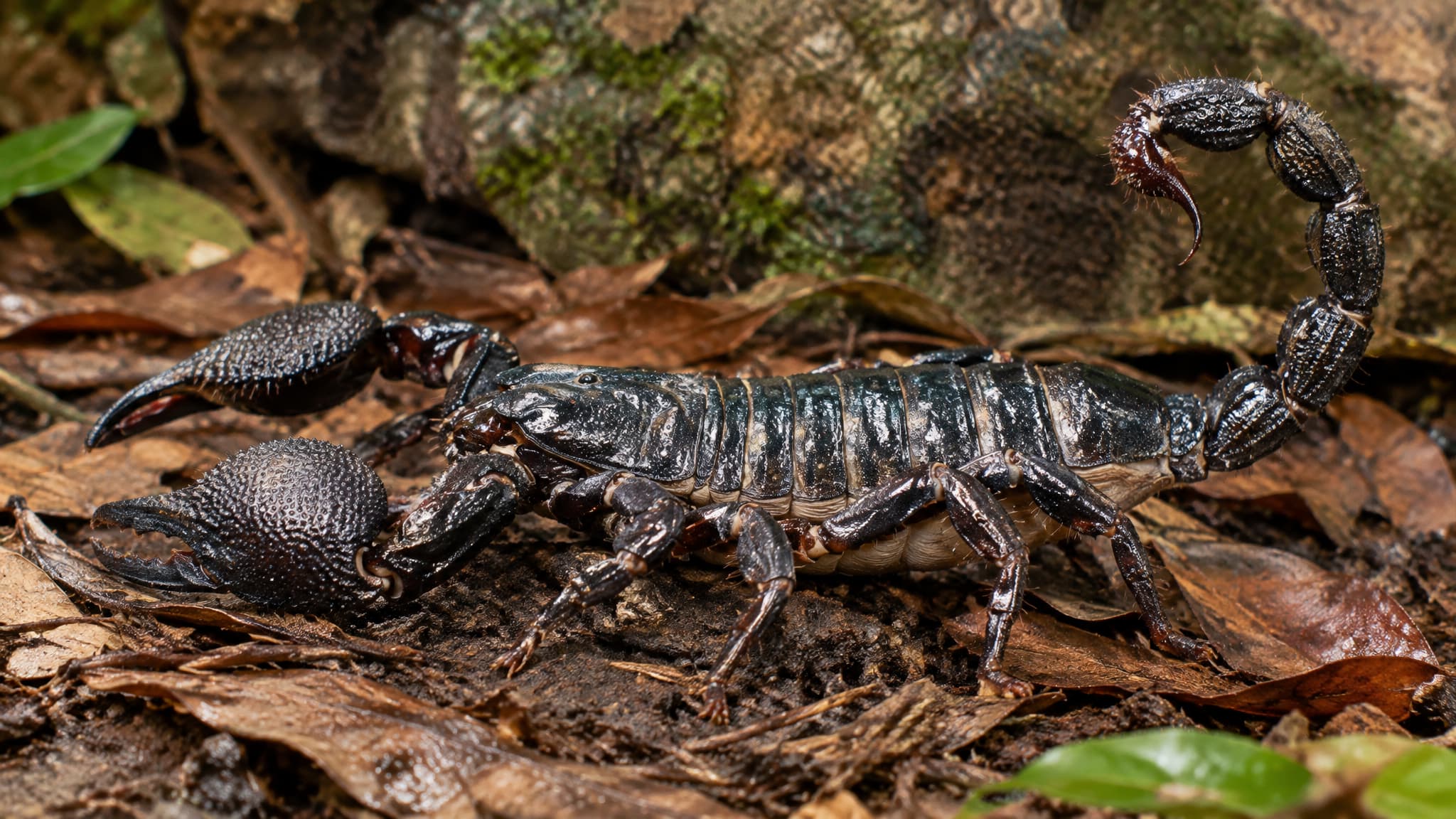
An Emperor scorpion rests low among damp leaf litter, displaying broad, textured pincers, a dark segmented body, and a tail arched upward with the stinger visible.
The emperor scorpion is one of the largest scorpions in the world and among the best known, largely because of its long history in the pet trade. Adults average about 20 cm in length and around 30 g, and the Scorpion Files gives a range of 15 to 20 cm and up to 32 g. The body is a glossy black, the pincers (pedipalps) are massive and granular, and females are larger than males, while males tend to have longer pectines, the comb-like sensory organs under the body.
The species is native to West Africa. Records cover countries such as Senegal, Gambia, Guinea, Guinea-Bissau, Sierra Leone, Liberia, Ivory Coast, Mali, Burkina Faso, Ghana, Togo, Benin, Nigeria and Cameroon. It lives in hot, humid tropical forest and also in open savanna, sheltering in burrows dug in the soil, under rocks, leaf litter and forest debris, along stream banks and very often inside termite mounds. It can be common close to human settlements.
Emperor scorpions are nocturnal and have poor eyesight, so they find prey and detect danger through touch, the pectines and fine sensory hairs on the pincers and tail that pick up vibrations in the air and ground. They feed mainly on termites, which make up a large share of the diet, and on other insects and terrestrial invertebrates, occasionally taking small vertebrates such as lizards and rodents. Adults usually crush and tear prey with the pincers rather than stinging it, while young scorpions rely more on the sting. The species is considered fairly docile and tends to flee, but it becomes defensive when cornered. Its sting is generally mild for people, and its venom has yielded several ion-channel toxins studied in research, including imperatoxin and pandinotoxin.
Unusually for scorpions, this species is social: groups of up to 15 individuals have been observed living together, and cannibalism is rare. Breeding can happen year-round. After a gestation of about 9 months, the female gives birth to live young, typically 10 to 12, which climb onto her back and are carried by her for a time; mothers are more aggressive in this period. Both sexes reach sexual maturity at about 4 years, and the species lives 5 to 8 years in captivity.
As a predator of termites and other invertebrates, the emperor scorpion takes part in the food web of West African forests and savannas, and it is in turn eaten by birds, bats, spiders and mammals. Heavy collection of wild animals for the international pet trade led to its listing in Appendix II of CITES, which regulates its export. The species has not been evaluated on the IUCN Red List.