Palette surgeonfish
Paracanthurus hepatus
 AI-generated
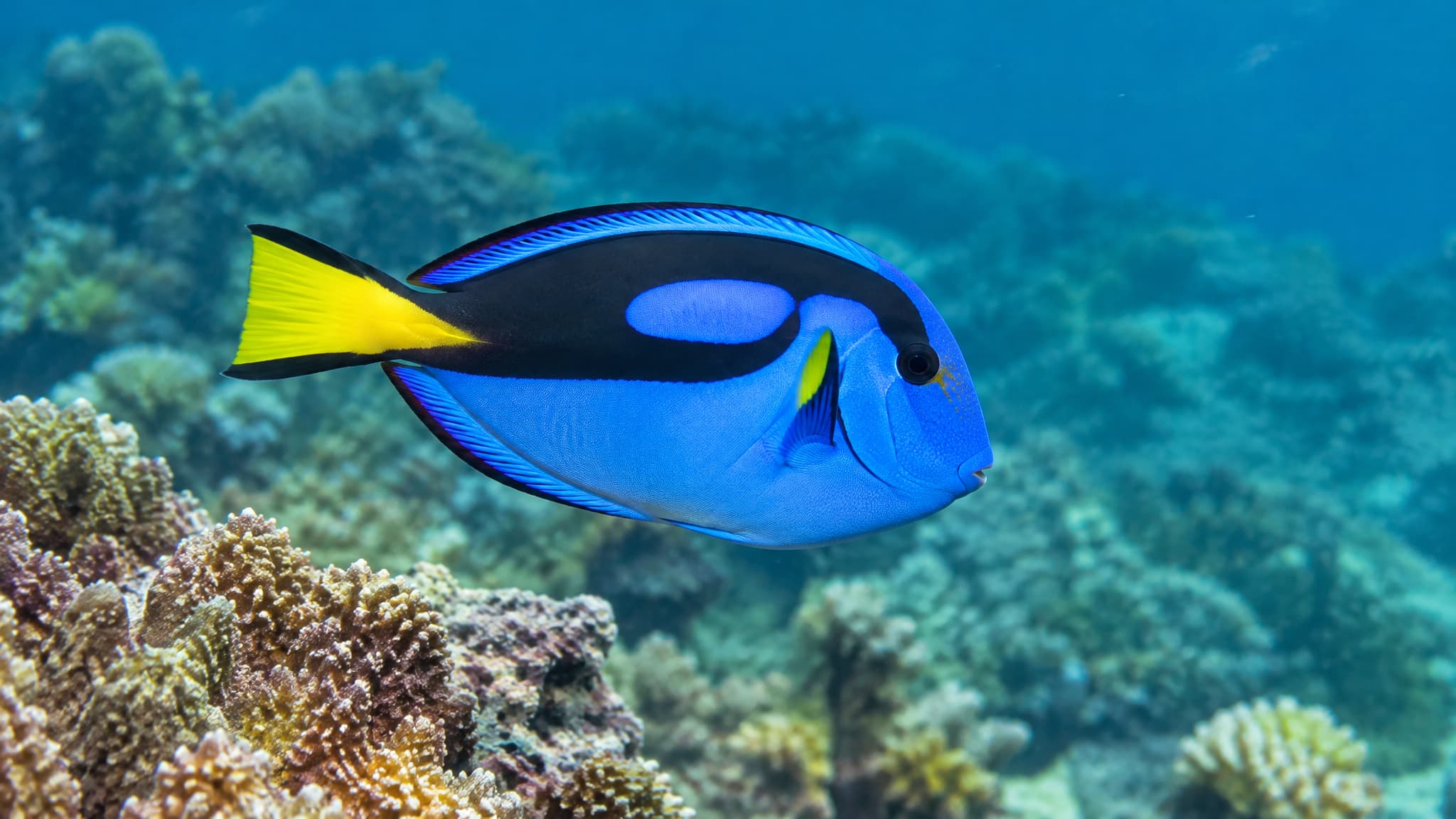
A palette surgeonfish swims in right-facing side profile above a coral reef, showing its vivid blue body, dark lateral markings, and bright yellow tail.
The palette surgeonfish—also called the Pacific blue tang, regal tang, or blue tang—is a vividly colored Indo-Pacific reef fish. Its laterally compressed body is bright blue with a bold black pattern along the upper side and rear of the body, while the tail is yellow with dark margins. Adults can reach about 31 cm in total length. It is the sole living species placed in the genus Paracanthurus.
Like other surgeonfishes, it has a sharp, folding spine on each side of the caudal peduncle, the narrow area before the tail. This defensive “scalpel” can inflict painful wounds, and associated spines are venomous. Juveniles are often more secretive than adults; when alarmed, they may wedge themselves deep among branching corals.
The species inhabits tropical, clear-water coral reefs and reef channels with appreciable currents, generally at depths of 2–40 m. Its native distribution spans the Indo-Pacific, from East Africa and the Mascarene Islands eastward to Kiribati, and from southern Japan south to the Great Barrier Reef, New Caledonia, and Samoa. Fish reported well beyond this range may be aquarium releases.
Palette surgeonfish occur alone, in pairs, or in loose groups above the reef. They feed chiefly on zooplankton, while algae and other plant material can supplement the diet. By grazing algae from irregular reef surfaces, they contribute to the balance between algal growth and reef-associated organisms. Reproduction is by broadcast spawning: adults release eggs and sperm into the water column, where fertilization occurs externally; eggs may hatch in roughly 25–28 hours. Reported longevity exceeds 30 years in the wild, though aquarium survival is often shorter. It is listed as Least Concern, but coral-reef degradation and collection for the aquarium trade remain relevant pressures to monitor.