Peacock mantis shrimp
Odontodactylus scyllarus
 AI-generated
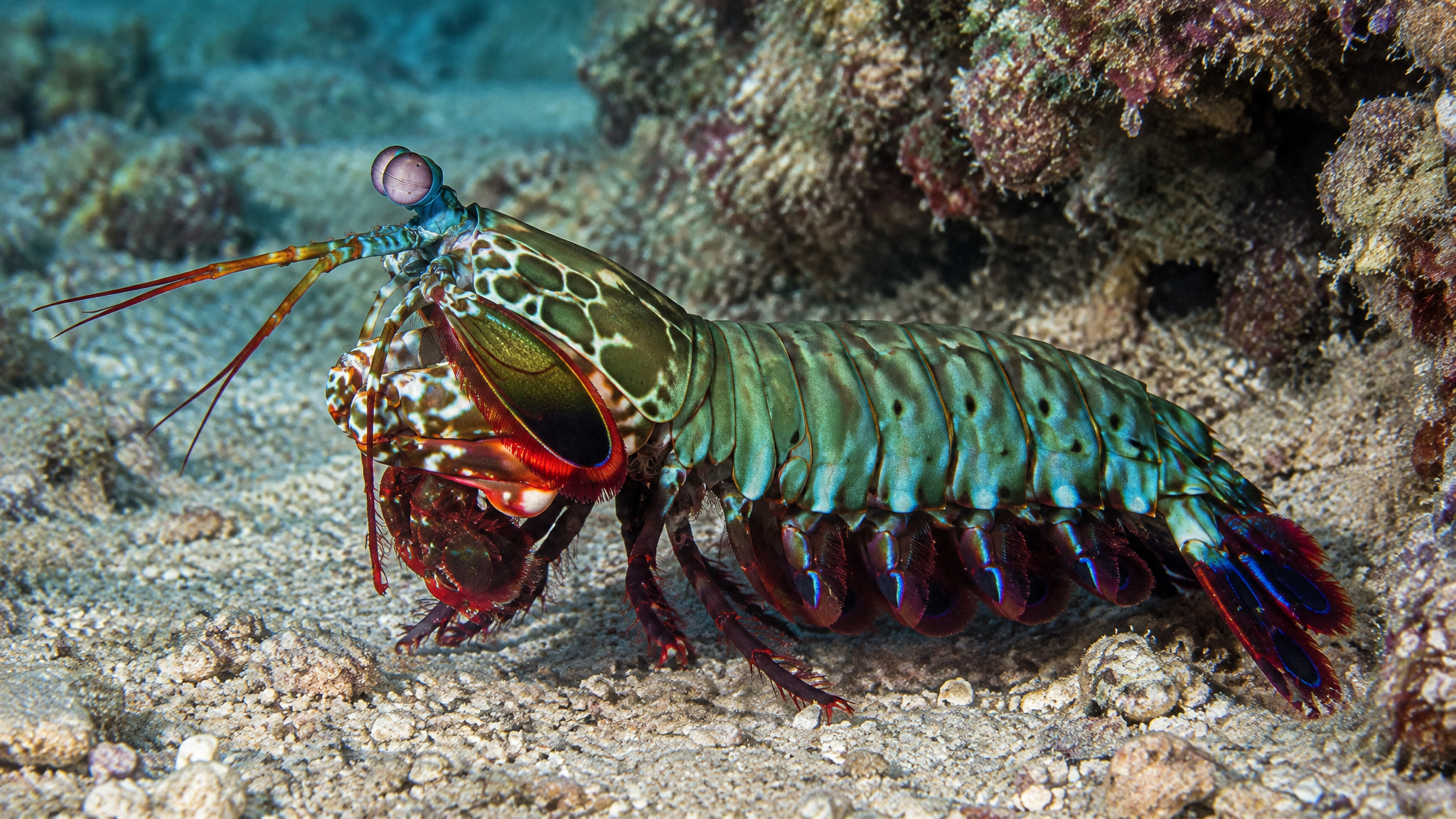
A peacock mantis shrimp rests on a sandy seabed beside a rocky reef, showing vivid green-and-blue segmented armor, stalked eyes, long antennae, and prominent front appendages.
The peacock mantis shrimp is a colourful stomatopod crustacean of Indo-Pacific reefs, also called the harlequin, painted, clown or rainbow mantis shrimp. Adults measure 3 to 18 cm. The body is mostly olive to green, with orange antennal scales, red raptorial appendages, leopard-like spots on the front of the carapace and blue stalked eyes. Males are more brightly coloured than females.
It lives on the sea floor from East Africa to Guam and the Marianas, south to northern KwaZulu-Natal in South Africa. It is found at depths of 3 to 40 m, most often between 10 and 30 m, in water of about 22 to 28 °C. Each animal digs a U-shaped burrow in sand or gravel near the base of coral reefs and seldom strays far from it.
This species is a "smasher". Instead of spearing prey, it uses a pair of club-shaped raptorial appendages to hammer snails, clams, scallops and, above all, crabs until the shell breaks. The strike is among the fastest known in the animal world, reaching about 80 km/h. It forms cavitation bubbles whose collapse adds a second blow to the shell. The club is a mineralised structure rich in hydroxyapatite, and its composition is studied as a model for bioinspired materials. Its eyes have 12 types of photoreceptors and detect colour, ultraviolet and both linear and circular polarised light.
Peacock mantis shrimp are solitary, territorial and active by day and by night. They defend their burrows and produce low vibrations, known as stomatopod rumbles, to warn intruders. Pairs are usually monogamous and breed all year, most often in warmer months. Spawning takes place at night inside the burrow. The female carries the egg mass on her front thoracic appendages and does not feed while brooding. Lifespan in the wild is 4 to 6 years.
The burrows it digs and later abandons become shelter for other animals. Few predators are known, though yellowfin tuna have been found with the species in their stomachs, and larger reef fish take smaller individuals. It is popular in the marine aquarium trade, yet aquarists also fear it: it attacks tankmates, can crack aquarium glass and sometimes arrives hidden in live rock. It has not been evaluated by the IUCN and no agency lists it as threatened.