Pearl Gourami
Trichopodus leerii
 AI-generated
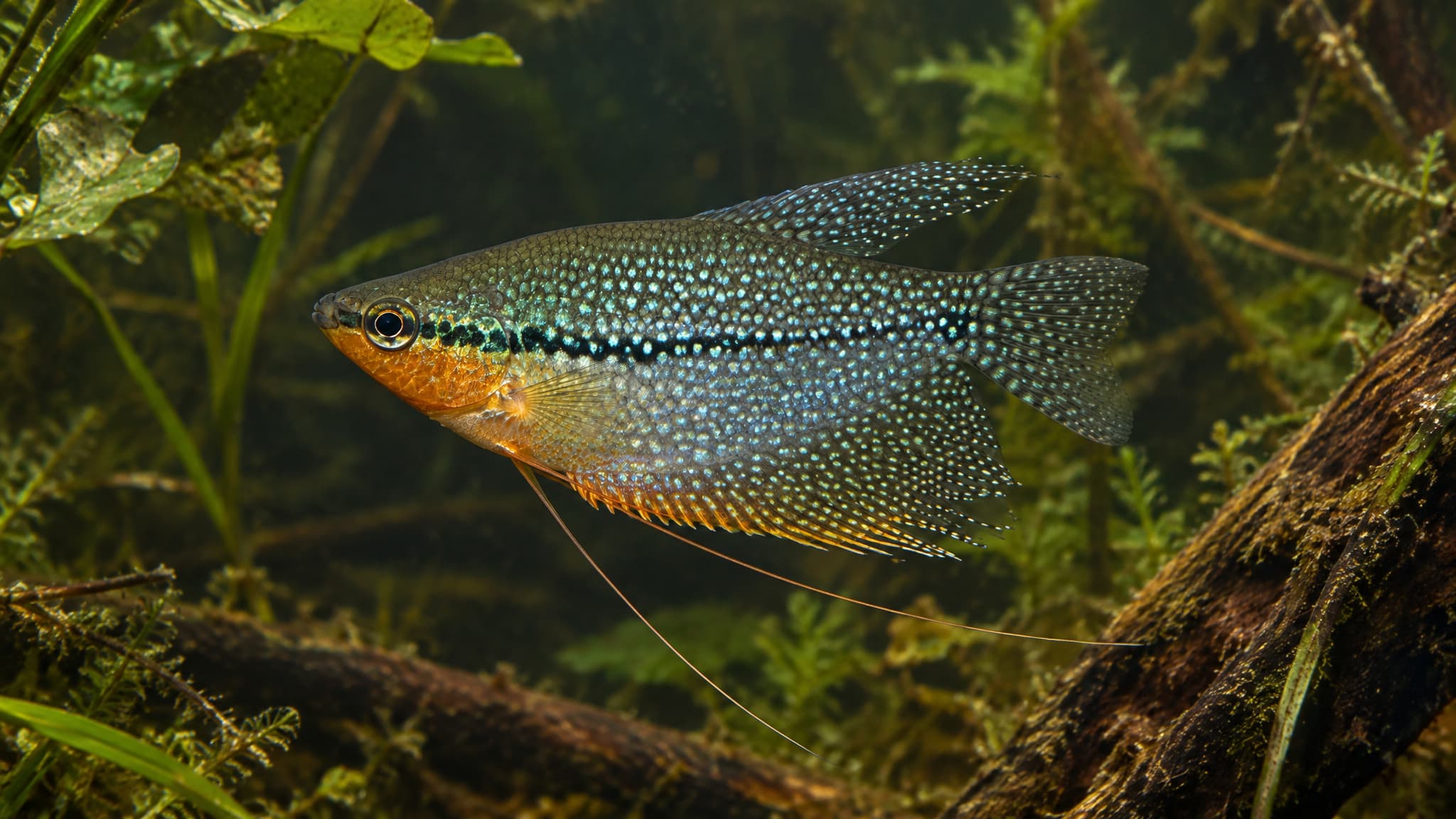
A pearl gourami swims leftward in profile through a densely planted aquarium, showing iridescent pearl-like spots, a dark horizontal stripe, orange coloration on the throat and belly, and long filamentous pelvic fins.
The pearl gourami (Trichopodus leerii), also sold as the lace or mosaic gourami, is a laterally compressed labyrinth fish reaching about 12 cm in standard length. Its brownish-silver body is densely covered with small pale, pearl-like spots, and a dark line runs from the snout along the flank, fading toward the tail. The pelvic fins are drawn out into long, thread-like rays that serve as touch and taste organs. Mature males have longer, more pointed dorsal and anal fins and develop a vivid orange to red throat and breast, while females are plainer and plumper.
The species is native to tropical Southeast Asia, where it is recorded from Thailand, the Malay Peninsula and the Indonesian islands of Sumatra and Borneo. It lives in lowland swamps and slow streams, often among dense vegetation, and is associated with soft, acidic, tannin-stained blackwater habitats.
Like other gouramis, it has a labyrinth organ that lets it gulp atmospheric air, and it is considered an obligate air breather, an advantage in warm, oxygen-poor water. It is one of the most peaceful gouramis, although males are territorial toward each other. In aquariums it is an unfussy omnivore that accepts most foods offered.
Breeding involves a bubble nest: the male builds a floating mass of air bubbles stabilized with a mouth secretion, courts the female beneath it, then gathers the eggs into the nest and guards them. The species is fairly long-lived, with aquarium individuals reported to survive eight years or more.
The IUCN assessed the pearl gourami as Near Threatened in 2019, mainly because of ongoing loss and degradation of its lowland swamp habitats. It is nonetheless extremely common in the aquarium trade, where most fish are mass-produced in captivity, and it is also used in commercial fisheries and aquaculture. Introductions in Florida and Hawaii failed to establish.
In collections
Ideal water
The water this fish does best in, as kept in aquariums.
- Water type
- Freshwater
- Temperature
- 24–28 °C
- pH
- 6.0–8.0
- acidic to alkaline
- General hardness
- 5–19 dGH