Peppered Corydoras
Hoplisoma paleatum
 AI-generated
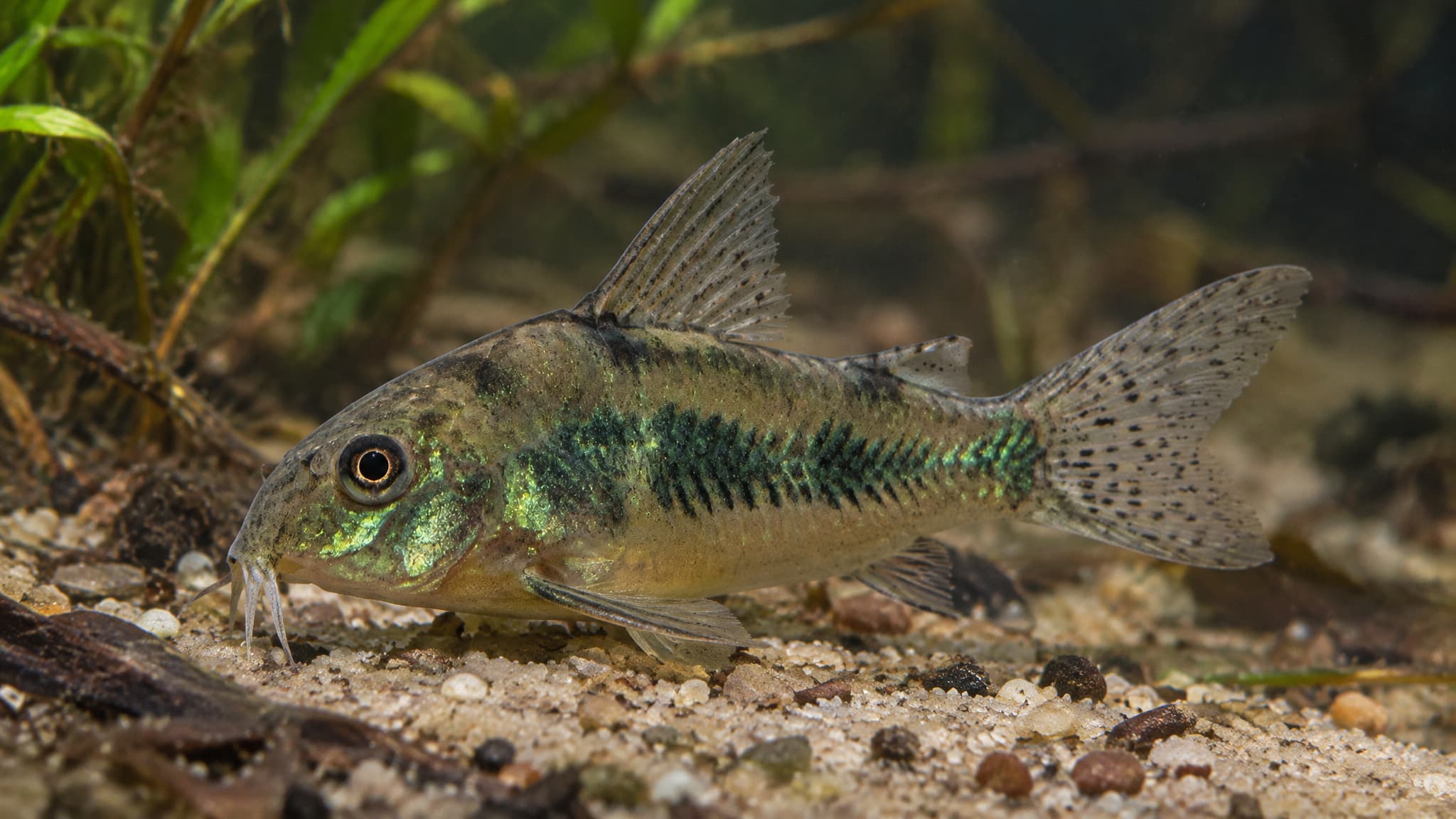
A Peppered Corydoras rests on a gravel substrate in a planted aquarium, shown in side profile with visible barbels, patterned body, erect dorsal fin, and spotted translucent fins.
The peppered corydoras (Hoplisoma paleatum) is a small armoured catfish of the family Callichthyidae and one of the most familiar bottom-dwellers in community aquariums. Its stocky body is covered by overlapping bony plates rather than scales. The back is dark olive-brown to greenish, the flanks are yellowish-green with a metallic sheen and the belly is pale. Large irregular dark blotches, sometimes merging into bars, and many fine dark spots give the "peppered" look, while the grey fins carry rows of dark streaks. Females are larger and rounder, reaching about 7.1 cm in standard length against about 6.6 cm in males, whose dorsal and pectoral fins are relatively longer. An albino form is common in the aquarium trade.
The species was described by Leonard Jenyns in 1842 from specimens collected by Charles Darwin during the voyage of HMS Beagle. For most of its history it was known as Corydoras paleatus, but a 2024 phylogenomic study of the subfamily Corydoradinae placed it in the revived genus Hoplisoma, a name meaning "armoured body".
It is native to southern South America, in the lower Paraná River basin and coastal rivers of southern Brazil, Uruguay and Argentina, with records from Paraguay. It lives in rivers and their tributaries as well as standing waters such as ponds, pools and small lakes, in a subtropical climate with relatively cool water.
Peppered corydoras are peaceful and social, foraging in groups over soft bottoms. They are opportunistic omnivores that sift the substrate for worms, small crustaceans, insect larvae and plant matter. They are facultative air-breathers: they dart to the surface to gulp air, which is absorbed through the gut as an extra source of oxygen. Males can produce sounds with their pectoral fins during courtship and when disturbed.
During spawning the pair adopts a characteristic "T-position". The female then carries 2 to 4 eggs between her pelvic fins until they are fertilized and sticks them to plants, rocks or glass, repeating the process until about 100 eggs have been laid. The eggs hatch in about 3 days. A lifespan figure is not reported in the scientific sources consulted.
As a bottom forager feeding low in the food web, it takes part in recycling organic matter and small invertebrates on the riverbed. The IUCN Red List assessed it as Least Concern in 2020, and nearly all fish sold in the hobby are captive-bred.
Ideal water
The water this fish does best in, as kept in aquariums.
- Water type
- Freshwater
- Temperature
- 18–23 °C
- pH
- 6.0–8.0
- acidic to alkaline
- General hardness
- 5–19 dGH