Atlantic mudskipper
Periophthalmus barbarus
 AI-generated
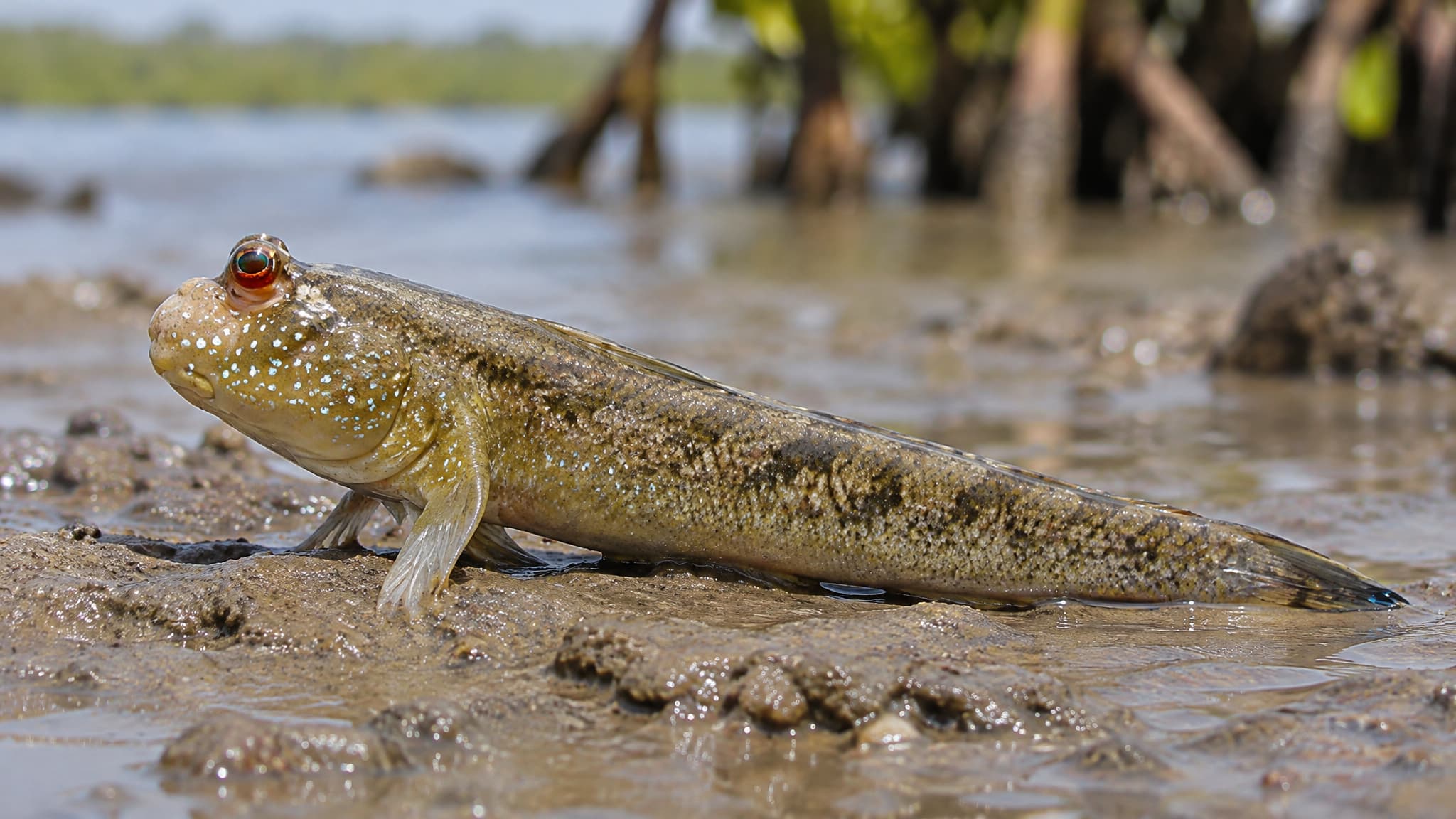
An Atlantic mudskipper rests on wet mud at the edge of shallow mangrove water, propped on its broad pectoral fins. Its raised eyes, rounded head, elongated mottled body, and tapering tail are clearly visible.
The Atlantic mudskipper (Periophthalmus barbarus) is an amphibious goby from West Africa that spends much of its day out of the water on tidal mud. Its large head carries bulging eyes set high on top, which can move independently and be pulled down into their sockets to stay moist, since the fish has no eyelids. Muscular pectoral fins work like crutches on land, and the pelvic fins form a sucker that helps it grip. FishBase gives a maximum of 14.7 cm standard length and 16.5 cm total length, and treats older reports of 25 cm as probable misidentifications.
The species lives along the Atlantic coast of tropical West Africa, from Senegal to Angola, including most offshore islands such as Bioko, São Tomé and Príncipe, with reports from Mauritania as well. It occupies muddy shores, brackish estuaries, lagoons and mangrove swamps, and sometimes enters fresh water, but always close to the coast. It tolerates wide swings in temperature and salinity.
Out of the water it breathes partly through its moist skin and keeps a supply of water in its gill chambers. It is active by day and moves over exposed flats by crawling or by skipping with a flick of its tail. Adults hunt mainly crabs, insects and other small animals on the mud surface, and also take worms and small fish; FishBase also records white mangrove in the diet. Prey is drawn into the mouth with a pulse of water held in the mouth, sometimes called a hydrodynamic tongue. Individuals are strongly territorial and may raise low mud walls around their patch.
Breeding takes place in burrows, which males dig up to 1 m deep in the mud; mating and care of the brood happen inside them. Spawning can occur through the year, with a peak from about February to May. Females lay thousands of eggs, but few young survive predation. Bioparc Fuengirola gives a lifespan of 5 to 8 years.
The Atlantic mudskipper is a common predator of small invertebrates on mangrove mudflats, and because it lives in close contact with coastal sediments it is used as a bio-indicator of pollution. People catch it for food, bait and traditional medicine, and it appears in the aquarium trade.
The IUCN lists the species as Least Concern. Local threats include overfishing, pollution, fishing with cyanide or electricity, and urban development along the coast.
Ideal water
The water this fish does best in, as kept in aquariums.
- Water type
- Freshwater
- Brackish
- Marine
- Temperature
- 25–30 °C
- pH
- 7.0–8.5
- neutral to alkaline
- General hardness
- 10–25 dGH