Cuyaba Dwarf Frog
Physalaemus nattereri
 AI-generated
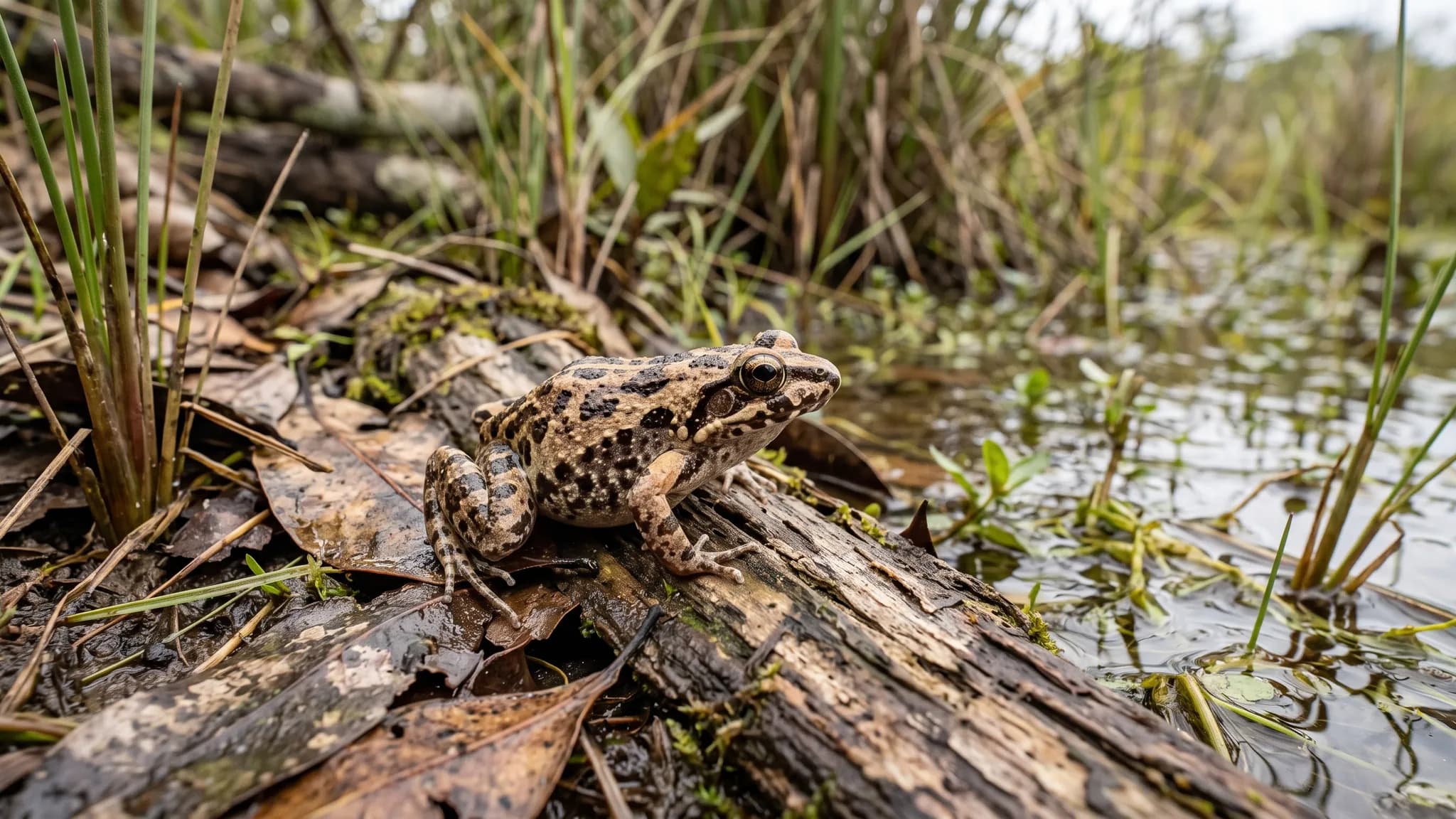
A mottled brown frog resting on a piece of wet wood at the edge of a grassy wetland.
Physalaemus nattereri, commonly known as the Cuyaba dwarf frog or four-eyed frog, is a small, fascinating species of terrestrial amphibian in the family Leptodactylidae. Historically known by the synonym Eupemphix nattereri, this species exhibits slight sexual dimorphism, with females growing slightly larger (ranging from 4.9 to 5.1 centimeters) than males (averaging 4.7 centimeters). Its dorsal coloration ranges from light to dark brown or reddish, adorned with a mosaic pattern of darker stripes or spots, while the ventral side is lighter with dark spots. A truly unusual anatomical feature of this frog is the deep pigmentation of its internal organs, including the testicles, which is a rarity among anurans caused by a dense concentration of melanocytes.
Endemic to South America, the Cuyaba dwarf frog is primarily found across central and southeastern Brazil, eastern Bolivia, and Paraguay. It thrives in the Neotropical savanna and the Cerrado biomes, often taking up residence near permanent or temporary water bodies such as swamps and ponds. These aquatic environments are absolutely essential for the frog's nesting behaviors. Despite its wide geographic range, the species is known to be poorly adapted to areas heavily impacted by human activity and urbanization.
As a generalist and opportunistic predator, Physalaemus nattereri has a diet heavily focused on social insects. It predominantly consumes termites and ants, which are abundantly available in its terrestrial habitat. However, the frog is most famous for its highly evolved defensive strategies against predators like birds, beetles, and giant water bugs, the latter being primary threats during the frog's vulnerable reproductive and metamorphic stages. The frog's posterior features a pair of large, prominent eyespots, known as ocelli.
When threatened, the Cuyaba dwarf frog employs an impressive deimatic, or startle, display. It inflates its lungs with air, lowers its head, and elevates its hindquarters. This posture conspicuously displays the large eyespots, creating a visual illusion of a much larger animal staring down the predator. Beyond the visual bluff, these eyespots house venomous inguinal macroglands that secrete a highly potent, fast-acting toxin, effectively deterring predation and allowing the frog to escape even if it is physically attacked.
The species is an explosive breeder, with reproduction closely tied to the rainy season spanning from October to January. Males attract females by emitting a single-harmonic vocalization in short, rhythmic sequences. Adult females demonstrate a significant correlation between their body size and the number of mature eggs they can produce. Despite predation and habitat sensitivity, Physalaemus nattereri maintains a stable population across its wide distribution range. Consequently, the International Union for Conservation of Nature (IUCN) currently assesses the species as Least Concern.