Portuguese Man o' War
Physalia physalis
 AI-generated
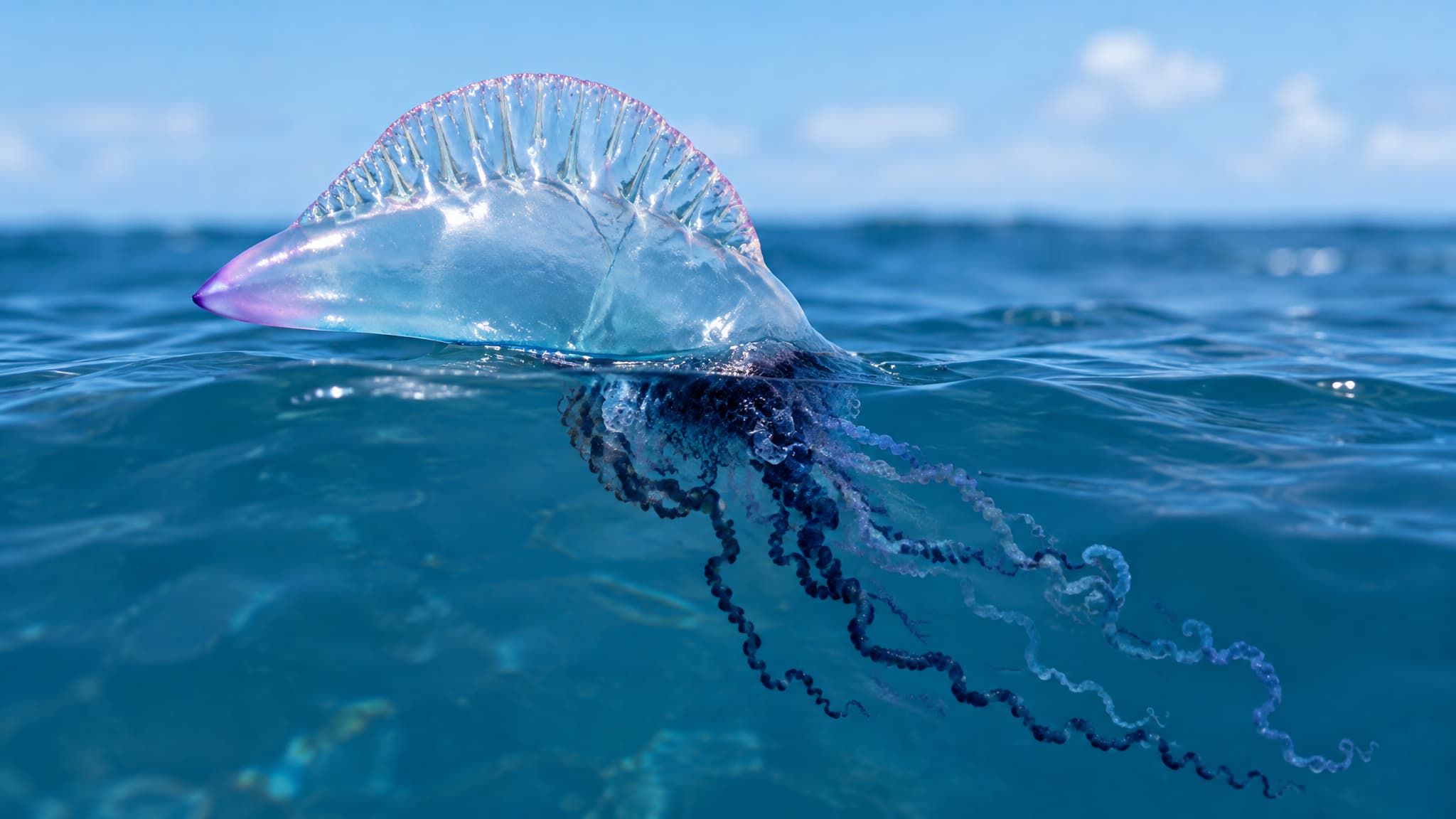
A Portuguese Man o' War floats at the ocean surface, showing a translucent, iridescent gas-filled sail and long curled tentacles trailing underwater.
The Portuguese man o' war (Physalia physalis) looks like a jellyfish but is a siphonophore: a colony of specialized, genetically identical zooids that work together as one animal. Its most visible part is a gas-filled float, or pneumatophore, tinted blue, violet or pink, which can be more than 30 cm long, about 13 cm wide and rise up to about 15 cm above the water. Below it hang tentacles and polyps that usually reach about 10 m and can stretch to about 30 m.
It lives at the surface of the open ocean as part of the neuston, mostly in tropical and subtropical seas, and is especially common in the Sargasso Sea, the Gulf Stream, the Gulf of Mexico and the Caribbean. It cannot swim. Winds, currents and tides carry it, sometimes in groups of 1,000 or more, and can push it into bays or onto beaches. The float works as a sail: "left-handed" and "right-handed" colonies drift at about 45 degrees to opposite sides of the wind, which helps spread the species across warm oceans.
The tentacles are armed with stinging cells (nematocysts) whose venom paralyzes prey. Fish, from fry to small adults, make up about 70 to 90% of what it catches; shrimp, other small crustaceans, molluscs and zooplankton make up the rest. Contracting tentacles lift the prey to the feeding polyps (gastrozooids) under the float, which digest it with enzymes.
Each colony is either male or female. Reproductive zooids release eggs or sperm into the water, where fertilization takes place, and most spawning happens in autumn, so many young appear in winter and spring. A fertilized egg develops into a larva that buds off the new zooids of a colony. There is no parental care, and the consulted sources give no reliable lifespan.
The man o' war is food for specialists that resist or exploit its stings, such as the loggerhead sea turtle, the blue sea slug Glaucus atlanticus and the violet sea snail Janthina janthina. For people, a sting usually causes severe pain for one to three hours and whip-like red welts that last two or three days; deaths are extremely rare. Stranded animals and loose tentacles can still sting. The species is not evaluated by the IUCN and is not considered rare.